
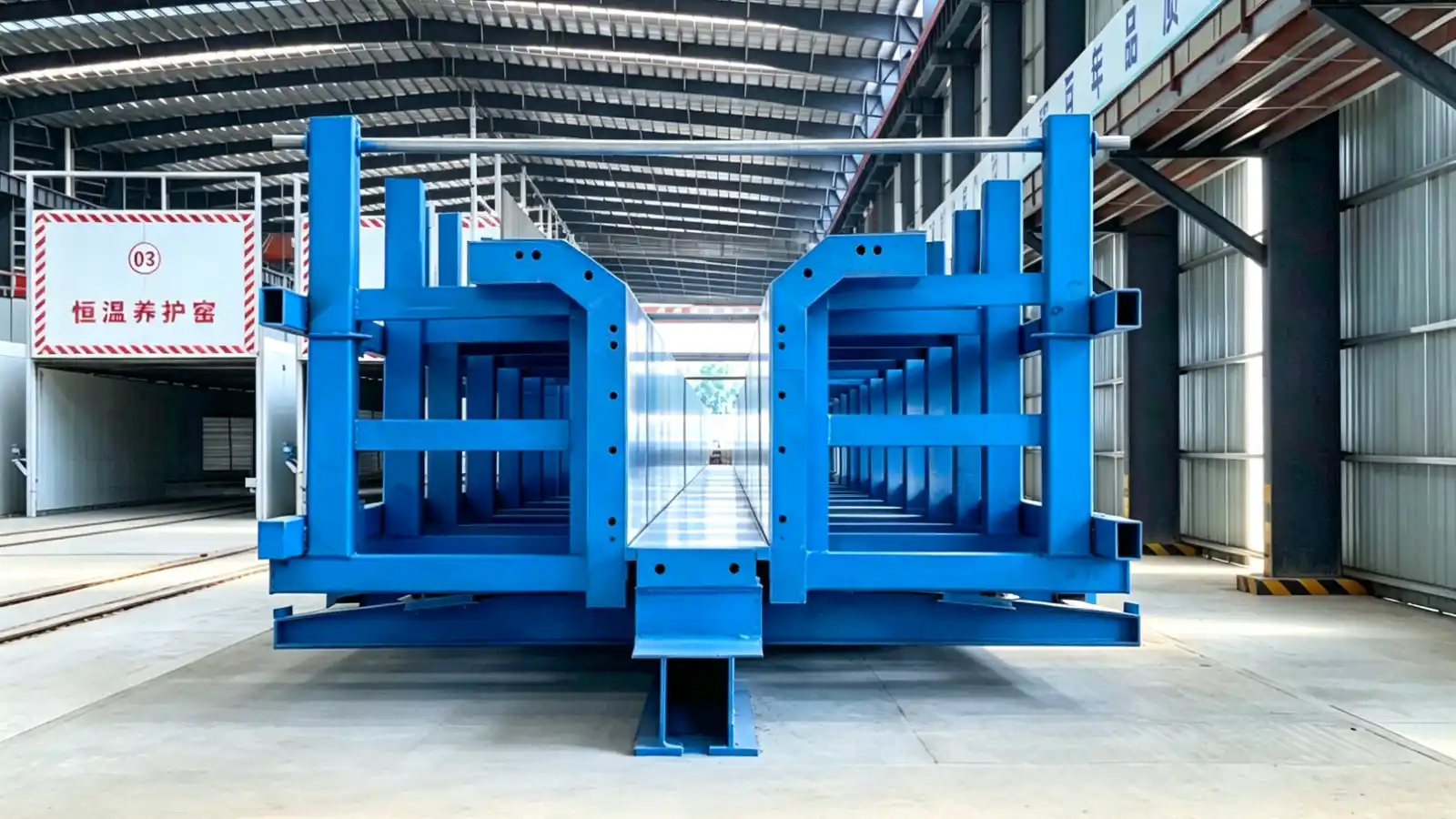
Begin with the complete T-girder family
A request for "one adjustable T-girder mould" does not tell a supplier which dimensions change or how often the mould must change between castings. Beam length may vary while the web, flange and end geometry remain constant. Another project may use different diaphragm locations, end blocks, bearing details, embedded items or prestressing layouts across the schedule.
Before requesting a price, build one controlled product schedule. List every approved beam type, drawing revision, quantity and planned casting sequence. Buyers comparing project-specific precast concrete moulds should make the variable geometry visible rather than ask bidders to infer a product family from one representative drawing.
The aim is not to make every part adjustable. It is to decide which variation belongs in the main mould, which belongs in removable end forms or inserts, and which requires a dedicated configuration.
Separate fixed section geometry from length variation
Mark the cross-section dimensions that remain constant across the family. These may include the principal web and flange surfaces, but the approved drawings control the actual fixed geometry. Then list every variable feature by beam type:
- overall length and end-face orientation;
- end block or diaphragm geometry;
- bearing and lifting details;
- embedded plates, ducts, sleeves and blockouts;
- reinforcement and prestressing interfaces;
- chamfers, rebates and local surface requirements; and
- inspection characteristics affected by the change.
This distinction lets the supplier assess whether one base and side-form arrangement can cover the family. It also exposes changes that need more than a movable end plate. An insert that alters a local recess has different structural, sealing and access requirements from an end form that only changes casting length.
Define the end-form strategy in the RFQ
For each length, show the proposed or required end-form position and its relationship to the fixed mould datum. State how the end form is located, locked and sealed. If the buyer is open to alternatives, ask bidders to compare movable end forms, interchangeable end-form sets and dedicated mould sections on the same production schedule.
The quotation should explain:
- the approved length range covered by the base mould;
- discrete or continuous adjustment positions;
- parts changed for each beam type;
- adjustment and locking method;
- access needed for reinforcement and prestressing work;
- sealing arrangement at joints and inserts;
- lifting or storage needs for loose tooling; and
- expected changeover tasks and responsible crew.
Do not treat "adjustable" as evidence of a short changeover. Ask for the sequence, tools, lifting requirement and inspection checks needed before the next casting. A design that covers many lengths may still be unsuitable if changeover occupies the crane needed elsewhere in the yard.
Put project tolerances into the mould brief
The mould supplier needs the dimensional acceptance basis for the finished girder, but should not invent it. The project designer or governing documents must identify the tolerances that affect fit, bearing, alignment, deck interfaces and erection.
FHWA guidance on prefabricated bridge elements notes that specialty elements should have tolerance requirements in the specifications or contract plans and points designers to established precast tolerance guidance. See the FHWA discussion of specification requirements and fabrication issues. The practical purchasing lesson is to pass the approved tolerance basis into the mould RFQ and identify which mould features control each critical result.
Ask bidders to propose a datum and inspection method for the mould itself. The response should distinguish mould setup checks from finished-girder acceptance. It should also state whether key positions are verified after every changeover, at defined intervals or after a repair.
Check prestressing, reinforcement and casting access
Length changes can move strand interfaces, reinforcement zones, diaphragms, lifting points and embedded items. Give the supplier the approved prestressing method and responsibility boundary. Identify anchor, hold-down, end-zone and safety interfaces that affect the mould, without asking the mould supplier to redesign the structural system unless that work is expressly included.
Review operator access for each configuration. The shortest and longest beams may create different working spaces at the ends. Check reinforcement loading, insert installation, concrete placement, vibration, finishing, curing enclosure, end-form removal and lifting. A configuration is not usable merely because it fits within the steel envelope.
The Bridge and Transportation Moulds category shows the relevant application family. For the selected product type, Realjet's T-girder mould product page identifies the approved section, length range, prestressing method, casting sequence and handling plan as project inputs.
Compare mould options on total production effect
Ask each bidder to show which beam types one mould set covers and which require dedicated parts. Compare the options using the actual casting sequence, not only the number of nominal lengths.
A useful comparison includes initial mould cost, loose-tooling quantity, changeover labour, crane occupation, inspection time, storage space and the production consequence of damaged or unavailable inserts. Also ask whether future beam types can be reviewed without replacing the fixed mould body. Do not assume future compatibility unless the supplier has the drawings and states the covered range.
Where volume is concentrated in one length, a dedicated configuration may reduce repeated changeover. Where the programme alternates several related lengths, a controlled adjustment system may use space and capital more effectively. The correct choice follows the beam schedule and production plan.
Send one controlled T-girder mould package
The RFQ package should include approved drawings, the beam schedule, revision list, production sequence, target casting cycle, dimensional acceptance basis, prestressing information, reinforcement and embedded-item data, concrete placement and curing method, lifting plan, yard layout and required delivery scope.
Require the quotation to return a configuration matrix. For every beam type, it should identify the base mould, end forms, inserts, adjustment position, changeover tasks and any excluded interface. This gives the buyer a direct way to compare coverage and operating effort.
Realjet develops project-specific steel mould systems around the approved component geometry and production conditions. A complete T-girder family lets the technical discussion focus on a defined adjustment strategy instead of an open-ended promise that one mould will fit every beam.