
What match casting actually controls
A segmental bridge is built from short precast concrete segments that are glued or stressed together to form a continuous girder. Each segment has to fit its neighbour exactly, because the whole alignment is created by the accumulated geometry of the individual pieces. Match casting is the production method that guarantees that fit. Instead of casting every segment to a fixed master mould, each new segment is cast against the previously cast adjacent segment. The wet concrete takes the inverse shape of its neighbour, so the two pieces close with a controlled joint.
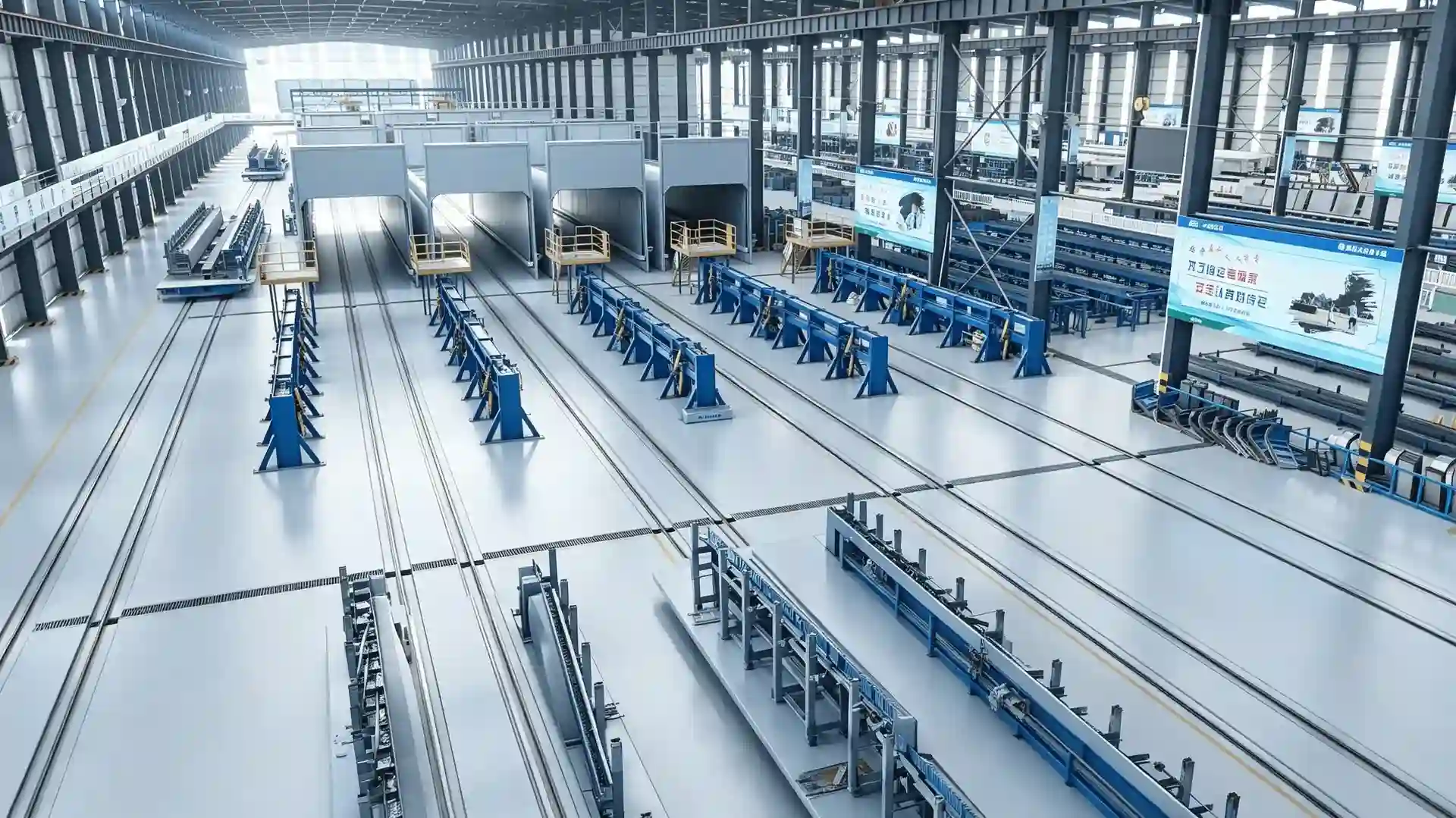
Realjet develops project-specific production-line solutions for precast concrete components rather than selling the segments themselves. Match casting is one of the process decisions that the production-line design has to support, together with formwork, gantry handling, curing and demoulding.
Short-line and long-line methods
Two casting layouts dominate. In the short-line method, each segment is cast in a short stationary form against the preceding segment, which is held in place as the match face. The form is adjusted for each segment to follow the bridge curve and grade. This method suits variable curvature and is common for span-by-span and balanced-cantilever bridges. In the long-line method, many segments are cast sequentially in a single extended bed so the whole curve is produced in one line; it favours high-volume, repetitive straight or constant-curvature sections.
The choice changes the production-line footprint, the number of forms, the gantry travel and the curing sequence. A buyer should decide the method from the bridge geometry, the segment count and the delivery sequence, not from a supplier preference for one system.
Match-cast tolerance and the epoxy joint
The practical fit target for match casting is commonly about plus or minus 1 millimetre between adjacent match faces. That tolerance is the difference the field crew can close with the joint material and the stressing system. The joint itself is a thin layer of specially formulated epoxy, typically 1 to 2 millimetres thick, applied to the match face before the segments are pressed together. The epoxy is usually a two-component structural adhesive qualified as Type A for segmental construction, and it also seals the joint against water and corrosion.
A step between adjacent segments at the match face is generally held to 1 millimetre or less, because a larger step forces the epoxy layer to vary and complicates the alignment during erection. These figures are process-control targets; the project specification, not the generic value, governs the accepted limit.
Geometry control and the pier segment
Segmental construction controls geometry through a documented chain of measurements. Each segment is cast to a target that includes the bridge curve, the grade, the camber and the planned erection alignment. The casting yard maintains a geometry-control table that records, for every segment, the as-cast deviation from the theoretical target and the adjustment applied to the next segment. The PCI Recommended Practice for Precast Post-Tensioned Segmental Construction describes the erection tolerances, match-cast epoxy joints and alignment methods used in the US practice.
The pier segment, sometimes called the "zero" segment, is the reference piece erected first at the pier and used to set the alignment for the segments that follow in each direction. Its position controls the entire cantilever or span, so the production line and the erection plan have to treat it as the master reference. AASHTO and ASBI classification documents separate segmental methods (span-by-span, balanced cantilever, incremental launching) and define the inspection and tolerance framework that the casting process must respect.
Production-line equipment that match casting needs
Match casting is not only a tolerance; it is a workflow that the equipment has to support:
- adjustable short-line forms or a long-line bed with curve control;
- a gantry or overhead system to move the match segment, place reinforcement and strip forms;
- a controlled curing system so each segment reaches the required strength before the next is cast against it;
- a clean, level match-face preparation station for epoxy application;
- lifting and transport gear rated for the segment mass and the handling route;
- a geometry-control record system tied to each segment identity.
If the curing cycle is too slow, the production line stalls because the next segment cannot be cast until its match face is released and verified. If the form adjustment is crude, the accumulated error grows segment by segment and shows up as misalignment at erection.
What to send when planning the line
A useful enquiry for a segmental girder production line includes the bridge alignment (horizontal and vertical), segment length and mass, segment count per span, joint and epoxy specification, required cycle, curing method, yard space, crane data and the delivery sequence. Realjet reviews these inputs to propose formwork type, gantry capacity, curing arrangement and the match-cast control procedure. Send the segment drawings, the alignment data and the target output through the precast beam factory production-line page so the first proposal compares production methods before the moulds, transfer route and equipment package are fixed.