
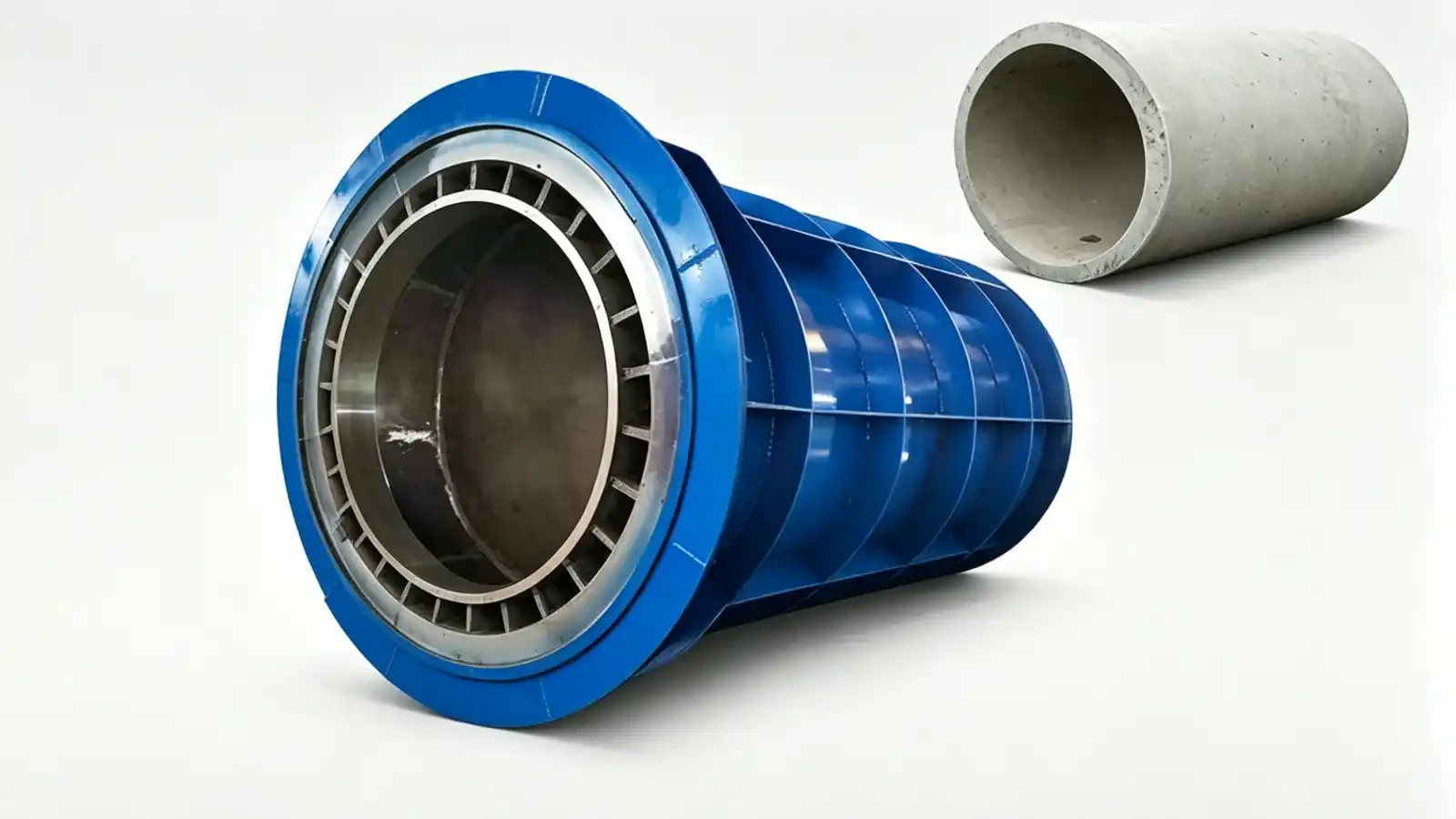
What a spun pipe mould does
A spun concrete pipe mould is the steel tool that shapes a reinforced concrete pipe during centrifugal casting. Concrete is placed inside the rotating mould, and centrifugal force packs it against the cylindrical wall to form a dense, even pipe. The mould is one part of a pipe line, not the whole line. A working setup also needs a spinning machine, a reinforcement cage, a curing area and handling equipment, so buyers should treat the mould as a defined component within a larger scope.
Realjet supplies moulds as part of its precast concrete moulds work, built to the buyer's approved pipe geometry rather than to a fixed catalogue size.
Diameter, length and wall thickness
The mould inside diameter sets the pipe internal diameter, and the mould wall plus the specified concrete cover set the pipe wall thickness. Spun pipe is made across a wide diameter range, commonly from about 150 mm up to 2000 mm, with standard lengths near 2 m or 2.5 m depending on the market. Larger diameters need a stiffer mould body and a more robust end ring, which raises both the steel weight and the machining effort.
Wall thickness is not free to choose at the mould stage. It is tied to the pipe class and the structural standard the project uses. In the United States, ASTM C76 defines dimensions and reinforcement for reinforced concrete culvert, storm drain and sewer pipe, and the mould must be built so the cast pipe can meet that class. Buyers should name the standard and class in the request so the supplier sizes the mould correctly.
Joint profile and end rings
The joint decides how pipes connect in the ground, and it is cut into the mould ends. Common profiles are spigot and socket, collar, and flush, each needing a matching end ring and a precise machined face. If the buyer later changes joint type, the mould ends usually need rework or replacement rings, so the joint should be fixed before the mould is cut.
End rings also locate the reinforcement cage and keep the pipe ends true during spinning. They are machined parts, and their flatness and diameter tolerance decide whether the finished pipe seats cleanly with its neighbour. State the joint standard or supply the mating spigot drawing so the rings are cut to the real profile.
Mandrel, pallet and demoulding
A spun pipe mould is typically a split cylindrical body with end rings held by tie rods, mounted on a pallet or cradle that runs on the spinning machine. The inner surface is the casting face, so its finish and roundness decide the pipe outer finish. After casting and early set, the mould opens and the pipe is stripped, then moved to curing.
Demoulding direction and the mould split line are buyer relevant because they affect the handling layout and the floor space around the spinning machine. A line planned without the strip and lift path in mind will bottleneck at the mould opener even if the spinning itself is fast.
Drawings and tolerances the buyer must supply
A firm mould quotation needs the pipe standard and class, the internal diameter, the length, the joint profile, and the concrete cover and reinforcement cage diameter. Dimensional tolerances on the mould inside diameter and end faces should be stated, because they drive the machining work. Where the buyer has a local standard for pipe ovality or joint fit, attach it so the supplier validates the mould against that rule rather than a generic one.
Buyers should also confirm who owns the geometry. The pipe standard often sets the finished pipe dimensions, while the mould geometry is the supplier's detailed design around those targets. The contract should state which party approves the mould drawings before cutting steel, because changes after that point are costly.
Quantity, lead time and spare rings
Moulds wear at the spinning face and the end rings, so the order quantity and a spare ring plan affect both price and future downtime. A buyer running one spinning machine may need only one or two mould bodies with extra end rings, while a higher volume line benefits from several bodies so casting continues while one is stripped or serviced. Lead time grows with diameter and with any nonstandard joint, because the rings and machining are made to order. State the required quantity and the acceptable delivery window in the request so the supplier can plan steel and machining rather than quote a generic minimum.
How the mould fits a production line
The mould only performs inside a complete pipe line. The spinning machine provides rotation and speed control, the cage making equipment forms the reinforcement, and the curing area brings the pipe to handling strength. When buying a pipe mould, the buyer should therefore confirm compatibility with the existing or planned spinning equipment, including pallet dimensions, drive engagement and the lifting method.
Buyers comparing options can start from the municipal and infrastructure moulds family and open the concrete pipe moulds product page, then prepare the diameter, length, joint and standard inputs above before requesting a quotation.