
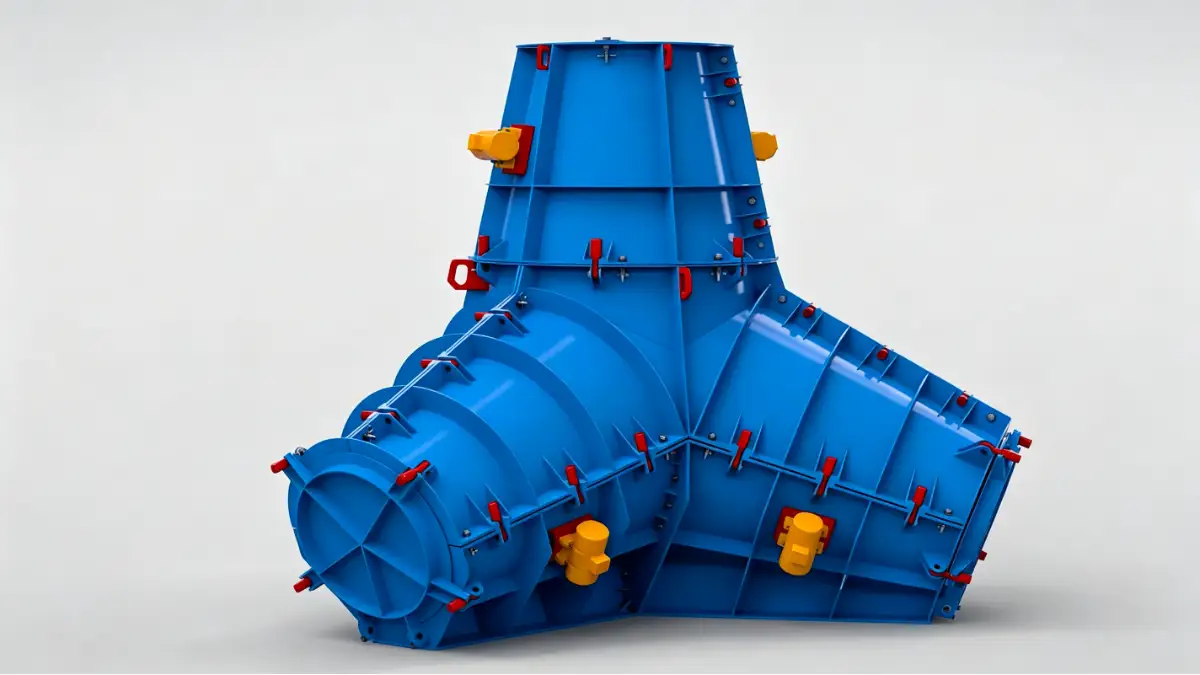
The approved tetrapod comes before the mould
A tetrapod is a four-armed precast concrete armour unit used in coastal works. The US Army Corps of Engineers manual on concrete armour units lists tetrapods among units used in rubble structures and treats unit size and placement as coastal-design decisions.
The mould supplier does not select the hydraulic design, unit mass or placement arrangement. Those inputs must come from the approved project documents. Its job is to develop panel joints, locks, support and an opening sequence around that fixed geometry and the planned casting method.
Begin the RFQ with controlled component data. A photograph or nominal mass is not enough to establish the contact surfaces, centre geometry, arm profiles or acceptance tolerances.
Define the unit family and production requirement
Some projects use one tetrapod size; others require more than one. List every approved unit and identify whether the buyer expects separate moulds, shared panels or change parts. Do not request an adjustable mould without stating exactly which geometry must change.
The enquiry package should include:
- approved 2D drawings and, where available, controlled 3D geometry;
- unit size or mass designation and the concrete volume for production planning;
- dimensional and surface acceptance requirements;
- casting orientation and concrete-placement method;
- required daily or shift output and working calendar;
- curing basis and the criterion for opening the mould;
- planned handling equipment and available crane capacity;
- total unit quantity, programme duration and delivery sequence.
The component designer remains responsible for lifting points, handling restrictions and structural acceptance. The mould proposal must follow those inputs rather than creating them.
Review panel segmentation around demoulding
The four arms make demoulding different from opening a straight-sided box. Steel panels need joints and opening directions that clear the approved shape without dragging across concrete edges or trapping a panel. The RFQ should ask the supplier to show the sequence from fully closed mould to released unit.
For every segment, the proposal should identify mass, lifting points, opening direction and temporary storage position. If the operator uses a crane, show the crane path and the order in which lifting points become accessible. If mechanical or hydraulic assistance is proposed, list the powered movements, supports, controls and manual recovery method.
More segments do not automatically make the mould easier to operate. They may reduce individual panel mass but add joints, locks and sealing work. Fewer large panels can shorten setup yet demand more lifting capacity and clearance. Compare these effects against the buyer's actual casting yard.
Specify joints, locks and leakage control
Panel joints affect both the finished concrete and daily setup. The buyer should mark any project limits on fins, steps or visible joint lines. The supplier can then propose joint locations, alignment features, seals and locking methods.
Ask how operators verify that every panel is fully closed before concrete placement. The inspection method may be visual, dimensional or based on defined setup references. Whatever method is selected, the proposal should include the access needed to perform it.
A generic promise of tight formwork does not settle leakage control. The approved concrete, joint design, panel condition and closing force all influence the result. Put the required inspection and trial-assembly checks into the purchase specification, and require the bidder to state any assumptions about sealants or consumables.
Calculate mould quantity from occupied time
Daily output does not determine mould quantity on its own. A mould remains occupied during preparation, reinforcement or inserts where applicable, concrete placement, curing, opening, demoulding and return to service. The planned shifts and available labour also matter.
Ask each bidder for a simple cycle chart. It should state the assumed time for each step and identify operations that depend on a shared crane, concrete supply or curing area. Use the project-approved release criterion rather than an optimistic demoulding time selected only to reduce mould count.
If the programme needs production cover, decide how to provide it. The buyer may add a spare mould, keep spare panels and locks, or accept recovery time after a damaged component. Each option has a different cost and space requirement. Put the selected strategy into the commercial comparison.
Check the casting-yard interfaces
A tetrapod mould needs a prepared production position, concrete access, lifting coverage, panel storage and a route for the finished unit. Give the supplier a yard plan with elevations, crane capacity and any restrictions on foundations or embedded anchors.
Review where workers stand while opening locks and attaching lifting gear. The opening sequence should keep platforms, hoses and temporary supports clear of moving panels. For powered systems, assign responsibility for hydraulic power, controls, guards and site connections.
Also show how the completed unit leaves the casting position. A mould that opens successfully can still create a bottleneck if a panel blocks the lifting route or if released units occupy the only place available for panel storage.
Compare the delivery boundary before price
Request a scope schedule that covers mould engineering, steel fabrication, trial assembly, inspection, coating, transport packing, site assembly and production support. Mark each item as included, optional, buyer supplied or excluded. Ask which spare seals, locks, pins or other wear items are supplied with the first mould set.
The document package should include approved drawings, an assembly sequence, operating instructions, panel weights and lifting points, inspection records and the agreed spare-parts list. State the language and file format required. If the buyer expects a trial cast or site supervision, define the responsibilities for concrete, crane, labour and acceptance.
Realjet's precast concrete mould portfolio covers project-specific formwork for several infrastructure applications. Tetrapods sit within the marine and coastal mould category, and the published tetrapod mould product page shows the exact mould type discussed here. For a technical review, send the approved unit geometry, size range, casting orientation, target output, curing basis, yard plan and required delivery boundary. Final design and operation remain subject to the approved project documents.