
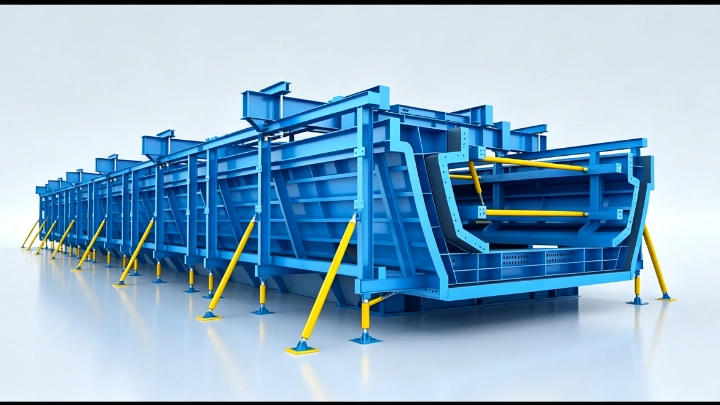
What a trough girder is
A trough girder is a channel-shaped precast concrete member used in railways, urban transit and bridge works, often where a continuous trough or edge element carries cables, drainage or track-side services. The exact profile, the way it seats against adjacent structures and the naming used on a project are defined by the approved design. Realjet engineers the steel mould to that approved geometry. Realjet does not set the girder shape and does not sell the finished precast member.
Because the section is project-specific, buyers should treat the approved drawings as the starting point. Generic descriptions such as "trough girder" are useful for search, but the mould must follow the actual section, wall and bottom geometry, reinforcement and embedded items in the contract documents. Do not assume a standard catalogue shape exists. Any protected or proprietary section name must be supplied by the client, not assumed by the mould supplier.
Why buyers should understand the mould before RFQ
The mould is one tool within a larger production setup, not a complete production line. It works alongside concrete placing, vibration, curing, lifting and handling equipment. Understanding this boundary helps a buyer write an RFQ that asks for the right scope and avoids assuming a single mould delivers a finished, installed component.
A clear brief also prevents mismatch. A trough section with tight inner-form angles, a long length range or heavy prestressing needs a different mould division and withdrawal route than a simple straight run. Specifying the section early protects both the price and the delivery window. It also helps the buyer compare suppliers on equal terms, because two quotes built from different assumptions about the section or the output are not directly comparable.
Inputs the supplier needs
A useful RFQ for a trough girder mould should include the approved trough girder drawings, the component schedule, the section and length range, the tolerance basis, the reinforcement and embedded-item details, any prestressing information, the target output, the casting sequence, the yard layout and the handling plan. The approved section drives the inner, outer, bottom and end forms. The length range and the number of variants drive how the mould is segmented. Where members exceed standard transport lengths, state the site delivery limit so the mould and the handling plan account for it.
Tolerance expectations should reference the applicable project standard. The PCI tolerance publications describe general product and erection tolerances for precast and prestressed concrete and are a common baseline. Final component acceptance remains subject to the approved project documents, the production controls and the applicable standards, not to a mould supplier's default.
Operation methods: conventional, mechanical, hydraulic, movable
The mould can be built to open and release in several ways. Conventional segmented inner and outer forms suit sites where crane access and demoulding clearance allow direct handling. Mechanical or hydraulic movement helps when inner or side forms must move repeatedly, with attention to stroke, guidance, synchronisation, safety and maintenance. A movable or station-based arrangement connects the mould to defined production stations and depends on rails, foundations, utilities and handling interfaces.
The choice is a trade-off between first cost, cycle time and the available movement envelope. A buyer should state the expected output and the handling space so the supplier can recommend a method instead of defaulting to the simplest option.
Responsibility boundaries
The design authority defines the girder geometry, the loads, the reinforcement and the acceptance criteria. The buyer or owner provides the approved drawings and the project constraints. The mould supplier engineers a steel system that reproduces the approved section and supports the agreed casting and demoulding sequence. Final mould configuration and any connected production-line scope are confirmed through technical review before manufacturing.
This review is the point where undefined items get resolved. If the approved drawings leave a connection detail or a tolerance open, the supplier should raise it then rather than build to an assumption. Buyers who answer those queries quickly keep the project on schedule.
This division matters for the RFQ. A buyer who supplies a complete, released section gets a mould that matches it. A buyer who supplies only a sketch should expect a longer engineering phase and a quote that includes design confirmation rather than a fixed price.
Where to look next
Buyers comparing options can start from the Realjet precast concrete moulds overview, then review the bridge and transportation mould systems that cover trough, T, box, segmental, I and U girder families. The trough girder mould product page shows the configuration directions and the project inputs Realjet reviews for this mould type.
When your project reaches the RFQ stage, share the approved drawings and the inputs above with a supplier who can engineer the mould to your section. Realjet's precast beam factory solutions cover the equipment and project scope needed to plan the surrounding production line around the mould.