
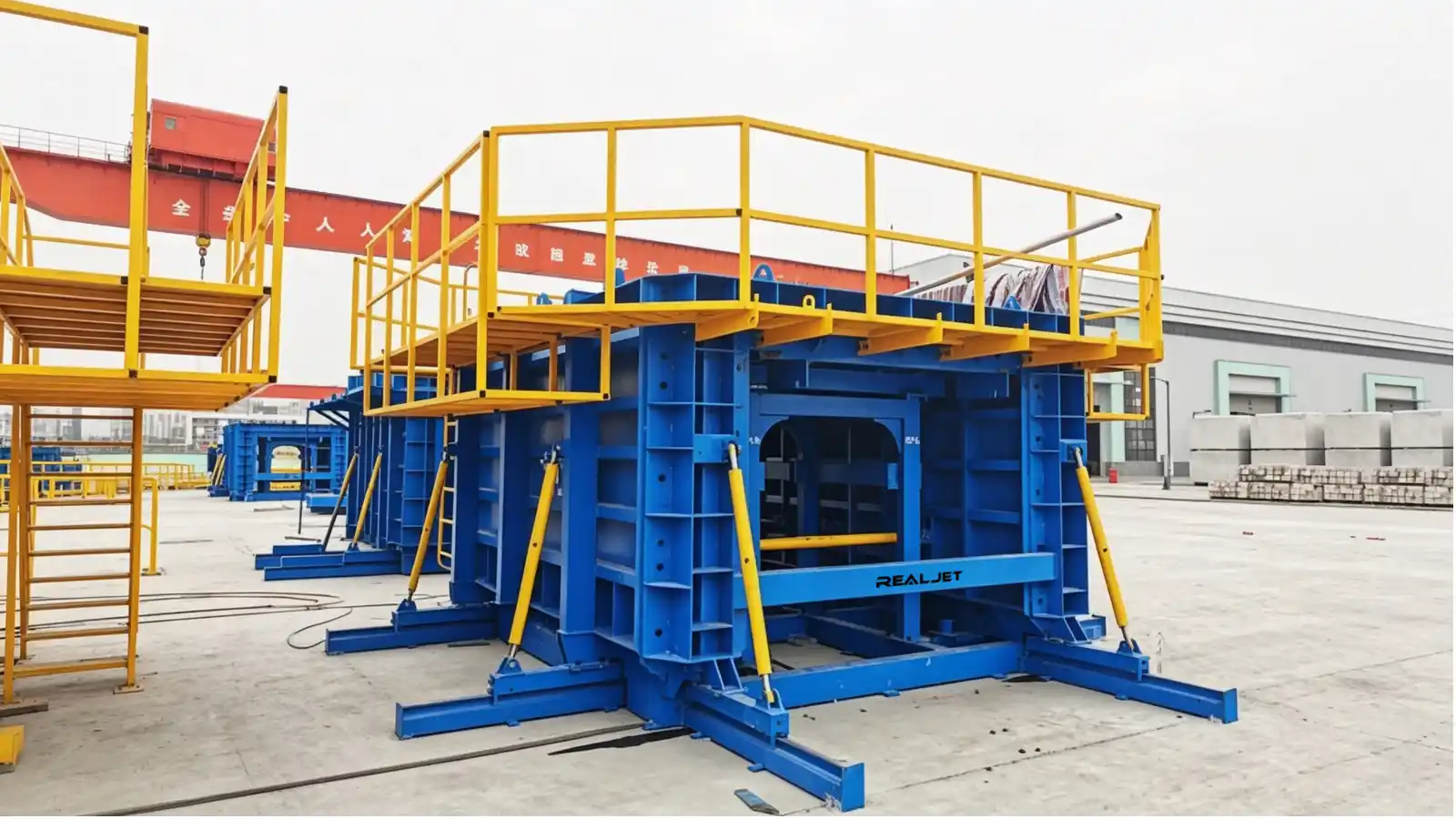
What a box culvert production line produces
A precast box culvert production line makes single-cell reinforced concrete box sections used for culverts, storm drains and sewers. The line is a set of equipment and moulds that casts the sections repeatably. Realjet supplies the production line and its equipment, not the precast components themselves. Buyers of such a line are typically precast producers, contractors or infrastructure owners setting up local production.
The box sections are defined by standards such as ASTM C1433, which covers monolithic single-cell reinforced concrete box sections for culverts, storm drains and sewers, including steam, water and membrane curing routes. The standard notes that proper selection, bedding and backfill, plus site inspection, govern final performance, so the production line is only one part of a compliant project.
Process steps in the line
The typical sequence is mould preparation, reinforcement cage placement, concrete placing and compaction, curing, demoulding, joint-face preparation and handling. Mould preparation includes cleaning, release agent and setting any inserts or block-outs. Reinforcement is placed to the cage drawings, then concrete is placed and consolidated by internal or external vibration. Curing follows the specified route, commonly low-pressure steam, water or membrane curing. After the concrete reaches the required strength, the mould opens and the section is lifted out.
Between steps, the producer checks reinforcement cover, concrete slump and early strength, and records the curing curve. These checks, not the equipment alone, decide whether the section meets ASTM C1433. The line should include the space and the instruments for them, and the quality plan should be agreed before the equipment is ordered.
These steps are the same family of operations used across precast component lines. What changes between projects is the section size, the output target, the mould count and the degree of automation, so the equipment package should be sized to the specific product range.
Capacity and mould count
Output depends on the number of moulds or casting beds, the casting cycle and the curing time. A longer curing route lowers daily output per mould, so buyers trade curing speed against floor space and energy use. Define the annual and peak monthly volume you need, and the range of section sizes, because both drive the equipment package and the mould quantity.
A helpful planning input is the section schedule for culverts: the list of section types, spans, rises and lengths. The mould set is then sized to cover that range with the fewest changeovers, which keeps the line running instead of stopping to reset tooling.
Also plan the delivery window for the project. A line sized only for average monthly volume will miss a peak, while one sized for the absolute peak may sit idle later. Most buyers size between the two and use inventory of finished sections to absorb peaks, which keeps the equipment investment in line with the contract.
Factory space, utilities and staffing
The line needs a covered production area, a reinforcement preparation zone, concrete supply such as an on-site batching plant or a ready-mix interface, curing space, and handling equipment sized to the heaviest section. Utilities include power, water and, for steam curing, a steam source. Staffing covers mould handling, rebar, casting, curing control and quality checks.
These requirements overlap with those of other precast lines, so a site survey and a layout review should precede any firm quote. The production-line equipment package scope, from steel structure to controls, should be confirmed in writing before manufacturing starts.
Design inputs to prepare before requesting a quote
Before contacting a supplier, prepare the approved section drawings, the volume schedule, the local standard such as ASTM C1433 or an equivalent national code, the target curing method, the factory dimensions and the utility limits. Also state who designs the production layout and who is responsible for installation and commissioning, because these boundaries change both cost and delivery time.
Component tolerances and acceptance remain subject to the approved project documents and the applicable standard, such as the PCI tolerance manuals for precast concrete. The line makes the sections; the casting process and quality control deliver the accepted component to the specified tolerance.
How Realjet supports precast production lines
Realjet supplies production lines for precast concrete components, including engineering, equipment manufacturing, installation and commissioning where confirmed by the project scope. The offer is the line and its equipment, not the precast components. You can review the precast production line solutions page and the steel box culvert moulds used in this type of line.
Next step
If you are planning a box culvert factory, prepare the section drawings, volume schedule and site constraints above, then ask suppliers to scope the equipment package against your outputs. Realjet can review your inputs and propose a production-line concept sized to your target.