
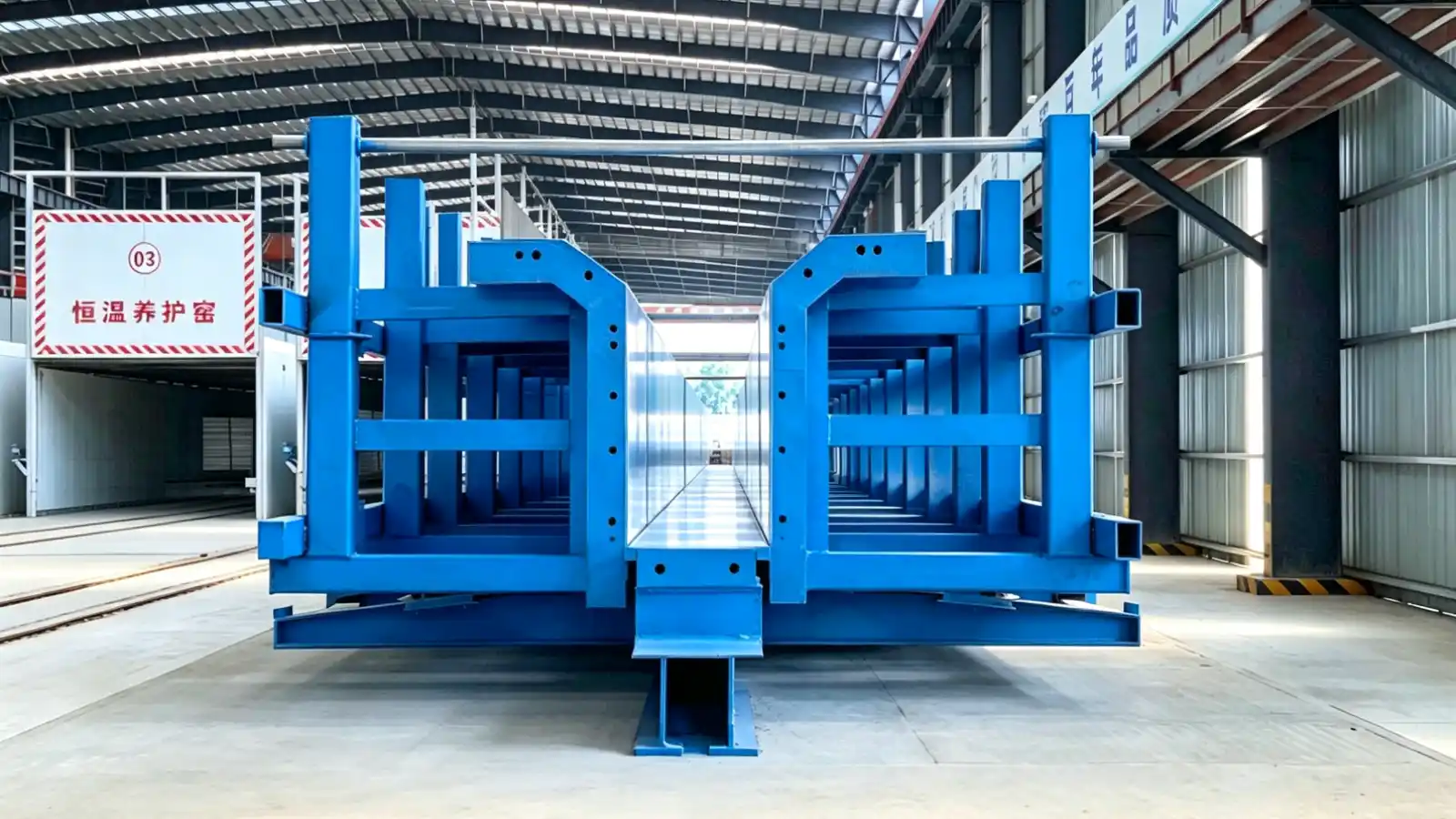
What a precast T-girder is and where it is used
A precast T-girder is a pretensioned concrete bridge member with a top flange, a web and a narrow bottom flange. The section is cast upside down, with the top flange of the finished girder at the bottom of the mould, and the web narrowing into the bottom flange. The shape gives an efficient compression area at the top once the girder is installed and the deck is cast, and the bottom flange concentrates the prestressing tendons where the tensile stress is highest under service loads. T-girders are the workhorse of short and medium span highway bridges in many markets because they combine a long production history, well known design methods and efficient use of concrete and steel.
T-girder and I-girder are often used interchangeably in project language. In US practice the term I-beam covers the AASHTO standard I-shapes (Types I through VI), while bulb-tee and deck bulb-tee are wider, deeper sections developed later for longer spans. The component name changes the production equipment, the mould concept and the handling route, so the buyer has to send the approved section, not a generic word.
AASHTO and PCI standard shapes
The PCI Bridge Design reference lists the standard precast pretressed sections used in the US market: AASHTO I-beams (Types I through VI), AASHTO-PCI bulb-tee beams, deck bulb-tees, double tees and box beams. AASHTO and PCI developed the original four AASHTO I-shapes in the 1950s and added Types V and VI in 1965, then proposed the bulb-tee shape in 1988 to extend spans without increasing girder depth. Each shape has a standard set of section properties, strand patterns and design charts. The PCI Preliminary LRFD Design Charts are based on the AASHTO LRFD Bridge Design Specifications.
The standardisation matters in a line RFQ. A buyer working with an AASHTO I-beam Type III or a BT-63 bulb-tee can rely on published section properties, strand patterns and lifting details. A buyer working with a non-standard section, a deeper girder or a wider top flange has to provide the controlled drawings, the strand layout, the release strength and the lifting point design before the line supplier can quote. The line is a project-specific engineering package built around the section, not a catalogue selection from the girder name.
How a pretensioned T-girder production line is arranged
A pretensioned T-girder line is a long-line or a short-line arrangement. In the long-line method, several girders are cast end to end along a single prestressing bed. The strands run the full length of the bed, are tensioned before concrete placement and are released after the concrete reaches the authorised release strength. The bed is reused for the next set of girders. This is the most common arrangement for high output, repeatable T-girder production. In the short-line or single-girder arrangement, one girder is cast and stressed at a time. Short-line suits lower output, longer girders that do not fit a long bed, or projects with frequent changes of section or length.
Whichever concept is used, the line has to cover the same basic activities. The mould has to define the section, the top flange, the web taper, the bottom flange, the end blocks, the bearing recesses, the embedded items and the strand positions. Reinforcement and strand setting have to be coordinated with the concrete placement sequence. The strands are tensioned on the bed before concrete placement and the force is checked. Concrete is placed, usually through the open top of the mould, and consolidated. Curing brings the concrete to the release strength approved by the project. The strands are then detensioned, the girder is lifted from the mould and moved to storage, and the bed is prepared for the next girder. The handling route from the bed to storage has to match the girder mass, the crane coverage and the transport limits out of the yard.
A precast concrete component production line for T-girders is therefore a set of stations (strand preparation, mould preparation, reinforcement and embedment setting, concrete placement, curing, release, lifting and storage) connected by a handling route. The line supplier configures these stations around the section, the output and the site, and the buyer defines the inputs that make the configuration specific.
What a buyer must define before the line RFQ
A T-girder line RFQ should be a controlled production brief rather than a representative image. The brief should state:
- the section family and the standard or non-standard drawings, with revision status;
- the strand pattern, the release strength, the concrete grade and the curing method;
- the target output in accepted girders per shift and per day, with shifts and working days;
- the maximum girder mass, length, width and the lifting points;
- the bed length, the bed type (long-line, short-line or station-based) and the number of casting positions;
- the site plan, the crane coverage, the storage layout and the dispatch route;
- the utilities available on site, including power, compressed air, steam or hot water for curing, and water;
- the inspection and quality plan, the documents to be issued and the laboratory arrangements;
- the boundary between buyer civil works, batching, transport, cranes, laboratory and the line supply.
A line quoted against a generic daily output figure, without a section, a release strength and a working calendar, usually hides the real capacity. The first task of the RFQ is to send the data that makes the number meaningful.
Why the mould and the line have to be reviewed together
The T-girder mould is not a separate purchase from the line. The mould defines the section, the surface finish, the end geometry and the strand positions, and the line defines how the mould is set, filled, cured, released and lifted. A change in the section can change the mould, the handling equipment, the curing cycle and the storage layout. A change in the lifting mass can change the gantry, the transport route and the storage foundations. The T-girder mould reference within the Bridge and Transportation Moulds category describes the mould scope, while a line enquiry is the right place to review the mould and the surrounding line together. A buyer ready to compare concepts should send the section drawings, the strand layout, the output target, the site plan and the utility data through the precast T-girder production line enquiry route so the proposal can address the correct mould, process and handling concept before the equipment package is fixed.