
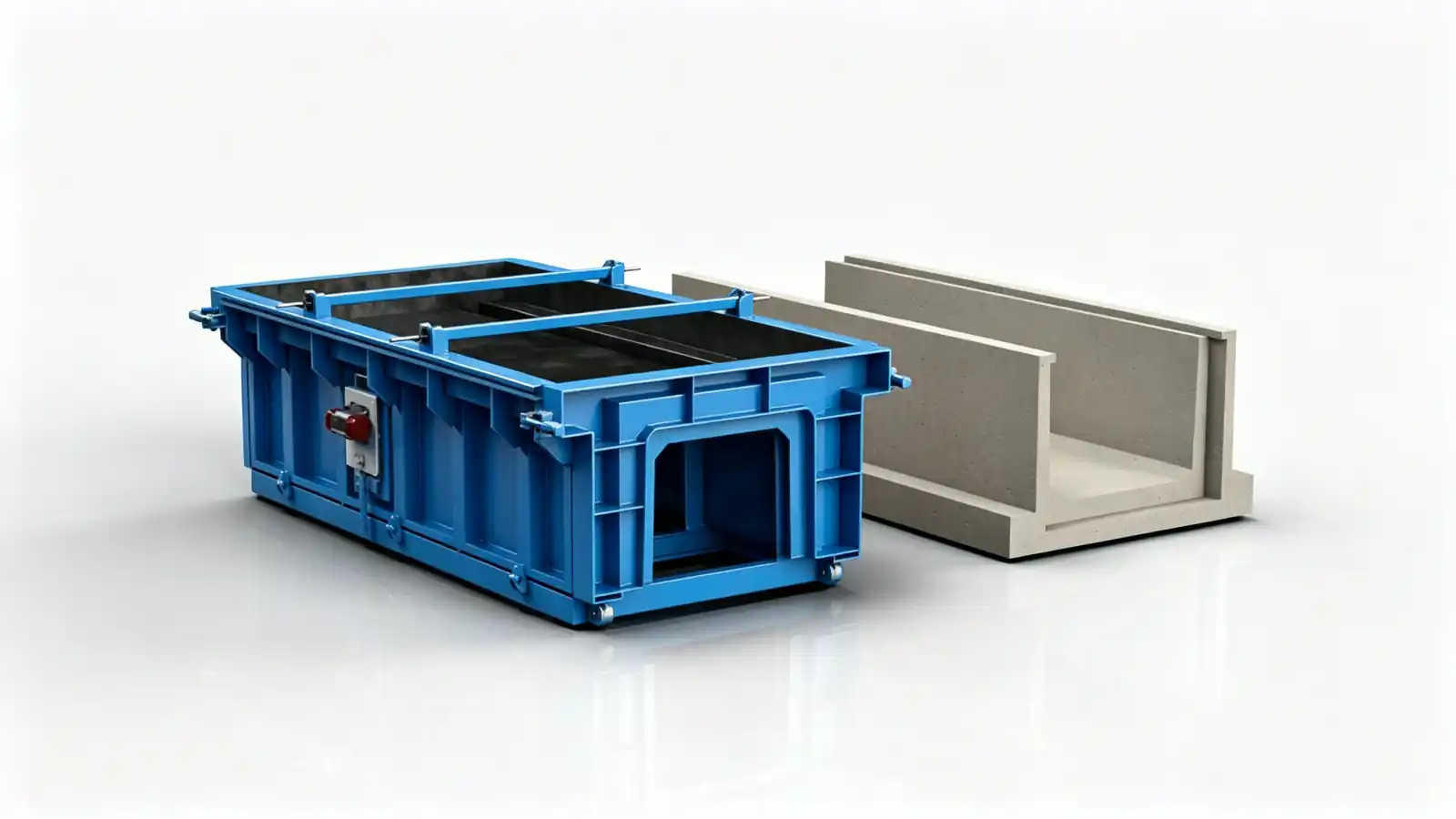
What a drainage channel mould produces
A drainage channel unit is a precast concrete element, usually a U shaped or trapezoidal trough, used for surface water on roads, airports, industrial yards, and logistics sites. Its steel mould forms the channel cross section and any integral features such as outlets, haunch, or grating seats. Buyers sourcing these units need the mould specification before the production line is scoped, because the channel geometry sets the mould type, the demoulding method, and how many mould sets the daily output requires.
Drainage channel moulds sit within the precast concrete mould range under the Municipal and Infrastructure Moulds category. The published drainage channel mould page is the product reference for this family. The mould enquiry is a project specific review of geometry, cycle, and handling. The catalogue page is a starting point, not a specification.
Channel types and where they differ
Drainage channels are not a single product. A trench run may be made from many identical short units jointed end to end, or from longer segments with formed ends. The grating may be a separate slip in frame or cast integrally with the unit. Some channels include a built in longitudinal fall, while others are level and rely on the site gradient. Each choice changes the mould: a built in fall needs a tapered core or form, an integral grating seat needs a precisely located recess, and a trench of repeated units needs consistent joint faces. State in the RFQ which variant you need so the mould forms the right features the first time.
Geometry and operation to define in the RFQ
State the channel parameters the mould must form:
- Cross section: width, depth, wall thickness, and any slope or fall along the length.
- Segment length and whether ends are square, chamfered, or formed for jointing.
- Outlet positions, diameter, and direction, plus any sump or catch basin geometry.
- Grating type and the seats or frames the mould must cast.
- Surface finish on the visible faces and any textured or painted requirement.
- Mould operation: mechanical clamping and stripping, or hydraulic side forms and core withdrawal, chosen to match the geometry and output.
Mechanical versus hydraulic operation
| Operation | Typical strengths | Watch points |
|---|---|---|
| Mechanical clamp and strip | Lower cost, simpler to maintain | Slower on complex demoulding |
| Hydraulic side form and core | Faster cycle, handles complex geometry | Higher capital and service skill |
The choice follows the channel shape and the daily volume. A simple U section at moderate output can suit mechanical stripping, while a channel with a deep draw or an undercut seat often needs hydraulic movement to demould without damage.
How mould count connects to output
The number of mould sets drives how many channels a line casts per day. More sets mean higher daily output but more floor space, handling, and capital. A buyer should give the supplier the target daily or monthly volume, the curing method, and the casting cycle, then let the supplier propose the mould quantity. This keeps the mould package matched to the real production target instead of a round number.
Finish, handling, and demoulding practical points
Tell the mould maker which faces are seen in service and which are buried. A visible channel lip may need a smoother mould surface or a specific texture, while a buried base does not. Demoulding method affects the lifting and handling gear on the line: hydraulic side forms may need a power unit and a crane or trolley to move the cores, whereas mechanical stripping often uses manual clamps and a forklift. These details change the floor layout, so include them in the RFQ rather than leaving them for the supplier to assume.
Tolerances and the standard to apply
Dimensional tolerance for precast units is commonly referenced to EN 13369, the European common rules for precast concrete products, or to PCI MNL-116 for structural precast quality control. Drainage channels are often non structural, so the project may call for tighter or looser limits than the structural default. Tell the supplier which standard applies and which tolerance class the channel faces must hold, because that choice affects the mould machining and the QA checks.
Supplier scope versus buyer responsibility
Realjet supplies mould manufacturing for precast concrete components to approved drawings. It does not sell the drainage channels themselves. The channel geometry, cover, reinforcement, and the standard to apply are the buyer's design responsibility, set by the project documents and the applicable code. Moulds are project specific: a drainage channel mould is developed around the approved section, the casting method, and the production layout, not taken from a generic catalogue. The drainage channel mould product reference shows the configuration directions a project can take, while final dimensions, interfaces, and delivery scope are confirmed through the buyer's project documents.
Next step before you request the mould
Before sending the RFQ, confirm the approved channel section, the outlet layout, the required finish, and the daily volume. With those inputs, a mould supplier can propose the operation method and the number of sets. When your drawings and output target are ready, open a review with a supplier who provides precast concrete moulds to customer drawings.