
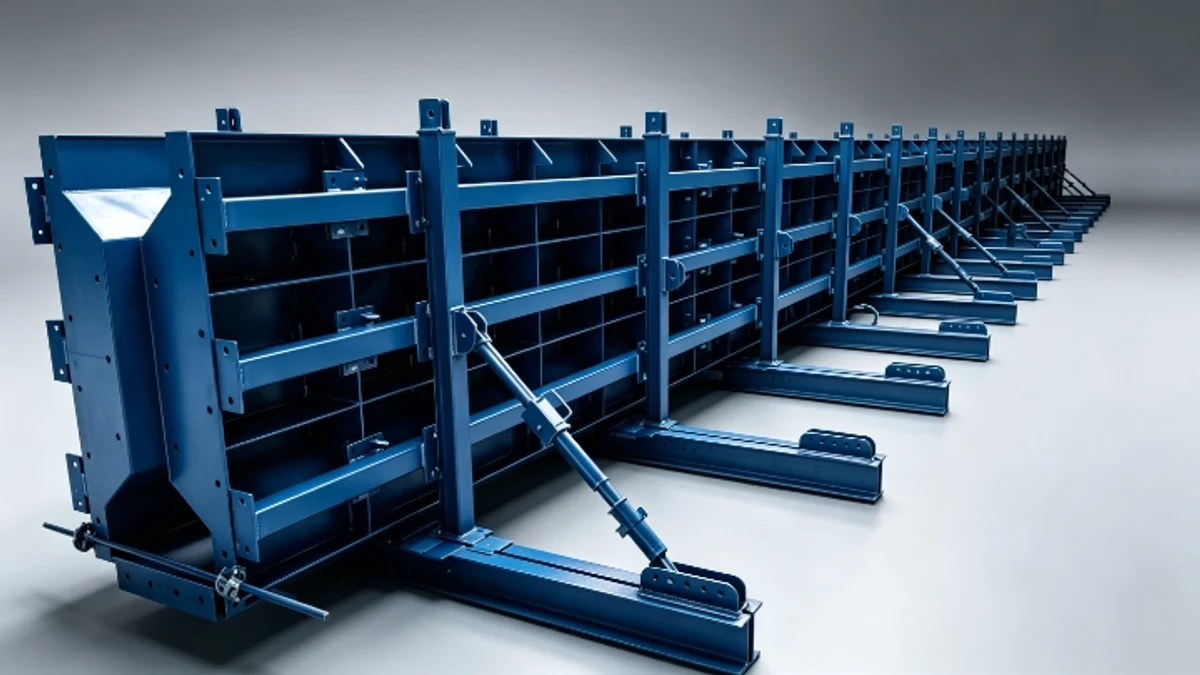
"Adjustable" is not a complete mould requirement
A bridge package may include I-girders with different lengths, depths, flange widths, end zones or diaphragm details. Buyers then face a practical question: should one mould use change parts for several sections, or should the project buy dedicated mould sets?
There is no universal answer. Sharing can reduce repeated steelwork, but every adjustment adds setup, verification and the possibility of selecting the wrong configuration. Dedicated moulds can simplify production while increasing capital cost, floor space and transport volume. The RFQ should turn the approved beam schedule into a clear configuration problem instead of asking suppliers for a generally "adjustable I-girder mould."
Realjet's precast concrete mould range includes project-specific systems for infrastructure components. I-girder formwork belongs in the bridge and transportation mould category, while the published I-girder mould page identifies the exact product type discussed here.
Build a controlled section matrix
List every approved girder variant in rows. Use columns for total length, beam depth, top and bottom flange geometry, web thickness, end-block geometry, diaphragm or opening details, prestressing arrangement, inserts and lifting provisions. Add the planned quantity and production sequence for each variant.
Do not group sections only by nominal depth. Two girders with a similar outline may have different end details, haunches, chamfers or embedded items that change the side form or end form. Controlled 2D drawings should govern. A 3D model can help suppliers review clashes and panel movement, but it should not silently replace the contract drawings.
Mark which dimensions are fixed by the approved design and which variants the mould must accommodate. If the design is still changing, state the release status and change-control route. A supplier cannot confirm shared tooling when the relevant geometry is preliminary.
Separate length adjustment from section adjustment
Length variation is often managed with movable end forms or defined end-form positions. Cross-section variation can require different side panels, bottom details, inserts, packers or a larger rearrangement. Treat these as separate decisions in the RFQ.
For each proposed adjustment, ask the bidder to show:
- which parts remain fixed and which are exchanged or moved;
- the adjustment range tied to named beam variants;
- reference points and stops used to set the mould;
- loose-part identification and storage;
- required crane or handling equipment;
- estimated changeover tasks and verification steps;
- seals, joints and surface marks introduced by the arrangement.
Do not accept an adjustment range without a drawing. The supplier should connect each approved section to a defined mould configuration and list any section that needs dedicated panels.
Compare shared tooling with dedicated tooling
A shared mould makes sense when variants use a stable base geometry, changeovers fit the production sequence and operators can verify the setup reliably. Dedicated moulds may be better when section changes are extensive, output is high, variants run in parallel or the programme leaves little time for conversion.
Compare the options using the project schedule. Include time for cleaning, panel movement, insert replacement, alignment checks and approval before the next cast. Also include crane occupation and storage space for removed panels. A low tooling price can be misleading if repeated changeovers consume the crane needed for reinforcement cages or finished girders.
Ask bidders to price a base case and clearly identified alternatives. One option might use a common bottom and replaceable side sections; another might use separate complete moulds. Include change parts, storage racks, lifting accessories, setup gauges, spares and documentation in the commercial comparison alongside the main steelwork.
Define the production and demoulding method
State the casting orientation, prestressing arrangement, concrete-placement access, vibration method, curing basis and planned demoulding route. The approved component design and project method determine these inputs. The mould supplier should explain how panels open and clear the flange and web without claiming responsibility for the girder's structural design.
If hydraulic or mechanical assistance is under consideration, ask which movements are powered and which remain manual. Require the proposal to show supports, locks, controls, hoses, power unit, maintenance access and a recovery method. Powered opening may help with larger panels, but it does not remove the need for positive locking, dimensional setup and safe access.
For every panel or change part, request mass, lifting points and storage position. Check those values against the buyer's crane coverage and available space. A mould that fits the casting bed can still be impractical if an exchanged side panel has nowhere to go.
Put project tolerances into the mould discussion
The mould RFQ should reproduce the dimensional and surface requirements from the approved project documents. Do not ask the supplier to choose finished-girder tolerances. The mould proposal should explain how its references, joints, supports and verification method support the specified result.
FHWA guidance on prefabricated bridge elements states that project specifications or contract plans should address tolerances for specialty elements and points readers to PCI tolerance guidance. The FHWA PBES guidance also explains that member dimensions, sweep and form variation affect fit-up. It does not replace the contract tolerances for the buyer's bridge or establish a Realjet mould capability.
Identify critical bearing, diaphragm, end and alignment interfaces in the RFQ. Ask how operators check the closed mould before casting and what records are produced. If inserts or end blocks move between variants, require a positive identification method so the production team can confirm the correct configuration.
Price the complete delivery boundary
The scope schedule should cover engineering, steel supply, fabrication, trial assembly, inspection, coating, hydraulic or mechanical equipment where selected, packing, transport, site assembly, training and production support. Mark foundations, rails, anchors, utilities, platforms and guards as included, buyer supplied or excluded.
Request a document list that includes approved mould drawings, a configuration matrix, assembly and changeover instructions, panel weights, lifting points, inspection records, maintenance information and spare-parts recommendations. If the buyer wants a trial assembly, dimensional witness or trial cast, define the location, materials, labour, acceptance basis and responsibility for any repeat work.
Transport may influence panel segmentation. Give the supplier the destination and shipping constraints, then ask for package dimensions and weights. A design divided for container transport may create more site joints and assembly work, so evaluate freight and operating consequences together.
Send an RFQ that produces comparable options
The minimum useful package contains the controlled beam section matrix, drawings, production quantities, casting sequence, prestressing and insert details, target output, available bed and crane layout, project tolerances, preferred operating concept and delivery destination. Ask bidders to return an assumptions and deviations schedule.
For a technical proposal, request a configuration drawing for every approved beam family, a changeover concept, a panel handling plan and a responsibility matrix. This lets the buyer compare dedicated and shared mould strategies on production impact, scope and risk rather than relying on the word "adjustable."