
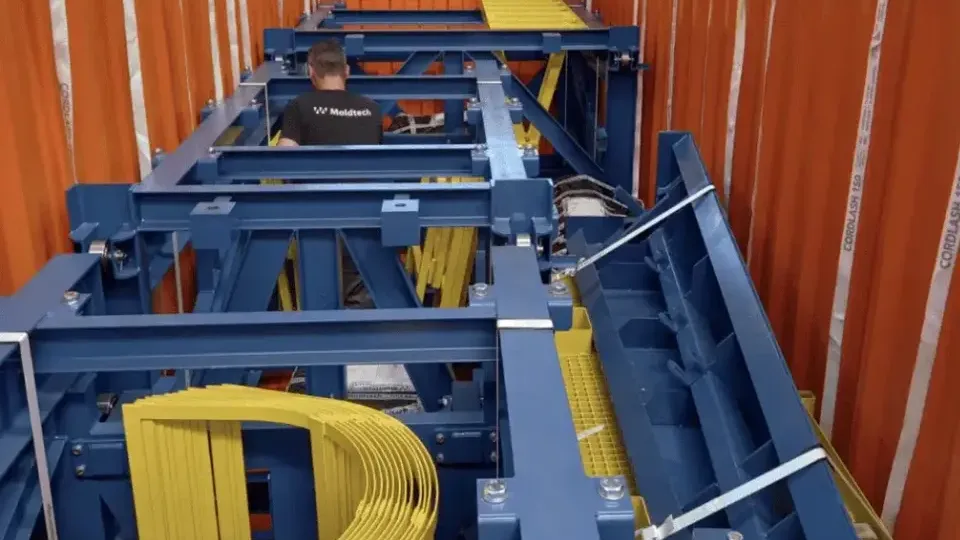
A precast production line arrives as steel, not as a factory. Casting beds, side forms, curing enclosures, transfer cars and the frames that carry them are shipped in pieces, often across several containers or on flat racks, and the last hundred metres of that journey are usually the most awkward. The trade term on the order decides who arranges the ship, who pays the port, who lifts the steel off the truck, and the moment when risk moves from the supplier to the buyer.
Many enquiries leave that term to the last email, or copy one from an earlier order for a different product. Both habits cause claims that have nothing to do with the quality of the equipment.
Why the term carries more weight on a line order
A line is heavy, long and awkward. A casting bed in sections, a set of side forms for a 30 m beam, a curing chamber frame: these do not travel as neat pallets, and they cannot be unloaded by hand. They need a crane with enough capacity at the radius, a lifting plan that uses the points the supplier designed, and ground that can take the outrigger load.
They also arrive before the plant is finished. Foundations may still be curing, the yard may be unpaved, and the crane booked for the steel erection may not be available on the day the container is released. Whoever owns unloading owns that scheduling problem, and the trade term is what assigns it.
What Incoterms decide, and what they leave alone
The Incoterms 2020 rules are published by the International Chamber of Commerce and consist of 11 rules. Their job is to allocate cost, risk and obligations between seller and buyer at a named point. They have been used in trade contracts since 1936 and were last updated in 2020.
They are not a contract of carriage, and they do not set the price, the payment schedule, the transfer of title, or liability for a defective product. Those sit in the sale contract around the term. A line order therefore needs both: an Incoterm for the physical movement, and payment and warranty clauses that do not assume the Incoterm covers them.
The terms that actually appear in equipment orders
Six rules cover most machinery purchases, and each one moves a different boundary.
| Rule | Where the seller's obligation ends | Who clears export | Who pays main freight |
|---|---|---|---|
| EXW | At the seller's premises, not loaded | Buyer | Buyer |
| FCA | Delivered to the carrier named by the buyer, cleared for export | Seller | Buyer |
| CFR | Loaded on board at the port of shipment | Seller | Seller |
| CIF | Loaded on board, with insurance to the destination port | Seller | Seller |
| DAP | At the named destination, ready for unloading | Seller | Seller |
| DPU | At the named destination, after unloading | Seller | Seller |
EXW looks simplest and is usually the worst choice for an imported line. The buyer becomes responsible for export clearance in a country where it has no presence, and the seller's staff still have to load steel they have no contractual duty to load. FCA is the more practical alternative, because the supplier keeps the export formalities it is best placed to handle.
CFR and CIF are port-to-port terms. They stop at the destination port, not at the factory gate, which means the inland leg, the port charges and the import clearance stay with the buyer. Many buyers discover this only when the forwarder invoices storage for a flat rack that nobody collected.
Who unloads, and why this is the line to check
The ICC is explicit about the difference between the two delivered rules. Under DAP the seller does not unload the goods. Under DPU the seller does unload them. Everything else about the two rules is close enough that the distinction is easy to miss on a quotation.
On a line order that difference is worth real money. Unloading a 12 m mould section or a casting bed frame needs a mobile crane, a spreader or slings rated for the weight, and a supervisor who knows which holes are lifting points. If the order is DAP, that is the buyer's operation, and the supplier's driver is entitled to wait, or to leave. If the order is DPU, the supplier has to price the crane and carry the risk of the lift, which most equipment suppliers will only do with a site survey and a firm date.
Whichever rule is chosen, the named place has to be precise. "Site" is not a place. The gate, the laydown area and the foundation edge are three different unloading positions with three different crane requirements.
What CIF insurance actually covers
The ICC changed the insurance position in the 2020 edition, and the change matters for machinery. Under CIF, the default level of cover is the Institute Cargo Clauses (C). Under CIP, the rule now requires cover compliant with the Institute Cargo Clauses (A) or similar clauses.
The C set is the narrowest of the standard clauses. It responds to major perils such as fire, stranding and collision. It is not designed for the damage that a set of machined mould faces is most likely to suffer in transit: water ingress, handling impact, or a shifted load. A buyer taking a line CIF, or a seller offering CIF, should check what the policy actually covers rather than assume the term means full protection.
Packing and lashing belong in the order as well
The CTU Code, published by IMO, ILO and UNECE, sets out practice for packing and securing cargo in containers and other transport units. It covers the chain of responsibility, the suitability of the unit, packing and securing, and what to do on receipt and unpacking.
Its central point is that the person who packs and secures the unit may be the last person to look inside it before it is opened at destination. For a line shipment, that person is usually the supplier's packer, not the buyer's forwarder. If the buyer's forwarder supplies the container, the split is less obvious. Writing the packing standard, the lashing arrangement and the photographs required before closing the doors into the order removes the ambiguity.
When risk passes, and what the site does on arrival
Risk passing is not the same as possession. Under CIF and CFR, risk moves when the goods are on board at the port of shipment, even though the buyer will not see them for weeks. Under DAP, risk stays with the seller until the goods are placed at the buyer's disposal on the arriving vehicle, ready for unloading. Under DPU, it stays until they are unloaded.
That sequence dictates what the site does in the first hour. Photograph the unit before opening, photograph the lashing before cutting it, and note any visible damage on the delivery document before signing. A claim raised after the steel has been unloaded, moved into the shed and unpacked is much harder to support, whichever rule applies.
Import clearance is a separate obligation from the trade term
Under EXW, the buyer handles export clearance as well as import. Under FCA and the C and D rules, the seller clears export, but import clearance and duties remain with the buyer in every rule. The importer of record, the tariff classification and any certification required at the border are commercial and regulatory matters that the Incoterm does not answer.
Machine safety compliance sits outside the trade term entirely. A line placed on the EU market has to meet the machinery rules in force at the time, which is a subject for the technical file rather than the bill of lading.
What to write into the order
| Item | What the order should say | Why it matters |
|---|---|---|
| Rule and place | The exact Incoterms rule, edition and named place | A missing place name makes the rule unenforceable in practice |
| Unloading | Who provides the crane, the lifting plan and the supervisor | The DAP and DPU difference, stated in words |
| Packing | The packing and securing standard, and the photograph record before dispatch | Shifts the argument about transit damage onto evidence |
| Insurance | The clause set, the insured value and who holds the policy | CIF default cover is narrow |
| Inland leg | Who moves the units from port to site, and who pays storage | The most common gap in a CIF or CFR order |
| Receipt | The inspection and notice procedure on arrival | Protects the claim window |
| Documents | Packing list, weights, lifting points, certificates and drawings | Needed by the crane contractor before the unit arrives |
The last row is the one crane contractors ask for first. They need the unit weight, the centre of gravity and the lifting point layout before they can plan the operation, and those details are usually in the supplier's packing drawings, not on the invoice.
Where this fits in the line purchase
The delivery term is one line in a contract that also has to settle capacity, mould count, curing, foundations and commissioning. It changes the price and the site programme, not only the paperwork, so it is worth settling early. What the equipment package contains is the neighbouring question, and the two are usually negotiated together.
Realjet supplies precast production lines as project packages covering casting equipment, moulds and the interfaces to batching, curing and handling. The delivery term, the named place and the unloading arrangement are agreed in the quotation for each project, because they depend on the port, the site access and the crane available on the day. The earlier those three facts are known, the more of the delivery scope can be priced rather than excluded.