
Begin the RFQ with the ring system
A tunnel segment mould quotation can look precise while resting on different assumptions. One bidder may price a mould for every segment position in a ring. Another may assume that geometrically identical segments share one design. A third may include additional moulds to meet output. The totals say little until the buyer defines the ring families, production plan and supply boundary.
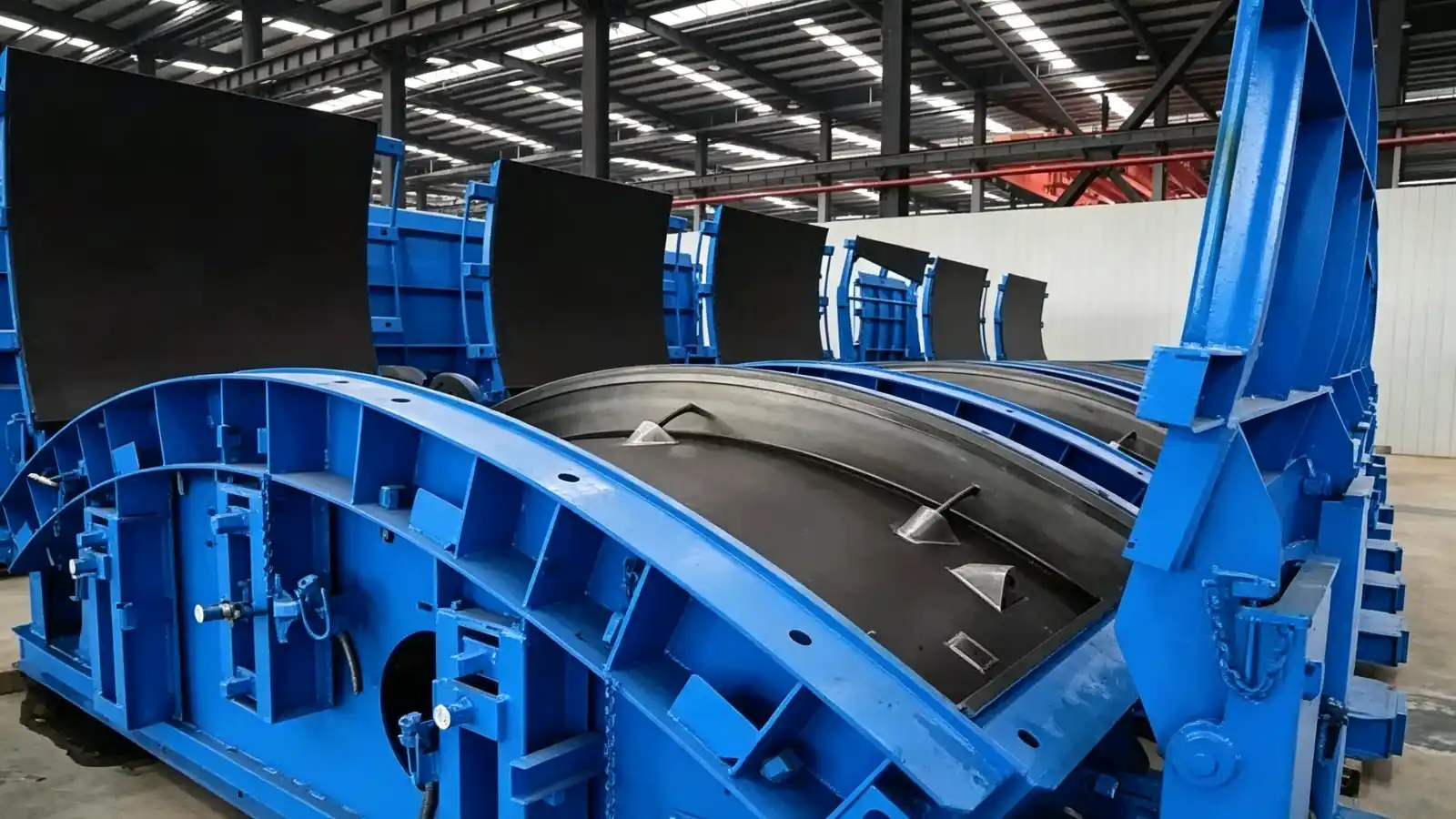
Start with the approved lining design. The mould supplier cannot infer ring geometry from tunnel diameter or a general arrangement. Buyers reviewing project-specific precast concrete moulds need to issue the controlled segment drawings and explain how the segments combine into each ring type.
Convert tunnel geometry into a segment schedule
Prepare a schedule that gives every physical segment type a unique identifier. For each one, list its ring family, position, quantity per ring, included angle, width, thickness, taper, joint geometry and drawing revision. Identify the key segment and any adjacent or counter-key segments. Record whether a segment is geometrically identical to another position or merely looks similar in plan.
The schedule should also locate:
- gasket grooves and sealing interfaces;
- bolt pockets, dowel holes or other connectors;
- reinforcement cage and cover requirements;
- lifting sockets and embedded items;
- injection, monitoring or service provisions;
- identification marks and traceability features;
- exposed-face and formed-face requirements.
Do not collapse left-hand, right-hand, standard and tapered rings into one line unless the approved design confirms that their segment geometry and mould interfaces are the same.
The FHWA synthesis on precast concrete segmental liners explains that ring arrangement and taper depend on factors such as segment type, width, outside diameter, curve radius and manufacturing considerations. It also distinguishes universal tapered rings from parallel and left-right ring arrangements. These are design inputs for the tunnel project. The mould manufacturer needs the resulting approved geometry, not permission to select the lining concept.
Decide what one mould type actually covers
The buyer and supplier should agree on the boundary between a mould type and a mould set. A type describes one approved geometry and operating configuration. A set describes the collection of moulds required to produce the planned segments.
Some segment positions may use the same basic steel body with controlled inserts or end arrangements. Others need separate contact surfaces because their geometry differs. Treat adjustability as an engineering proposal, not an automatic saving. Every adjustable feature adds setup work and creates an interface that must return to the specified position.
Ask the bidder to submit a mould allocation table with these columns:
| Segment identifier | Ring family | Proposed mould type | Quantity | Interchangeable parts | Changeover required |
|---|---|---|---|---|---|
| Buyer schedule ID | Approved ring reference | Supplier mould reference | Quoted units | Inserts or end parts | Steps and expected boundary |
This table exposes assumptions before they become tooling changes. It also gives the buyer a stable document for reviewing future design revisions.
Calculate mould quantity from the delivery programme
The number of unique geometries does not determine the number of moulds. Output does. Build the quantity model from the tunnel erection demand, production calendar, accepted yield assumption and time that each mould remains occupied.
For each segment family, estimate the required accepted segments per working day. Then map the full cycle: preparation, reinforcement placement, closure, concrete placement, curing, release, demoulding and return to ready condition. If one mould can complete more than one cycle within the working day, support that assumption with the proposed curing method, shift coverage and handling sequence.
Keep spare capacity visible. The buyer may choose additional moulds for maintenance, repair, design mix or schedule recovery, but the percentage or quantity must come from the project risk plan. Do not accept an unexplained "one spare set" from a supplier or insert a generic contingency in the RFQ.
The relevant Tunnel and Underground Moulds category shows the application family. For this specific purchase, the published tunnel lining segment mould page confirms that ring geometry, segment types, gasket grooves, connection provisions, reinforcement data, curing method and target cycle are project inputs. It does not provide a universal mould count or tolerance.
Define operation and changeover before pricing
State whether the project expects conventional, hydraulic or movable mould operation. Describe the available floor, crane coverage, casting method, vibration arrangement, curing route and segment handling equipment. A hydraulic function has value only if it matches the required opening sequence, access and local maintenance capability.
For every proposed changeover, ask the supplier to explain:
- which parts are removed, repositioned or adjusted;
- which datums establish the new geometry;
- what lifting or tools are required;
- how the setup is locked;
- which dimensions are checked before casting resumes;
- how the active configuration is identified.
Avoid accepting a single unqualified changeover time. The actual duration depends on the agreed procedure, workforce, handling equipment and inspection hold points. A better quotation defines the work and states its timing assumptions.
Make dimensional acceptance part of the supply scope
The RFQ should identify the approved tolerance standard or project specification and the characteristics controlled by the mould. Ask the designer to mark the relevant datums, joint faces, gasket grooves, connection features and ring interfaces. The mould supplier can then propose how those characteristics will be set and inspected.
Agree on the evidence required before shipment. This may include material records, dimensional reports, trial assembly records, hydraulic or mechanical function checks, photographs and identification records. If a trial concrete segment is required, define who supplies concrete, reinforcement, embedded items, labour and testing, and where the trial will occur.
Dimensional inspection of an empty mould and acceptance of a finished segment are related but not identical. Concrete materials, reinforcement position, placing, compaction, curing and demoulding also affect the product. The contract should separate mould acceptance from the precast producer's process responsibility.
Compare delivery boundaries and change risk
Request one scope table from each bidder. It should identify the mould bodies, end and side parts, inserts, hydraulic power unit if used, controls, access platforms, vibration interfaces, installation items, commissioning support, training, spare parts, documentation and packaging. Record what the buyer supplies at the factory and at site.
Then add a drawing-change rule. Tunnel design can develop while tooling is being quoted. The commercial terms should define the design freeze, supplier review period, approval route and how a revision affects price or delivery. Without this rule, two suppliers may price different levels of change risk.
Send the ring schedule, controlled drawings, output calendar, factory arrangement, operating concept and acceptance requirements when requesting a proposal. Realjet can review a standalone mould package or its interfaces with wider precast production equipment, but the final configuration and delivery boundary are confirmed for the specific project. A complete RFQ lets the buyer compare geometry coverage, mould quantity and evidence before an order is placed.