
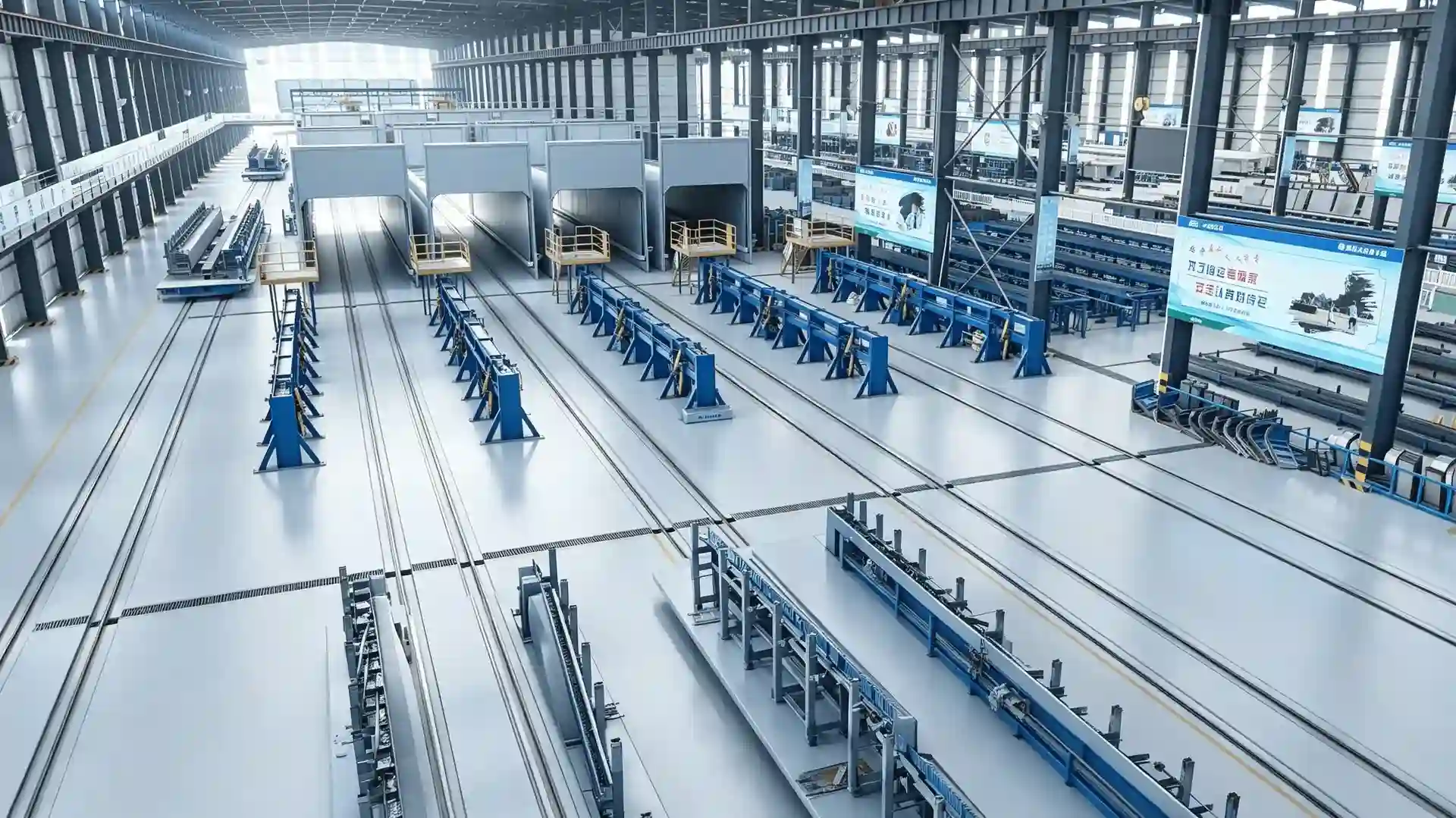
What a box girder production line produces
A precast box girder production line makes the concrete box-shaped superstructure elements that go into highway, railway and viaduct bridges. The line itself is a set of coordinated equipment: moulds or forms for the cross-section, prestressing systems, concrete placing and curing facilities, lifting and handling gear, and the rail-mounted circulation system that moves components between stations.
Realjet supplies project-specific production lines for precast concrete components, including engineering, equipment manufacturing, installation and commissioning where confirmed by the project scope. The company does not sell the finished box girders; those are produced by the bridge contractor or precast producer who owns and operates the line.
Box girders are chosen for their torsional stiffness, which helps on curved alignments and where the deck needs a closed section. A typical single-cell trapezoidal box has top and bottom flanges, two inclined webs, internal diaphragms at supports, and sometimes longitudinal post-tensioning ducts cast into the webs or flanges. The production line must accommodate that geometry through every step from rebar cage assembly to cured component lift-out.
Fixed-formwork versus circulating-bed layouts
Two basic arrangements dominate box girder yards:
Fixed-formwork lines keep each mould in one position. Concrete is placed, the component cures in place, then a crane or gantry lifts the finished girder out and brings in the next rebar cage. This layout suits sites with limited floor space but enough lifting height, and it works well when the girder weight is within reach of available cranes. Cycle time depends on curing speed and how fast the crane can clear the station.
Circulating-bed (or long-line) lines move the mould or the casting bed between stations on rails. After casting, the bed travels to a curing zone while the next casting starts at the original position. This approach raises daily output when you have multiple beds and a long yard, because casting and curing happen in parallel. Rail-mounted transfer carts carry the forms between stations; the term "casting bed" refers to the moving platform, not to the mould itself.
The choice between fixed and circulating affects floor area, capital cost, daily output and the skill level of the operating crew. Neither is universally better; it follows from your target output, site dimensions and budget.
Segmental match casting versus full-span production
Box girders for long-span bridges are often built as segments rather than full spans. PCI documents show that short-line match casting, where each new segment is cast against the face of the previous one, delivers tolerances in the order of fractions of an inch across a curved alignment. Segments are typically 1.5 to 4 m long, stored after curing, and erected span-by-span using an overhead gantry or underslung traveler.
A full-span box girder line casts each girder as one piece, which simplifies the casting sequence but requires longer beds, heavier lifts and more curing space per unit. Full-span precasting works well for constant-depth girders on straight or gently curved alignments with spans under about 60 m, where the complete girder can be transported and lifted without excessive temporary works.
If your project uses segmental construction, the production line must include match-casting fixtures, geometry control points and storage areas in addition to the standard casting, curing and handling stations. State the erection method in the RFQ so the supplier can confirm whether the line layout matches it.
Equipment that goes into a box girder line
A typical equipment package includes:
| Function | Typical equipment |
|---|---|
| Formwork | Bottom plate, side forms, inner core (mansard) form, end bulkheads |
| Prestressing | Stressing jacks, anchor plates, ducts or strands if pretensioned |
| Concrete placing | Distributor, vibrator, screed |
| Curing | Steam covers, heating system or ambient-cure enclosure |
| Handling | Gantry crane, rail-mounted transfer cart, lifting hardware |
| Rebar | Cage assembly jig, welding station |
The inner form is often the most operationally sensitive item. It must withdraw cleanly after concrete reaches stripping strength without damaging the fresh surfaces or the embedded ducts. For box sections with variable depth or diaphragms, the inner form may split into multiple pieces that come out in a defined sequence. This withdrawal route should be part of the mould design review.
Box girder moulds are project-specific steel formwork engineered around the approved section, diaphragm positions, duct layout and demoulding space. They are one part of the full line, not the whole solution.
Capacity, cycle time and mould quantity
Daily output from a box girder line comes down to:
- Curing time: steam curing can bring a component to release strength in 8 to 16 hours; ambient cure may need 24 to 48 hours depending on mix and temperature.
- Bed count: more beds mean more components curing simultaneously, but each bed needs floor space, rails and a mould set.
- Cycle time: the interval between successive casts on the same bed, including cleaning, form setup, rebar placement, concreting and initial set before the bed can move.
- Shift pattern: one or two shifts per day change the effective capacity without adding equipment.
A rough starting point for planning is to work backwards from the required delivery rate: if the bridge needs four girders per week and each bed produces one every two days, you need at least eight beds with some margin for maintenance and weather. The supplier will refine this once you provide the girder schedule, site conditions and acceptable curing method.
Site, utilities and personnel
The line needs a level casting yard large enough for all beds plus access lanes, curing enclosures, rebar storage and a staging area for finished girders before transport. Utilities typically include three-phase power for vibrators, curing heaters and cranes; water for concrete and curing; and compressed air for form cleaning and vibrators.
Staffing covers rebar fabrication and cage assembly, concrete placing and finishing, curing operation, prestressing (if applicable), lifting and quality inspection. The crew size scales with the number of active beds and the automation level of the handling system.
What to put in the RFQ before contacting a supplier
A useful enquiry includes:
- Girder geometry: span lengths, cross-section drawings, depth range, web inclination, flange widths, diaphragm positions.
- Production method: full-span or segmental, fixed or circulating, expected daily or weekly output.
- Concrete grade, prestressing details (if any), and surface-finish requirements.
- Site plan with dimensions, ground condition notes, and available utilities.
- Standards you want applied (e.g., AASHTO LRFD, local bridge code).
- Your responsibility boundary: what you supply (site, civil foundations, rebar, concrete) and what you expect the line supplier to deliver (equipment, installation, training, commissioning).
Realjet reviews the approved girder design, production targets and site conditions before confirming the line configuration and equipment package. Send the geometry and output requirements through the precast beam factory page to start a project-specific assessment.