
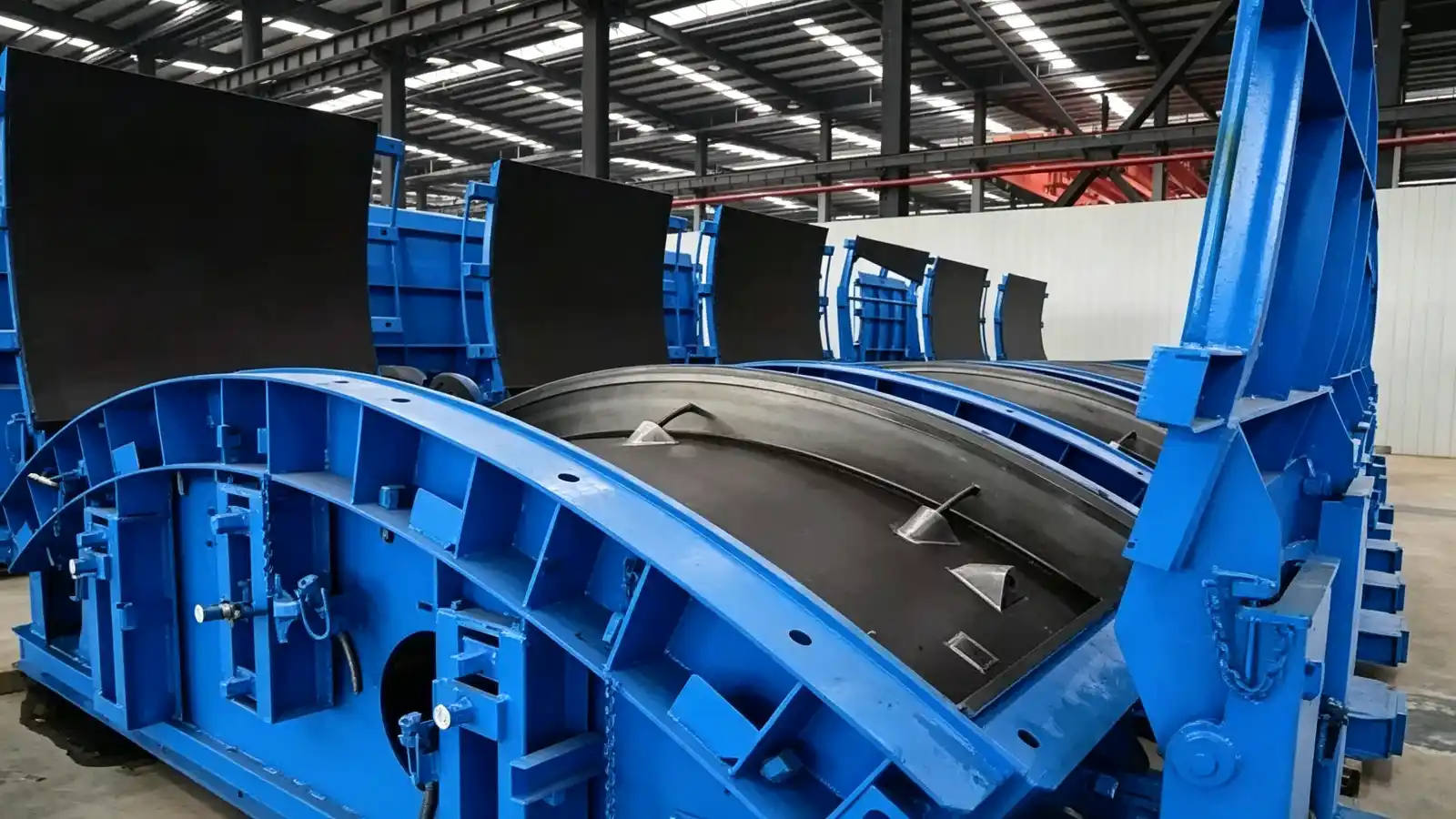
What a tunnel segment production line makes
A precast tunnel segment production line makes the curved concrete units that are assembled into lining rings behind a tunnel boring machine. Each ring is formed from a scheduled set of segment types, which may include regular segments and a key segment. The approved ring design controls the geometry, joint faces, connection provisions, gasket grooves, reinforcement, embedded items and acceptance criteria.
The production line does not design the tunnel lining. It reproduces the approved segments at the rate and quality needed by the tunnelling schedule. That distinction matters when comparing suppliers. A proposal can include impressive equipment yet still be poorly matched to the ring schedule, curing requirement or site logistics.
The FHWA survey of precast concrete segmental liners describes segmental linings as the lining system used in tunnel boring machine projects and notes that design and detailing must address materials, joints, gaskets, connection hardware and performance testing. Those project requirements become production inputs. They are not values for an equipment supplier to guess.
A line is a connected production cycle, not a mould count
In the factory, the line connects reinforcement preparation, mould cleaning, assembly and release-agent application, cage and embedded-item placement, concrete delivery, casting and consolidation, curing, demoulding, inspection, marking and storage. Segment handling links these stations.
There are several possible production concepts. Moulds may stay at fixed stations while labour, concrete and equipment move to them. Moulds may move through a carousel of specialised stations. A hybrid arrangement can keep some operations fixed and move others. The right choice depends on required output, segment variety, available space, labour model, level of automation and planned project duration.
Ask suppliers to show material and information flow, not only an equipment list. Reinforcement cages, embedded items, fresh concrete, finished segments, rejected pieces and empty moulds all need defined routes. A bottleneck at curing or crane handling can limit accepted output even when casting equipment has spare capacity.
Convert tunnel demand into a production brief
Begin with rings, not cubic metres of concrete. The buyer should state the planned rings per day or shift, segments per ring, segment type schedule and production calendar. Allowance for inspection, repairs, planned downtime and inventory policy should be visible rather than hidden in a percentage selected by the supplier.
A useful demand brief contains:
- approved ring and segment drawings with revision status;
- the segment schedule for each ring and any variant rings;
- expected rings per day, shifts per day and working days;
- the tunnelling demand profile, including planned ramp-up and peak periods;
- concrete mix and authorised curing basis;
- required demoulding criteria and project acceptance requirements;
- reinforcement concept, cages, fibres and embedded items as applicable;
- gasket, connector and identification provisions;
- storage buffer and dispatch sequence to the tunnel site.
Do not convert the demand into a guaranteed line output until the parties agree on assumptions. Concrete supply, curing time, mould availability, labour and segment handling all influence the result.
Size the mould fleet around cycle time and segment mix
Mould count follows from the production plan. It is not simply the number of segments needed per ring. Each mould occupies time for preparation, reinforcement placement, casting, curing, opening, demoulding and return to service. Different segment types can also need different quantities because the ring schedule is not uniform.
Ask the supplier for a mould loading chart by segment type and hour. It should show when each mould is prepared, cast, cured and released, along with the assumed working shifts. The calculation should identify the governing operation and the effect of a missed cycle.
The mould itself is configured to the approved geometry and production method. Realjet's published tunnel lining segment mould range shows conventional, hydraulic or movable configurations, but those labels do not select a solution. The buyer still needs to define ring geometry, grooves, connection details, reinforcement, curing method and target cycle before a configuration can be reviewed.
Treat curing as a capacity input before equipment selection
Curing is easy to overlook in a sales proposal, yet it can place a hard limit on cycle time. The RFQ should state the approved concrete and curing requirements, available heat source, ambient conditions, monitoring expectations and criterion for mould release. The equipment supplier can then propose an enclosure, circulation and control concept around those project inputs.
Avoid asking for the fastest possible cycle without a project-approved basis. Accelerating heat too aggressively can conflict with the concrete specification or quality plan. Conversely, a slow assumed cycle can increase the mould fleet and factory footprint. These are commercial consequences of a technical assumption, so the curing basis should be agreed before bid comparison.
Check handling, storage and traceability at line level
Once a segment leaves the mould, the line still has work to do. The concept needs to cover turning if required, inspection, transfer, stacking, storage and loading for delivery. The buyer should provide maximum segment dimensions and mass, lifting provisions, allowable orientation and storage rules from the approved design.
Traceability should follow the segment through production and storage. Define what identifier is required, which batch and inspection information it connects to, and whether the system boundary includes labels, scanners, production records or interfaces to the buyer's software. Do not assume that an automation proposal includes a complete manufacturing execution system.
The same boundary discipline applies to cranes, concrete batching, cage fabrication, laboratory facilities, utilities and civil works. Mark each item as supplier scope, buyer scope or third-party scope. Then verify every interface in the layout.
What to request from competing line suppliers
A comparable proposal should include more than a total price. Ask each bidder for:
- a process flow and station list tied to the segment schedule;
- the mould quantity by segment type and the cycle assumptions;
- a capacity calculation in accepted rings and segments per shift;
- a layout with movement routes, safety clearances and buffer locations;
- utility loads and connection points;
- the proposed curing concept and control boundary;
- crane and handling assumptions from demoulding to storage;
- the inspection, traceability and data scope;
- exclusions, buyer works and third-party interfaces;
- the document, training, installation-support and commissioning boundary.
The best proposal is not necessarily the one with the highest nameplate output. It is the one whose assumptions match the approved product, the tunnelling schedule and the site that will host the line.
Realjet configures precast concrete production line concepts for project-specific components around buyer-provided drawings, output targets, site conditions and scope boundaries. For a tunnel segment line review, send the ring and segment package, production calendar, curing basis, maximum segment mass, site plan, utilities, storage policy and required delivery boundary. Final capacity and configuration can only be confirmed after those inputs are technically reviewed.