
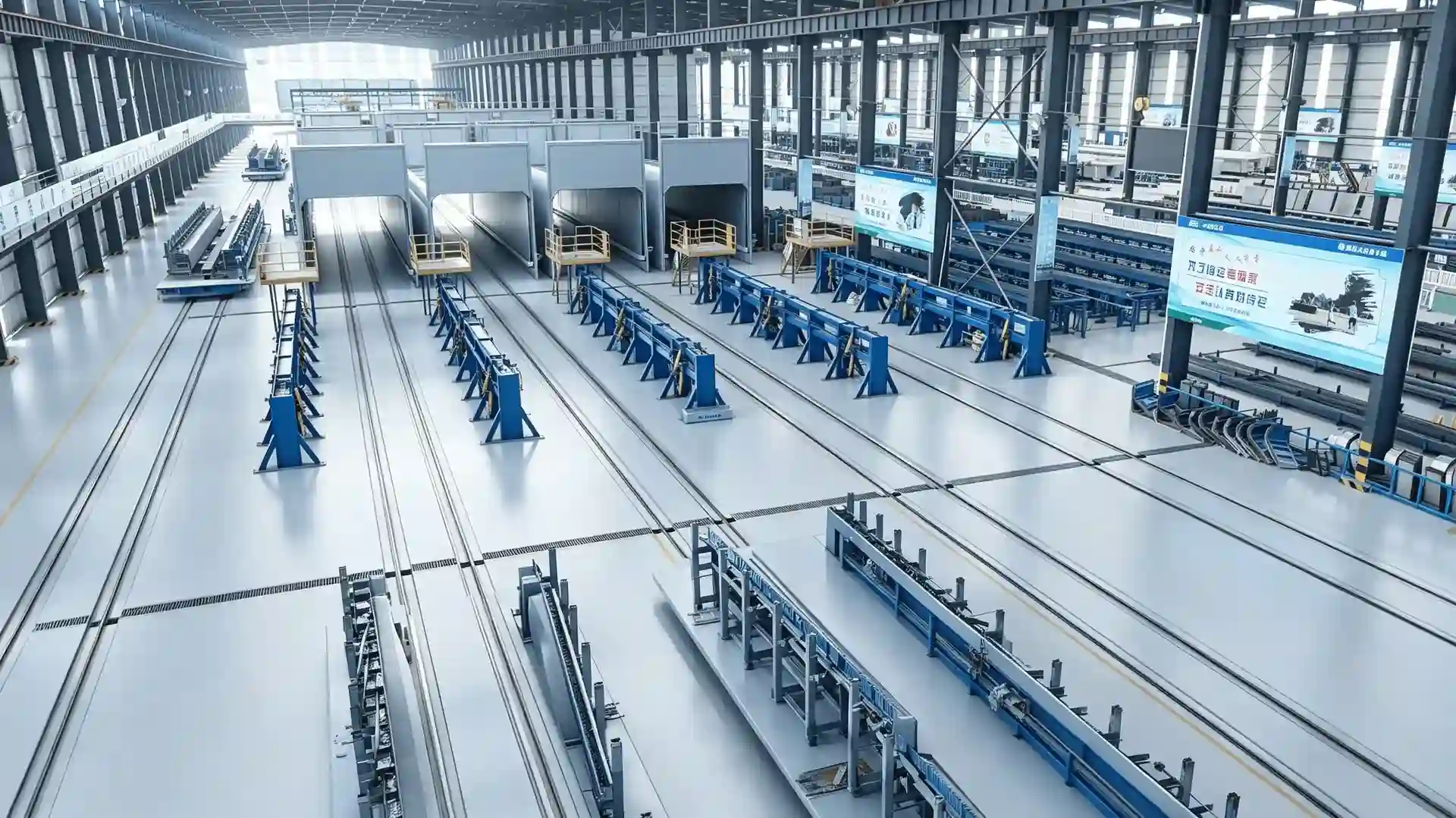
What a precast U-girder is
A precast U-girder, also called a U-beam or channel girder, is a U-shaped prestressed concrete bridge member. A single-track U girder has two edge girders joined by a central bottom slab, forming a channel that carries the track or roadway. PCI Journal work on full-span precasting notes that single-track U beams span about 30 to 35 m, while stiffer dual-track box girders reach 40 to 45 m for simply supported spans. The open top makes them useful for urban viaducts, light rail and metro alignments where a low structure and built-in noise barriers help.
This article is about the production line that makes these girders, not about the girders as a product to buy. Realjet supplies production lines and equipment for precast concrete components, not the concrete elements themselves.
How the line casts U-girders
Most U-girders are made by pretensioning on long casting beds. Strands run the length of the bed, the closed U form is set, reinforcement and embedded items are placed, concrete is cast and cured, then the strands are released and transfer prestress to the concrete. A long-line bed can hold several girders in one pour, which is why this method scales well for repetitive spans.
Some projects use match casting, where segments are cast against an already cast segment so the joint faces fit during erection. For U-girders this is more common on dual-track box-girder sections than on single-track U beams. The casting method you choose changes the form design, the bed length and the handling plan, so it should be fixed before the line layout is set.
Equipment and forms in the line
A U-girder line is a coordinated set of stations rather than a single machine. The core items are the pretensioning bed with anchor blocks and reaction beams, the steel forms for the U section, a reinforcing cage assembly area, a concrete supply and placing system, a curing arrangement, and lifting and handling gear. The open U section needs side forms that hold the edge-girder geometry while the bottom slab is cast, and the forms must resist the prestress transfer and stripping forces.
The form system is specific to the approved girder section. U-girder mould systems are configured around the exact edge-girder profile, bottom-slab width and embedded items, so the mould and the line are specified together. The number of form sets in circulation sets how many beds can be in production at once.
What drives capacity
Installed capacity is not the same as daily output. The cycle is governed by bed length, number of form sets, concrete curing time, strand release strength and the handling window. A line sized for 30 m single-track U beams on a long bed with several form sets can cast a steady rhythm of girders per week, but the real rate depends on how the casting, curing and lifting steps are balanced.
Realjet scopes a production line around the product mix, daily or weekly output target, casting method and yard layout you define. Stating the span lengths, girder width and required delivery schedule up front is what lets the equipment package and mould count be sized instead of guessed.
Factory space and utilities
A U-girder line needs a long, flat casting area with soil conditions that suit the reaction loads of pretensioning. The bed length follows the girder length plus end anchorages, and multiple beds multiply the footprint. You also need space for cage assembly, form storage, a curing arrangement, a stacking yard sized for concrete strength gain before erection, and circulation routes for concrete and lifting.
Utilities are concrete supply, water for curing and mixing, power for plant and lighting, and often steam for accelerated curing in cold or fast-track programmes. The steam curing system is a separate scope item with its own capacity and control needs. A site survey of ground, access and utility availability belongs in the early brief.
What the buyer prepares before purchase
Before asking a supplier to quote, gather the girder section drawings, span lengths and quantities, the casting method (pretensioning long-line versus match cast), the daily or weekly output target, the site plan with ground and access constraints, and the local utility limits. The prestressing equipment scope and the curing system are two items buyers often leave vague, and both materially change the quotation.
Our notes on prestressing equipment scope for precast beam lines and on steam curing systems for precast production lines cover those two items in more detail. Read them before you finalise the brief.
Next step
A U-girder line is a project-specific package, not a catalogue item. Define the product, output, method, site and utilities, then ask the supplier to size the beds, forms and equipment against that brief.
Realjet's precast beam factory solutions cover production lines for U-girders and other precast concrete components, engineered around the geometry and output you confirm.