
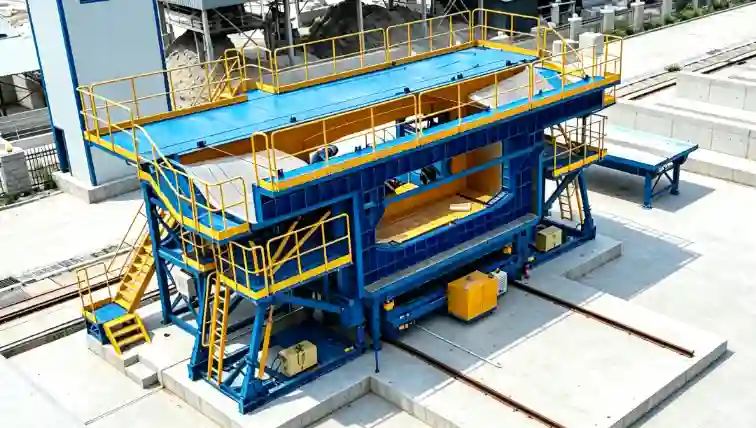
What does a segmental girder production line make?
A segmental girder production line makes individual precast concrete segments that are later assembled into a bridge span or part of a span. Each segment is much shorter than the completed bridge unit. Its geometry, joint faces, ducts, embedded items and survey references must fit the approved bridge design and erection method.
A segment line is not a smaller version of a full-span box girder line. Its casting method, geometry control and movement sequence are built around repeated segments and the way they fit together. Buyers need that distinction in the production brief.
The precast concrete component production-line service includes segmental girder applications, but no standard equipment list can be selected from the component name alone. The buyer must first define how the segments will be cast, identified, cured, moved and released.
Why match casting changes the production concept
Many precast segmental bridge projects use match casting. In this method, a newly cast segment uses a previously cast segment as one end face so the two can fit during erection. The US Federal Highway Administration's Bridge Geometry Manual explains that the common short-line method casts a new segment between a fixed bulkhead and the previous segment. It also describes adjustable soffits, outside forms and a retractable core form as parts of the casting machine.
Geometry control is therefore part of production equipment planning. The match-cast segment must be positioned for the required alignment of the next unit. Survey data and casting coordinates need to stay within the physical adjustment range of the casting cell. Without that geometry basis, a mould price tells the buyer little about whether the proposed equipment suits the bridge.
Short-line casting uses a compact casting cell and changes the position of the match-cast segment for successive units. Long-line casting arranges several segments along a longer casting line. The bridge designer and approved construction method govern the choice. A production-line supplier should configure equipment around that decision, not select the bridge construction method on the buyer's behalf.
What happens along the line?
The exact stations differ by project, but the process usually has to provide for these activities:
- Prepare the mould surfaces and position the bulkhead, soffit, side forms and core form.
- Set reinforcement, ducts, anchorages and embedded items from approved drawings.
- Position the match-cast segment or other approved end form and verify survey references.
- Place and compact concrete while controlling access to the segment geometry.
- Cure the new segment until the authorised release condition is reached.
- Open or retract the mould, move the segment and transfer the next match-cast unit into position.
- Inspect, identify and store the segment according to the project control system.
Some projects keep the casting cell fixed and move materials and segments around it. Others use a wider station-based or circulation concept for related tasks. Automation can support positioning, material movement, curing control and data collection, but it does not remove the need for approved geometry data or release decisions.
Start the RFQ with the bridge production brief
The equipment supplier needs a controlled product schedule rather than a representative segment image. The schedule should state segment types, quantities, maximum mass and dimensions, casting sequence, planned erection sequence and required production dates. Include diaphragm segments, pier segments, deviator segments or other special units if the project uses them.
The drawing package should identify the box section, webs, deck, diaphragms, shear keys, post-tensioning ducts, embedded items, lifting provisions and joint details. Provide the governing tolerance and survey basis through the responsible bridge designer. If drawings are still developing, mark their status and define how changes will be approved before equipment manufacture.
The production brief also needs the target output and working calendar. State accepted segments per shift or day, shifts per day, working days, product mix and planned allowance for special segments. A headline daily number without the mix can hide the effect of complex reinforcement, different geometry or a longer curing period.
Check the casting cell adjustment envelope
Buyers should ask each bidder to show how the proposed casting cell covers the approved segment family. Review the minimum and maximum section, variable web or deck geometry, crossfall, horizontal curvature, vertical profile and any change in joint orientation. The required movements and datums should be stated, not inferred from a rendering.
For a short-line match-casting proposal, request a clear explanation of how the previous segment is supported and adjusted. The proposal should also show the fixed bulkhead, soffit arrangement, core withdrawal route, side-form opening and access for reinforcement, ducts, concrete placement and inspection.
The matching segmental box girder mould reference identifies geometry, casting sequence and yard conditions as project inputs. It is useful for understanding the mould family, while a complete line proposal must also cover production flow, handling, curing, utilities and control interfaces.
Size handling, curing and storage together
Segment movement begins at the casting cell and continues through inspection and storage. The buyer should provide segment mass, lifting points, centre of gravity, travel route, crane availability and storage layout. If transfer equipment is included, define its load cases, travel distance, floor or rail interface and interaction with people and other machines.
Curing affects when the mould and match-cast position become available for the next cycle. The responsible concrete technologist must set the release criteria and approved curing regime. The line supplier can then develop the equipment occupancy plan and utility demand around those requirements. A promised cycle time without a stated concrete and release basis is not a reliable purchasing comparison.
Storage is part of the capacity check. Segments need identification, inspection status and an approved support arrangement while they wait for erection. The site plan should show how accepted units leave the production area without blocking incoming reinforcement, concrete delivery or the next match-cast movement.
Compare proposals by process boundaries
Ask each bidder for a process flow, station list, cycle calculation, equipment list, utility schedule and interface matrix. The proposal should distinguish supplied equipment from buyer-provided civil works, batching, cranes, laboratories, survey instruments, power distribution and storage facilities. It should also identify installation, commissioning and training services that are included or optional.
The line supplier does not approve bridge geometry, concrete design, prestressing design or erection engineering unless the contract explicitly assigns that responsibility to a qualified party. Those inputs normally come from the project's authorised designers. Buyers should keep the boundary visible so an equipment assumption is never mistaken for bridge design approval.
A buyer ready to compare concepts should send the segment schedule, controlled drawings, casting method, target output, site plan, utilities and delivery boundary through the segmental girder production-line planning page. Realjet can then review the casting cell and surrounding production flow against one defined purchasing case.