
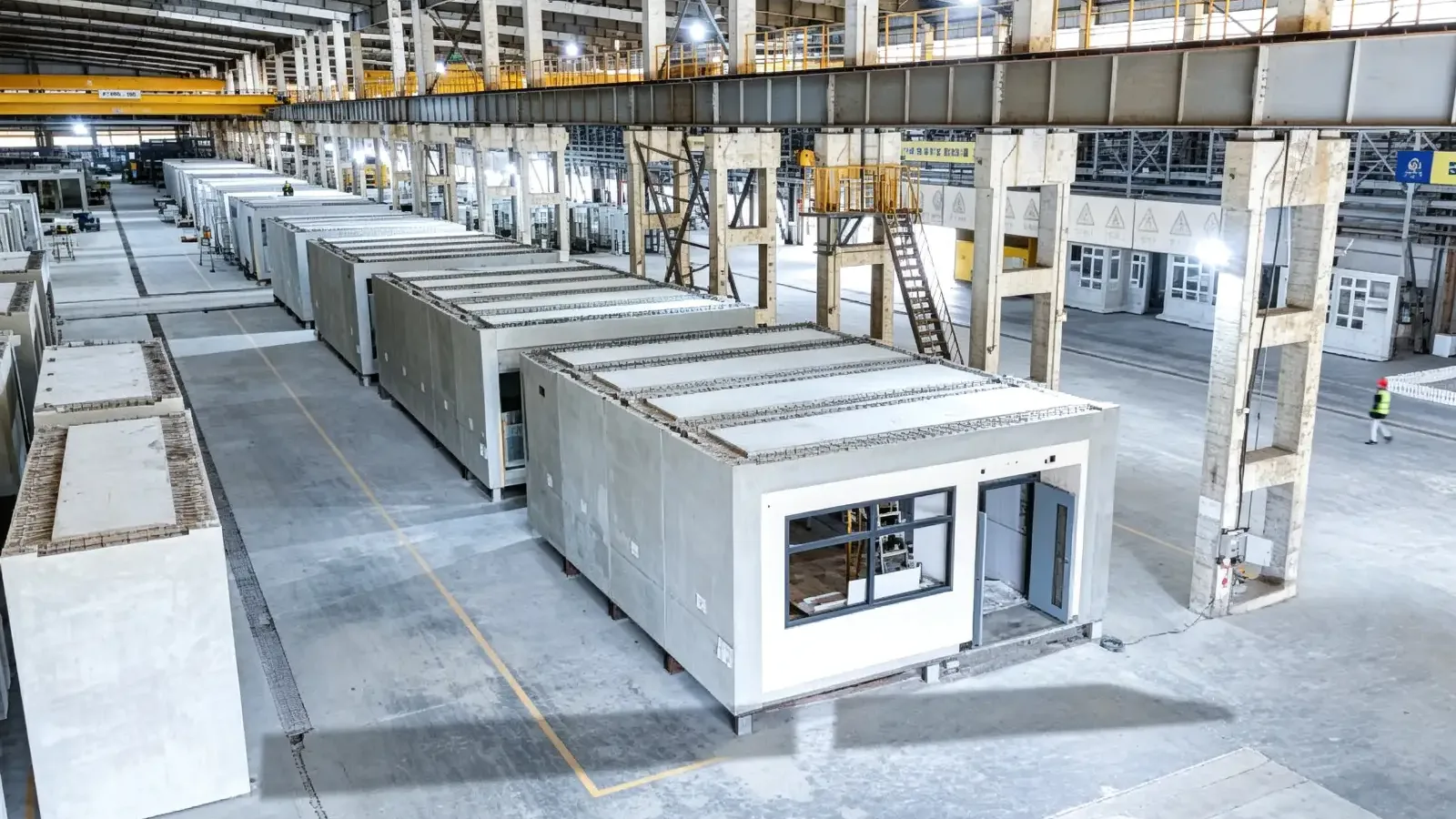
The plant is one large piece of metal
Walk into a precast hall and count what is electrically continuous. Steel moulds sit on steel rails. The rails are fixed to a concrete floor with steel anchors. The gantry crane runs on rails carried by steel columns, and those columns are tied into the roof structure. Curing chambers are steel boxes. Batching plants, skip hoists and stacker cranes add more. Almost every surface an operator touches during a shift is metal, and much of it is wet.
That is why earthing is not a detail to be left to the electrical subcontractor at the end of construction. It is one of the few line items where the physical layout of the plant and the electrical design have to agree, and where a change made late is expensive because it means cutting concrete or adding conductors across a finished floor.
The subject also has a habit of arriving in the wrong meeting. It gets raised during commissioning, when the cabinets are already on site and someone notices that the building earth bar and the machine earth bar are two different things. By then the cheapest options are gone.
Three systems that get treated as one
Buyers and suppliers often say "earthing" when they mean one of three separate systems, and the confusion is worth clearing before any enquiry.
The first is protective earthing: the fault path that lets a breaker or residual current device operate when a live conductor touches a frame. IEC 60364-5-54 covers earthing arrangements and protective conductors, including bonding conductors, and its annexes address concrete-embedded foundation earth electrodes and soil-embedded electrodes, which is directly relevant to a plant built on a slab.
The second is lightning protection: the air termination, down conductors and earth termination that carry a strike to ground, plus the surge protective devices that keep the surge out of control cabinets. The IEC 62305 series covers this in parts, with Part 1 setting general principles, Part 2 the risk management procedure and Part 3 the physical damage requirements.
The third is equipotential bonding: the deliberate connection of exposed metalwork so that everything a person can touch at once sits at the same potential. In a precast hall this is the one that touches the most items, because it includes rails, moulds, crane structures, pipework and chamber frames.
A plant can have a perfectly adequate protective earth and still have a bonding problem, because bonding is about differences between metal parts, not about the resistance to earth of any single one.
What the 2024 editions changed
The lightning standards were revised in September 2024, and the 2010 editions have been replaced, so a specification that still cites the old part numbers is a small warning sign about how current the rest of the electrical package is.
Two changes matter to a plant buyer. In IEC 62305-2:2024 the risk assessment now uses lightning ground strike-point density, which replaces the flash density figure used in the previous edition when calculating the expected number of dangerous events. In IEC 62305-3:2024 the minimum thicknesses of metal sheet and metal pipe used as air termination are given in a table, so a thin steel roof sheet cannot simply be assumed to double as a strike receptor without checking.
For the buyer, the practical consequence is that the risk assessment is a document someone has to produce for this specific site, with the local ground strike-point density, the building geometry and the contents of the plant as inputs. It is not a page copied from a previous project in another country.
Inputs the electrical designer needs from the plant
The earthing and lightning design cannot be finished from an architectural drawing alone. A set of inputs has to come from the plant side, and gathering them early is the most useful thing a line buyer can do.
- Soil resistivity measured at the site, not assumed from a regional map, because the electrode design depends on it
- The local ground strike-point density for the risk assessment
- The utility's requirements at the point of connection, which often set the earth resistance the installation must achieve
- The foundation and reinforcement design, since concrete-embedded electrodes have to be agreed with the structural designer before the slab is poured
- Buried services, drainage and any metallic pipe entering the building
- Rail layout and the intended method of bonding rails and moulds
- Curing chamber construction, including whether chambers are steel boxes or insulated panels with a steel frame
- The position of control cabinets, drives and any equipment the buyer intends to install later
Most of these are cheap to obtain at design stage and awkward to obtain afterwards. Soil resistivity in particular is measured before the slab goes down or not at all.
Where the boundary sits
The most common gap on a precast project is not a technical one. It is a line in the contract that nobody drew.
| Item | Usually building electrical scope | Usually line package scope | What to write |
|---|---|---|---|
| Earth electrode and foundation connections | Yes | No | Who verifies continuity before the slab is poured |
| Main earth bar and risers | Yes | No | Its location relative to the line |
| Earthing of structural steel and crane rails | Yes, often by the steelwork contractor | Not usually | Who bonds the rail joints, and to what |
| Protective conductors inside line equipment | No | Yes | The terminal each item bonds to |
| Bonding of steel moulds | Depends on the mould supply | Depends | Whether bonding is a mould item or a site item |
| Surge protection at the main board | Yes | No | Type and coordination with equipment SPDs |
| Surge protection inside control panels | No | Yes | Who supplies and who tests it |
| Testing and documentation | Yes, for the installation | Yes, for the equipment | Who compiles the combined record |
The exact split varies by contract and by country, and nothing in the table should be read as a default. What matters is that each row is answered in writing, because the row that stays blank is the one that gets discovered during commissioning.
The questions worth asking before the line order
A buyer preparing a precast production line enquiry does not need to design the earthing system. They do need to know what to ask, and when.
Whoever produces the lightning risk assessment should be named, with a date attached. The answer decides whether the roof needs air termination rods or whether the steel structure can be used, and whether that decision lands before or after the roof is clad.
Ask how the rails and moulds are bonded, and who is responsible for continuity across rail joints. A rail run is not a single conductor, and the joints are where continuity gets lost.
Ask whether the mould supplier's scope includes a bonding terminal on each mould, or whether the site electrician is expected to drill and bolt one on delivery. The second option is workable but has to be priced and scheduled.
Ask what documentation will be handed over, and in what form. A set of test sheets for the building installation and a separate set for the equipment is normal; a combined record that a future maintenance team can use is rarer and more valuable.
Change control is the last one. If the line layout moves by two metres after the electrical design is issued, which conductor runs change, and who pays for the change?
What Realjet does, and what it does not
Realjet delivers precast production lines as project packages covering casting equipment, moulds and the interfaces to batching, curing and handling. Within that scope, the equipment the line supplies arrives with its own protective conductors and bonding points, and the electrical interface requirements are stated so the building design can accommodate them. The control scope article sets out how that interface is defined, and the utilities article covers power, steam and water as separate scope items.
What Realjet does not do is design or install the building's earthing and lightning protection system. That design belongs to the project's electrical engineer, working to the standards and utility requirements of the country where the plant is built, and it is signed off by whoever holds that responsibility locally. A supplier who offers to take it on without local design responsibility is offering something that will not survive inspection.
The useful position for a buyer is narrower and more practical: get the plant-side inputs listed above into the electrical designer's hands before the layout is frozen, and make the boundary table an exhibit to the contract rather than a discussion in a meeting. That is the difference between a commissioning week that closes on schedule and one that stalls on a test certificate nobody owns.