
Why utilities belong in the planning stage, not the RFQ
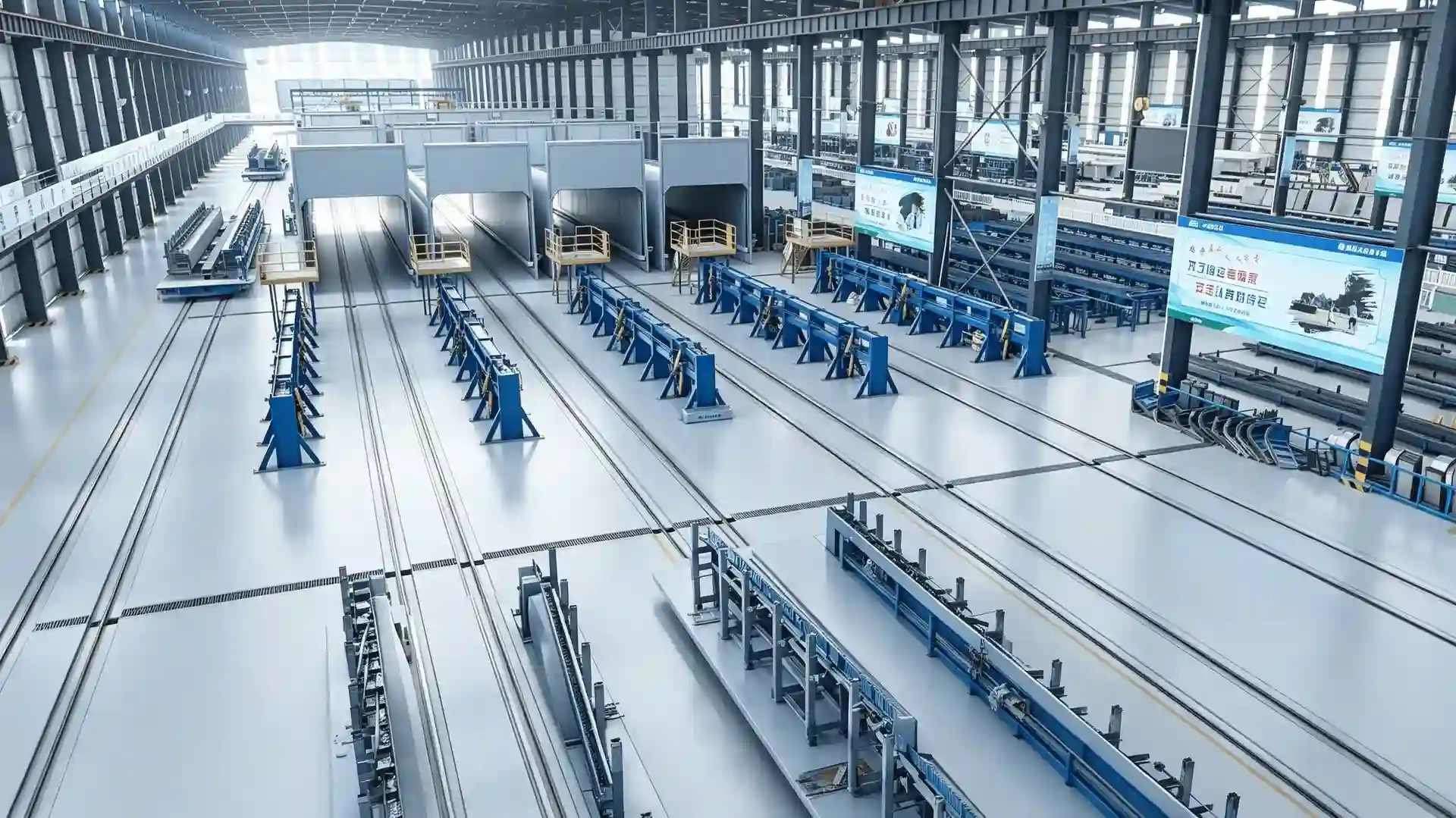
A precast concrete production line is more than a list of equipment. It is a small industrial site, and it has the utility footprint of one. Power, steam, compressed air, water and drainage are needed before the first mould is installed, and changing them later costs both time and money. A buyer who freezes them with the project brief, instead of asking the equipment supplier to "size what is needed," avoids redesigns on the day the line is supposed to start.
The right level of detail depends on the product and the takt time. A short-line casting bed for T-girders and a steam-heated circulation line for segmental box girders have very different demands. A buyer who knows the products and the daily output can also write a utilities section that bidders can price against, instead of asking each bidder to invent a basis of design.
The wider precast beam production line planning guide covers the project sequence from brief to handover. Utilities sit between the layout decision and the civil works, and they have to be settled before either is locked.
Electrical supply and distribution
The first utility to fix is electrical power. The line's main consumers are usually the batching and concrete distribution system, the gantry or overhead cranes, the prestressing jacks, the vibration system, the curing plant and the lighting for an indoor hall or a covered casting area. Each consumer has its own demand and duty cycle, and the two together decide the transformer size and the short-circuit level that the switchgear has to clear.
The RFQ should state the available grid voltage and frequency at the site boundary, the preferred nominal voltages for motors and control, the maximum allowed voltage dip during motor starts, and the fault level at the main incoming panel. IEC 60364 is the reference most international projects use for low-voltage electrical installations. NFPA 70 (the US National Electrical Code) is the alternative reference in some markets. The RFQ should also say whether the installation must use a particular edition or local equivalent.
Three points are often missed:
- harmonic distortion from variable-frequency drives, which can require filtering or a higher-rated transformer;
- power-factor correction, which is sometimes a buyer supply and sometimes a line-scope item;
- emergency and standby power for control systems, safety devices and any required battery-backed lighting.
Each one changes the cost of the line and the civil works. State them in the RFQ so bidders can price them on a comparable basis.
Steam, hot water and heat for curing
Curing is the utility that most often sets the production rate. A buyer who under-sizes the steam system will not reach the target takt time, regardless of how well the rest of the line is built. A buyer who over-sizes it pays for a boiler that never runs at its design load.
The starting point is the chosen curing method. Low-pressure steam, hot water, radiant heating and electric heating blankets each have different supply, return, control and condensate return requirements. Steam curing, where used, must follow the PCI MNL-116 or equivalent method on preset, ramp, hold and降温 stages. The buyer should fix the method, the maximum concrete temperature, the ramp rate and the duration for the family of products, not leave it to the supplier.
The RFQ should also state the available fuel (natural gas, diesel, biomass or electricity) and the emissions or noise limits at the site boundary. Where the boiler is in the line scope, the buyer should fix its location, its flue path, its fuel connection point and its water-softening or feed-water requirement, since each one affects the layout.
Compressed air for vibration, demoulding and process control
Compressed air drives the vibration system on most casting beds, the pneumatic valves on the batching system, the demoulding cylinders on hydraulic and mechanical moulds, and a number of control and cleaning points. Its pressure, dew point and cleanliness depend on the equipment list, but the demand peaks are dominated by the vibration system and the demoulding strokes, which usually run together.
The RFQ should state the working pressure, the minimum pressure at the point of use, the maximum dew point and the filtration grade, and whether oil-free air is required for any part of the system. Compressed air piping design follows ASME B31.3 or an equivalent national code, and the buyer should say which one applies. Receiver size, drop size and the location of the compressor room are then part of the layout, not part of a late negotiation.
Process water, curing water and drainage
Water has three distinct roles in a precast yard. Process water is used for concrete mixing, where quality and temperature are controlled. Curing water is used for pond, spray or mist curing, where the volume and the temperature profile matter. Service water is used for cleaning, the boiler feed, the compressor cooling and the yard wash-down, and is normally taken from a separate supply.
The buyer should fix the available pressure at the site boundary, the analysis of the supply (chlorides, sulphates, suspended solids) and the maximum summer temperature. ASTM C1602 covers mixing water for ready-mixed concrete, and ASTM C1603 covers water used for curing. The same source rarely suits all three uses, and a buyer who lists the requirement for each can avoid a late redesign of the pumping station.
Drainage has to be planned in parallel. Process water and curing water carry suspended solids, cement fines and, where used, curing compounds. A line that drains straight to a storm sewer can fail environmental approval. The RFQ should state the drainage boundary, the required treatment (settling, oil separation, neutralisation) and the discharge point, so bidders can price the correct pit, trench and pump design from day one.
Lighting, ventilation and small utilities that still cost money
Two smaller utilities are often left out of the utilities section and then added as variations. Lighting decides whether the line can run on a winter afternoon and whether night shifts are possible. Ventilation decides whether an indoor casting hall can host diesel-driven equipment or only electric machines. Both belong in the RFQ.
For lighting, the buyer should state the maintained illuminance for each area, the colour rendering requirement for quality control surfaces, and whether the lighting has to meet a particular lux level at the casting face. Industrial lighting levels are typically drawn from the ASHRAE Handbook for HVAC and from EN 12464-1 for indoor workplaces in European projects. For ventilation, the buyer should state the air change rate, the maximum air temperature at the workstation, and the heat or fume sources that have to be captured, including welding stations, boilers and diesel-driven equipment.
Close utilities out before the layout is frozen
The practical step is to add a utilities section to the production line brief at the same time as the product and capacity are fixed. The section should list the grid supply, the steam or hot water basis, the compressed air basis, the water analysis and drainage plan, and the lighting and ventilation rules, with the standards or local codes that apply. Each bidder then prices the same basis, and the buyer's design team can compare bids on equal ground.
Buyers who want to align utilities, layout and equipment scope can use the project-specific production line service to start the engineering review. Final utilities, layout and equipment scope are confirmed through the buyer's project documents, and the bid basis is the buyer's controlled brief, not a supplier's assumed design.