
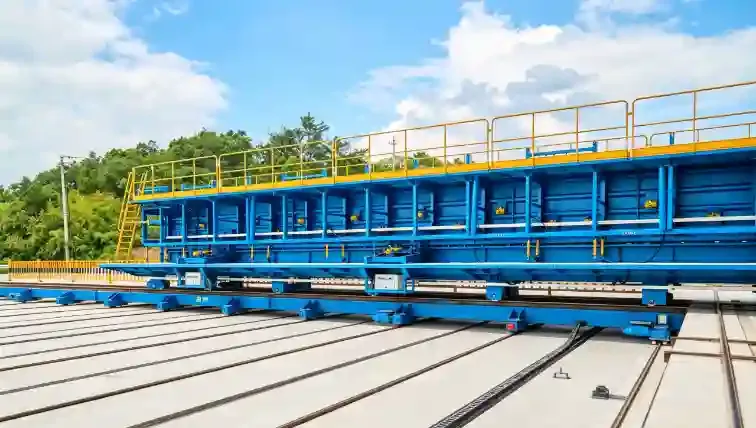
A precast line moves moulds, pallets, concrete, reinforcement and lifting equipment through a shared sequence. The safety circuit is the part of the control system that decides what happens when someone enters a danger zone or reaches for a stop. Define it in the enquiry instead of leaving it inside a line item called electrical controls. Buyers comparing a precast beam production line should settle the safety functions, the zones and the evidence early.
The standards give a useful boundary. ISO 13850:2015 states functional requirements and design principles for the emergency stop function, independent of the type of energy used. ISO 13849-1:2023 gives a method for designing safety related parts of control systems and says that it does not set the required performance level for a particular machine. That choice follows the risk assessment, which ISO 12100 covers. In a purchase, the buyer owns the process description, the designer proposes the functions and the supplier states what is included in the control package.
Begin with the risk assessment owner
Before asking for a performance level, agree who produces the risk assessment for the line as a whole. A supplier can assess the equipment it builds. The buyer usually knows the site rules, the product task and the neighbouring equipment. If nobody owns the whole line, guards and stops will be specified station by station with no consistent logic.
Ask for a list of safety functions rather than a list of devices. Stop the pallet transfer before a gate opens. Prevent a mould vibrator from starting while a worker is inside the mould bay. Hold the batching discharge when the conveyor is stopped. These are functions. The pushbutton, sensor, relay or safe drive that delivers them is a design decision that can be priced and verified.
Define stop categories in plain language
An emergency stop can remove power, stop motion under controlled braking or bring the line to a controlled pause with power retained for a defined function. The right answer differs between a conveyor, a hydraulic press and a curing kiln door. Write down what must stop immediately, what may coast to rest and what must stay energised for a safe reason, such as lighting or a monitoring circuit.
The term emergency stop is often treated as a single button on a drawing. ISO 13850 covers the function, not every way of achieving it, and its notes point to electrical implementation in IEC 60204-1. The practical question for a buyer is what motion is guaranteed to stop after the button is pressed, and who can reset the circuit.
Place stops by task, not by station count
A line may have one operator station but several places where a person can be trapped. Walk through a production shift: mould assembly, concrete placing, vibration, pallet transfer, demoulding, curing transfer and finished unit handling. Each place needs a reachable stop. Spacing based only on metres of conveyor can miss the bay where a worker reaches into a mould.
Record the height and side of each stop, and note whether it is accessible from the walking route. A stop behind a guard door is not reachable in an emergency. The layout RFQ checklist shows how access routes and equipment positions are fixed before electrical design begins.
Decide what reset means
After a stop, the circuit must not allow an unexpected restart. Define where reset is permitted, whether it can be done from the operator station only and what condition must be cleared first. A reset at the same button that triggered the stop invites someone to restart without looking into the danger zone.
For longer lines, define whether reset restarts the whole line or only the affected zone. A full line restart can leave material stranded upstream. A zonal restart needs clear status indication so the operator knows which sections are ready. Both choices affect the control software and the operator training scope.
Put the reset rule on the operator display in words the crew will use. A lamp that shows only fault or ready is not enough when three zones can be in different states. Ask for a drawing that shows each stop, each reset point and the state shown on the screen after a stop. That drawing becomes useful during training and during a later change, because it links the physical button to the logic behind it.
Interface with cranes and external equipment
Precast plants rarely use the line in isolation. An overhead crane may lift a mould out of a station while the line control sees an empty position. A batching plant may discharge into a bucket that is still moving. Define the hard wired or communicated interface for each case and state what happens when communication fails.
The control scope guide explains how the supplier boundary is drawn between line controls and other plant systems. Use the same boundary for safety functions. A safety signal that crosses two suppliers needs an owner for design, an owner for testing and an owner for later changes.
Guards, gates and interlocks
Fixed guards and interlocked gates solve different problems. A fixed guard around a drive needs a tool to remove. An interlocked gate at a loading bay needs a switch, a lock out arrangement and a defined behaviour when the gate is opened during a cycle. The machine guard RFQ guide covers reach distance and frame stiffness from the fabrication side. The line order should say which gates are interlocked and what the interlock does to motion.
Where a mould is opened by hand during a changeover, the safety function may be a mode selector and a controlled slow motion rather than a gate. Write that mode into the order, including who is allowed to select it and how the line returns to normal operation.
Evidence to require before shipment
Ask for a list of safety functions with the device, the input, the logic and the output for each one. Ask for a test record that shows each function was exercised, not just a statement that the circuit was checked. Where a performance level was selected, record the basis and the calculated result in the project file.
The conformity documents guide lists the records that buyers commonly request for a line package. Safety function test records belong in that set. If site acceptance is part of the contract, state whether the buyer may repeat the tests with its own personnel and what happens if a function fails.
What changes after the order
Site changes are the usual source of confusion. Adding a conveyor, moving a stop button or bypassing a gate changes the safety circuit. The order should say who may change it, what documentation must be updated and who pays for revalidation. That boundary is easier to agree before delivery than after a modification has already been made on site.
For a buyer preparing an enquiry, a short safety function matrix is enough to start. Name the task, the danger, the required response and the party responsible. A supplier can then propose devices and a control architecture against a defined requirement. That makes a precast line enquiry comparable across bidders and keeps safety out of the general electrical allowance.
Useful links
Realjet describes the delivered equipment scope on the precast production line solutions page. The plant layout checklist and the control scope guide cover the two adjacent decisions that usually determine whether a safety circuit is complete.