
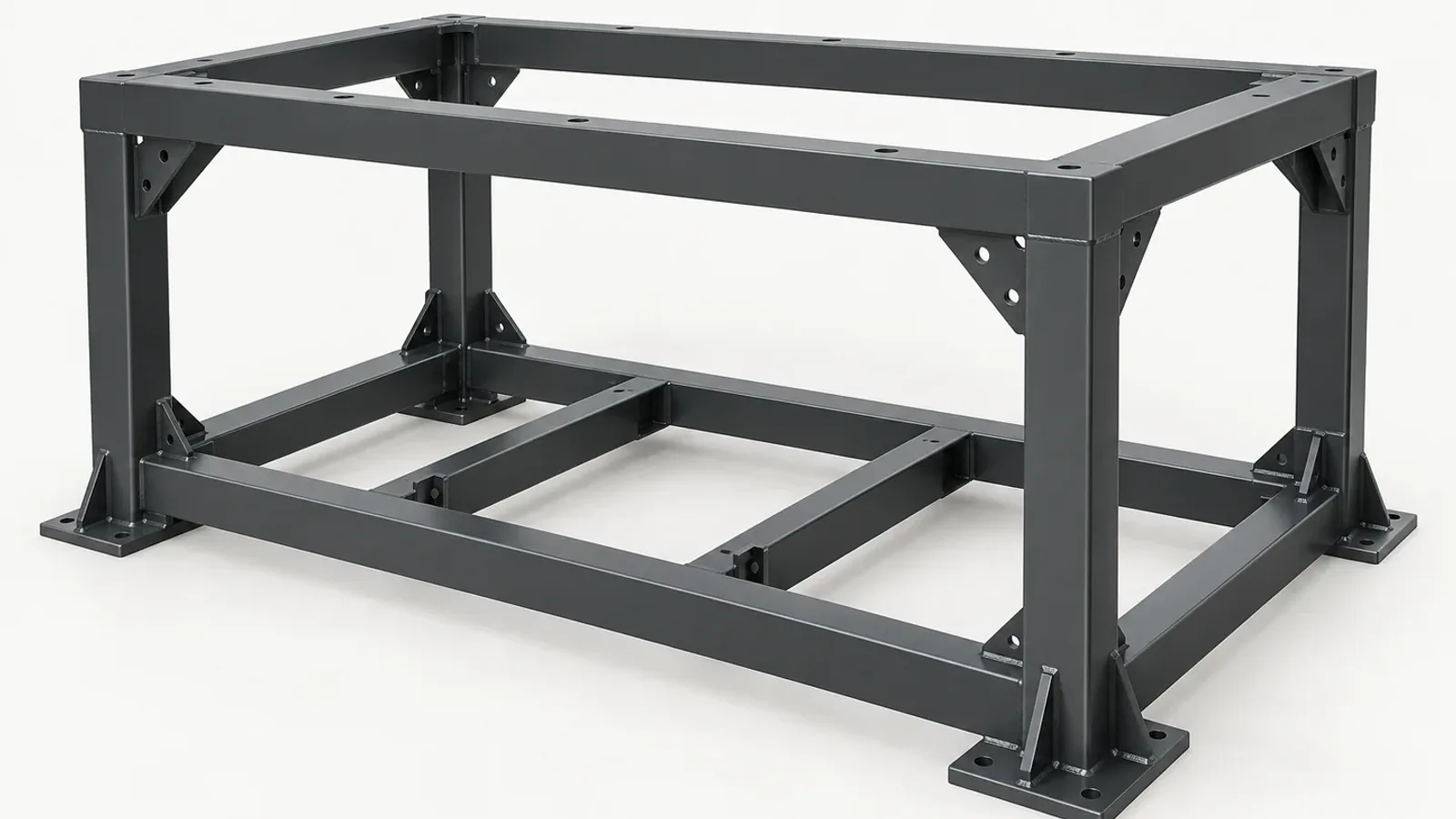
A repeat order is three different situations
Buyers use one phrase for three cases, and a fabricator prices them very differently.
The first is a straight batch repeat: same drawing, same revision, a second lot inside the same year. The second is a re-order after a gap, when the drawing has not moved but the shop, the plate supply or the subcontractor for surface treatment may have. The third is a repeat with a marked-up drawing, where someone has moved a hole or thickened a plate, so the frame is now a different part carrying a familiar name.
Only the first case is a copy. The other two are new orders that happen to share a part number, and sending the same enquiry to all three is how a buyer ends up with a frame that fits the first machine and not the second.
What travels between orders
The drawing travels. Almost everything else is a decision someone has to make and something someone has to pay for.
Welding is more durable than people expect. A fabricator working to ISO 3834-2 has to hold qualified procedures and the records behind them, so the weld detail should not drift between lots simply because a different shift is on the job. The drawing itself is the second anchor: ISO 7200 defines the data fields in title blocks and headers, and its stated purpose includes supporting the cross-use and re-use of documents. That matters when a frame is ordered again from a file that was last saved two years earlier, by a design office that has since changed two of its own standards.
What usually does not travel is the physical setup. Jigs, stop blocks, drilling templates and match-marked sub-assemblies built for the first batch get dismantled to free floor space once the order ships. Retention is a commercial term, not a technical default. If the buyer wants the tooling kept, and wants it to be the same tooling, that belongs in the first order rather than the second.
Material is the third variable. A frame cut from one plate heat and a frame cut from another look identical on the shop floor. If the first lot carried a certificate pack that the end client approved, the repeat order has to reproduce that trail, which means the enquiry has to ask for it rather than assume it.
The gap between orders carries its own risk, and it is rarely in the drawing. A fabricator that built the first batch in 2024 may have bought new bending tooling, moved the machining to a second bay, or changed its surface treatment subcontractor by 2026. None of that shows up on the part drawing. It shows up as a slightly different weld profile, a different primer, or a delivery date that no longer matches the promise made against the first order. A buyer re-ordering after a long gap is well served by asking two direct questions: who is doing the work, and what has changed since the last lot.
When the drawing has changed
The third case, a repeat with a marked-up drawing, is the one that generates disputes. Two things go wrong.
The first is that the change arrives as a conversation. A hole moves 15 mm because a hose route changed, the fabricator agrees over the phone, and the drawing is never reissued. The next lot is then built to the drawing and does not fit. The second is that the change is real and the buyer underestimates what it touches. Moving a hole can mean re-drilling a fixture, re-qualifying a weld detail nearby, and re-checking the tolerance chain through the frame, which is exactly the sort of knock-on that the tolerance stack-up work exists to expose.
A marked-up drawing with a revision number and a date is enough to start. A verbal brief is not, even when the change looks trivial from the assembly side.
The table to fill in before the second enquiry
| Item | What to state | What it prevents |
|---|---|---|
| Drawing revision | The exact revision required, and whether any change is approved | A frame built to a superseded revision |
| Changes since the last lot | A marked-up drawing or a change note, not a verbal brief | Re-engineering decided at the shop floor |
| Tooling | Whether first-order fixtures are retained, and who stores them | A re-tooling charge that arrives as a surprise |
| Certificates | Whether the material pack must match the first lot | A shipment held at the gate for paperwork |
| Welding | Whether the qualified procedures from the first order still apply | A new procedure introduced without approval |
| Inspection | First article, full dimensional, or sampling by lot | Paying for full inspection twice, or getting none |
| Marking and packing | Whether the first order's marking scheme and stillages are repeated | Two lots that cannot be mixed on site |
Inspection can step down, but only on evidence
The first lot and the second lot should not be inspected the same way, and treating them identically is a quiet cost that buyers rarely challenge.
ISO 2859-1:2026 sets out acceptance sampling indexed by acceptance quality limit for lot-by-lot inspection. The 2026 edition replaced the 1999 edition and added skip-lot sampling, alongside the switching rules that let a supplier with a stable record move to reduced inspection and push a supplier producing defects back to tightened inspection.
That mechanism only works if the first lot produced real evidence. A first article record that lists every dimension against the drawing, with the datum scheme stated and the measuring equipment named, gives the buyer something to compare against. Without it, "the last batch was fine" is a memory held by whoever was on the project at the time, which is not the same thing as a record. The first article inspection enquiry is worth settling at the start, because it is nearly impossible to reconstruct later.
Where the price moves, and where it does not
Repeat orders do get cheaper, but not uniformly, and a quote that drops heavily deserves a line-by-line read.
Setup and programming amortise across the batch. Material can be bought in one heat or one length instead of several. Retained fixtures save hours on the second run. What does not get cheaper is the weld volume, the machining of interfaces, the non-destructive testing coverage or the surface treatment, because those scale with the part rather than with the batch size. A second quote that is much lower than the first either has genuinely lost its setup, or has quietly lost part of the scope with it.
The same logic applies to lead time. A repeat order does not queue like a new part, but it does not skip the queue either. What changes is preparation time, not the hours a machine spends cutting and welding. Buyers who plan a production ramp on the assumption that the second lot will arrive in half the time are usually disappointed by the third month.
What a fabricator can and cannot hold for you
Realjet builds welded machine frames, structures and equipment supports to customer drawings, and machines interfaces after fabrication. Robotic welding covers arc and GMAW with post-weld cleaning, the welding quality system runs to ISO 3834-2 and EN 15085-2 CL1 for railway work, bending covers 3,200 to 6,000 mm at up to 500 t, and machining covers drilling, boring, deburring and sub-assembly. Those are the operations a repeat order draws on, and the contract manufacturing scope describes them in more detail.
What no fabricator can hold on a buyer's behalf is the product design. A frame that cracked in service, a hole that was always slightly out of position, a tolerance stack the assembly cannot absorb: those are drawing problems, and repeating the order repeats them. The second enquiry is the cheapest moment to correct them, because the fixture has not been built and the material has not been cut.
One boundary worth stating plainly. The scope described here is steel. Aluminium frames sit outside it, and a buyer comparing fabrication routes should know that before the enquiry is sent rather than after.
What to send with the second enquiry
- The drawing at the revision you want built, and the revision you last received
- A change list since the last lot, however minor it looks
- The previous lot's inspection record and certificate pack reference
- Quantity, delivery pattern, and whether the order is one lot or call-offs
- Any retained tooling, where it is stored, and its condition
- The standard the welding is to be verified against
- Packing and marking requirements, if the first lot's were agreed verbally
Assembling that takes an hour. It removes most of the reasons a repeat order of welded frames goes wrong, and it gives the fabricator a basis for quoting the part rather than the paperwork. Buyers who want the wider picture on how drawings and bills of material set up a first order can start with drawing and BOM readiness, which is the stage before any of this becomes a repeat.