
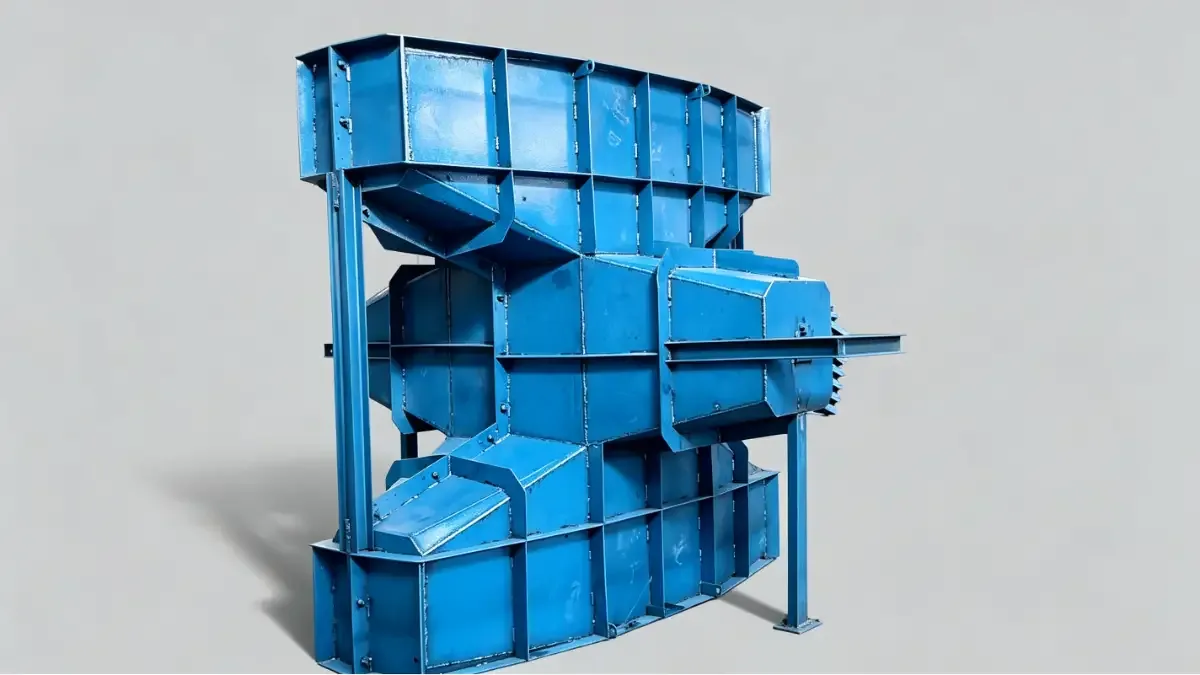
Why the coating belongs in the mould order
Armour unit moulds for breakwaters and revetments work in a harsher environment than most precast steelwork. They sit near salt water, are hosed down after casting, may be moved between outdoor storage and the casting line, and often have more bolted panels and internal cavities than a simple beam mould. A paint name on a drawing does not tell a buyer how the mould will survive that service, or which surfaces may be coated without changing the unit geometry.
Treat corrosion protection as an order item with its own scope, evidence and boundary. Realjet's precast concrete mould portfolio covers project-specific steel formwork, and the marine and coastal mould category groups the families used in this work. The interlocking armour unit mould details describe the segmented arrangement and the inputs a review needs. None of those pages sets a coating system for a particular site, so the buyer has to supply the environment and the required life basis.
Start with the environment, not a paint name
ISO 12944-1:2017 defines the scope and terms used across the ISO 12944 series. ISO 12944-2:2017 defines atmospheric corrosivity categories from mass loss or thickness loss of standard specimens, describes typical natural environments, and gives categories for structures immersed in water or buried in soil. It also identifies special corrosion stresses that can raise the corrosion rate. A coastal casting yard may expose a mould to more than one of those conditions during its life: outdoor storage, splash exposure, wet concrete contact and periodic cleaning.
Put those conditions in the enquiry as separate statements. State whether the mould is stored outdoors, whether it is used under cover, whether it is occasionally immersed, and what cleaning agents are expected. The supplier can then propose a system against a stated class instead of choosing one from a catalogue. If the project specification names a corrosivity category, quote the category and its source rather than translating it into a paint brand.
Surface preparation is a measurable item
ISO 12944-4:2017 covers types of steel surface and their preparation, including uncoated, thermally sprayed, hot-dip galvanized, electroplated and previously painted surfaces. It defines preparation grades but does not set the condition of the substrate before preparation begins. ISO 8501-1:2007 specifies rust grades and preparation grades by written descriptions and representative photographs, mainly for hot-rolled steel prepared by blast cleaning, hand and power tool cleaning, or flame cleaning.
A useful RFQ names the preparation grade and the standard that defines it. It also says when preparation happens relative to welding, machining and workshop trial assembly. Coating a panel before all fitting work is finished means the coating will be cut, burned or ground at the joint, and a touch-up clause has to cover that. Coating after trial assembly preserves the system but delays the point at which the mould can be shipped. The buyer should choose the sequence and record it.
Decide which faces are coated
A mould has several surface groups with different treatment needs. Concrete-contact faces, joint faces, sealing lands, bolt threads, lifting points, external stiffeners and hydraulic parts may each need a different treatment. A blanket instruction to paint the whole mould can change the release behaviour of a contact face or fill a seal groove. External steel is also left bare at times because the mould is used inside a hall.
Use a short surface schedule in the enquiry:
| Surface group | Decision to state | Evidence to request |
|---|---|---|
| Concrete-contact faces | Coated, untreated or sealed, and which agent is permitted | Masking record and first cast observation |
| Joint and seal faces | Whether coating is allowed in the groove or on the land | Fit-up record after trial assembly |
| External steelwork | Preparation grade and system basis | Preparation and application record |
| Threads and lifting points | Protection method that keeps the fit and marking readable | Inspection before dispatch |
The release agent guide explains why a coating on a contact face can affect finish and later coatings. Keep the decision with the buyer where it changes the cast surface, and with the supplier where it only affects shop process.
Select the system against a defined basis
ISO 12944-5:2019 describes common paint types and gives guidance on selecting systems for different environments, surface preparation grades and expected durability. Its selection guidance excludes corrosivity category CX and immersion category Im4 as defined in ISO 12944-2. If a project falls in one of those categories, the system has to be developed from a project specification rather than picked from that guidance.
The enquiry should therefore state the environment class, the durability basis and any project-specific restriction on coating chemistry. Without a specification, ask the supplier to propose the film thickness and number of coats with a basis, then compare the proposals on the same environment class. The refurbish or replace guide shows how a condition report can be used when the decision is about an existing mould rather than a new one.
Sequence around welding and trial assembly
Welding quality for these moulds is governed by the agreed quality requirements, with ISO 3834-2 as the reference for the welding quality system Realjet operates to. Structural repair welds, whether made during manufacture or later in service, need preparation before any coating is applied to the affected area. The mould also has to be measured after assembly, using the datum scheme agreed against the component drawing, because a coating cannot correct a geometric deviation.
Workshop trial assembly is the natural checkpoint. Open the mould, check the joint faces and sealing lands, confirm the lifting points, and only then release the surfaces for final preparation. The trial assembly guide sets out what a witnessed workshop trial can cover for interlocking units. If the buyer wants the trial before coating, say so in the RFQ; if the supplier proposes to coat first and assemble later, ask how the joints will be restored.
Touch-up, transport and storage
Coating damage happens in transport and on site, particularly on panel edges and bolt holes. Define who supplies the touch-up material, who is allowed to apply it, and which surfaces may be touched up without a new inspection point. A small kit with written instructions is more useful than a general obligation to keep the mould protected.
Storage conditions belong in the same clause. If the mould is to be stored outdoors before use, state that in the enquiry so the system and the packing are chosen for it. If it will be stored under cover, say that too. The precast production line page describes the wider line programme when the mould is one part of a casting line project.
Evidence to ask for before dispatch
Request a record set that follows the surface schedule: preparation grade, coating batch references, application conditions, measured dry film thickness where specified, and a note of every area masked or touched up. Add the dimensional record from the final assembly and the lifting point inspection. No single certificate replaces those records, because the coating is applied to a specific mould at a specific stage.
Responsibility and enquiry inputs
The buyer's engineer owns the unit geometry, the naming rights for any proprietary armour system, the exposure basis and the acceptance criteria. The generic name used for an interlocking armour unit mould does not grant a licence for a protected system; approved geometry and naming must come from the project documents. Realjet reviews project-specific moulds from that approved geometry and the production plan, and its verified scope covers mould engineering, steel fabrication, workshop assembly, inspection and agreed interfaces. Final dimensions, materials and acceptance remain subject to the agreed documents.
Send the approved unit drawings, mould quantity, casting orientation, target output, site exposure statement and any project coating specification. With those inputs, a supplier can quote a protection system that can be inspected instead of one that is simply written down.