
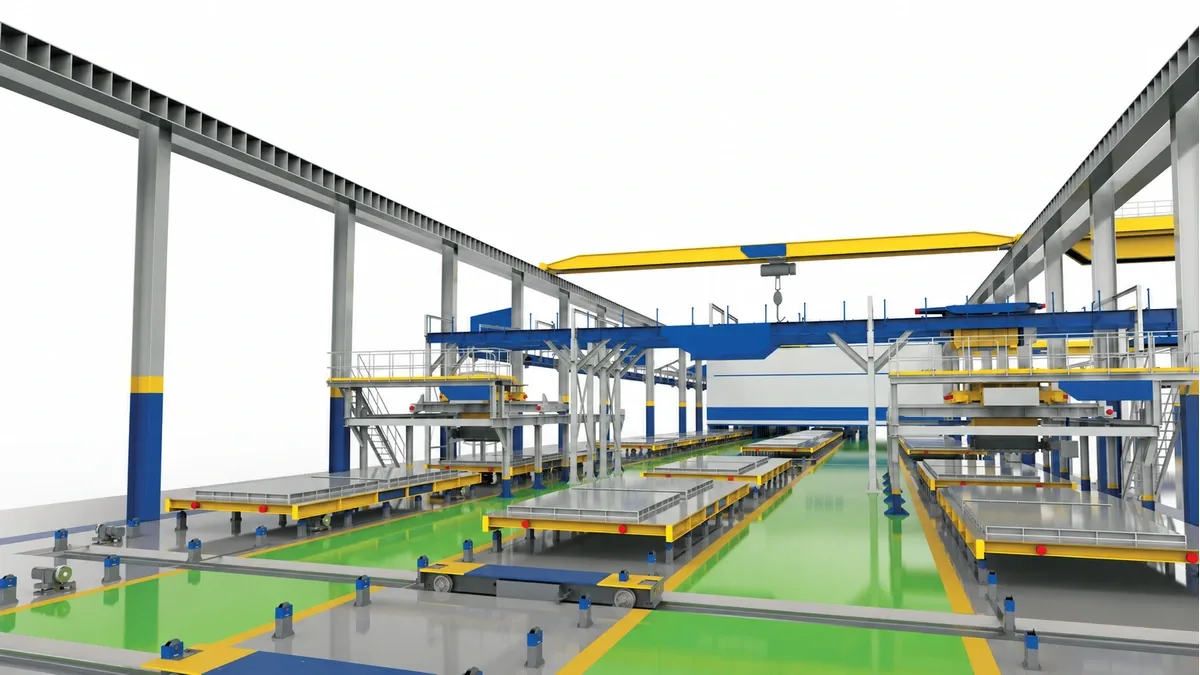
A new precast production line is a capital project measured in months. A used one is often available in weeks and at a fraction of the price, which is why the question comes up in almost every expansion meeting. The answer depends less on the equipment than on what surrounds it.
The machines are usually the easy part. Moulds, foundations, controls, compliance paperwork and the product mix the line was built for are where a refurbished purchase turns into a rebuild, and those costs appear after the deposit rather than before it.
What refurbished can mean
Three quite different transactions get the same label.
The first is relocation. A producer closes a plant or replaces a line, and the equipment is sold as it stands. The buyer gets the machines that were running last month, with whatever documentation the seller kept, and takes on dismantling and transport.
A dealer rebuild is the second case. A trader buys the line, replaces worn parts, paints it and sells it with a short warranty. What was replaced is often described in general terms, and the engineering file may be partial.
An OEM rebuild or upgrade is the third, where the original manufacturer takes the equipment back, renews drives, controls and wear parts, and re-issues documentation. This is the closest thing to a new line, and it is priced accordingly.
The distinction matters because the risk sits in different places in each case. Ask which one you are being offered before comparing price.
Compliance comes before the price
In the European Union, machinery legislation applies to products placed on the market for the first time. The European Commission's machinery pages put it plainly: the Machinery Directive 2006/42/EC applies to machinery placed on the EU market for the first time, or to existing machinery modified to such an extent that it becomes de facto new machinery. Machinery placed on the market before 20 January 2027 must comply with that Directive, and the Machinery Regulation (EU) 2023/1230 applies on a mandatory basis from that date.
Two consequences catch buyers out. Used equipment imported into the EU or EEA for the first time has to meet the legislation even though it has already been used somewhere else, as the Irish Health and Safety Authority and DGUV both set out. And a rebuild substantial enough to count as new machinery moves the manufacturer's obligations onto whoever carried it out.
Outside the EU the rules differ, but the principle travels: the buyer at the destination is the one who has to demonstrate conformity. Ask for the existing declaration of conformity, the technical file, and a written statement of what will be changed. If a line is being rebuilt with new controls, new guarding or a different drive arrangement, treat the conformity question as open until the supplier puts an answer in writing.
What travels and what does not
Equipment moves. Documentation often does not.
Before a deposit, establish what comes with the machines: general arrangement drawings, electrical schematics as built rather than as designed, the PLC program and its source, the parameter backup, the hydraulic diagrams, the spare parts list and the maintenance history.
The PLC source is the one buyers forget. A line that runs perfectly can still be unmaintainable if the only copy of the program is a compiled file on a laptop that left with the previous owner. The same applies to drive parameters and to any custom HMI project. Without them, a small fault becomes a controls replacement.
Moulds rarely travel well
A production line and its moulds are designed together. The moulds sit on a specific bed, at a specific rail gauge, with end forms that match a specific abutment and a specific lifting arrangement.
When a used line arrives with its moulds, those moulds produce the previous owner's products. If your product mix differs, the moulds become the first new order, and the line's tooling interface becomes the constraint on what you can buy. If the moulds are not included, the new mould order has to be designed against a bed that was built for a different supplier's assumptions.
This is where the arithmetic of a cheap used line changes. Steel moulds for precast elements are project specific, and a set built for one plant rarely transfers without modification. Budget the mould package and the interface survey as part of the purchase, not as a later phase.
What the quoted capacity actually assumes
Sellers quote output. Buyers need to know what the line will produce in their plant, with their mix, their curing and their labour.
Ask for the cycle that produced the quoted figure: how long a pallet spends at casting, how the concrete is placed and compacted, how long it cures before demoulding, and how many people were on the line. Then test those numbers against your own mix design and climate. A line that achieved a short cycle in a warm plant with steam curing may not repeat it in an unheated hall.
The relationship between cycle time and daily output is worth modelling in a spreadsheet before the site visit, because it turns a sales claim into a set of assumptions you can challenge.
Controls, spares and the obsolescence test
Automation from fifteen years ago can still be serviceable. The problem is automation from a vendor that no longer supports the hardware.
Ask for the make and model of the PLC, the HMI, the variable frequency drives and the hydraulic power units, then check support status independently. Ask how many spare drives and cards the seller holds. Ask whether the safety functions are implemented in the PLC or in a separate safety relay, because that answer decides what a controls upgrade actually involves.
For a line expected to run for fifteen years, supplier verification before purchase covers the wider question of whether the organisation behind the equipment can support it. With used equipment the question is sharper: the support may sit with a manufacturer who never built this configuration.
Civil, utilities and layout differences
A line designed for a 120 m hall does not fit a 90 m hall, and a bed with a pit is not the same civil works as one at floor level.
Survey before committing. Bed length and width, rail gauge, pit depth and drainage, foundation loading at the abutments, power rating and where the supply enters, steam and compressed air capacities, crane span and hook height, and the turning circle for whatever moves the pallets.
A mismatch on any of these becomes a civil or utility project with its own lead time, and those lead times usually exceed the equipment delivery. The equipment package scope article sets out which interfaces normally sit with the line supplier and which stay with the plant, and that split has to be renegotiated for a used line rather than assumed.
Who does what in a rebuild
A refurbishment contract has more boundaries than a new equipment order, and each one needs an owner: dismantling and condition survey at the seller's site, packing and transport, customs and import formalities, foundation works, erection, alignment, commissioning, training, and the conformity documentation.
Acceptance criteria should be written before work starts. A line that produces one acceptable element proves that it runs; it does not prove that it holds tolerance across a shift or that the cycle repeats. Agree the number of elements, the dimensional check, the cycle time and the conditions under which the test is void.
When new wins and when refurbished wins
| Situation | Refurbished | New |
|---|---|---|
| Product mix | Same family as before, moulds included | New sections or other families |
| Time to production | Hall and services already exist | Site and civil works still ahead |
| Documents | Complete file, source code, drawings | Partial file, unsupported controls |
| Compliance | Existing conformity route accepted | Current conformity required, no route |
| Support horizon | Ten years or fewer, local maintenance | Fifteen years or more, critical output |
| Budget | Capital is the binding constraint | Downtime and ramp-up cost more |
Neither column is a rule. A used line with a complete file in an existing hall is often the better buy, and a cheap line with no drawings in a market that demands conformity is usually the worse one, whatever the price.
What the enquiry should contain
Give a supplier the hall dimensions, the product range and section drawings, the target output per shift, the power and steam available, the crane capacity, the destination country and the conformity route you expect to use. State whether moulds are in scope and whether the existing bed is staying. Those answers decide whether the offer is a line, a rebuild, or a project.
The precast beam factory page describes how Realjet packages a line around casting equipment, moulds and the interfaces to batching, curing and handling, which is the same scope a refurbishment has to be measured against.
Buy the equipment and the surroundings together. A used line is a bargain when the hall, the moulds, the file and the conformity route all line up, and an expensive lesson when one of them does not.