
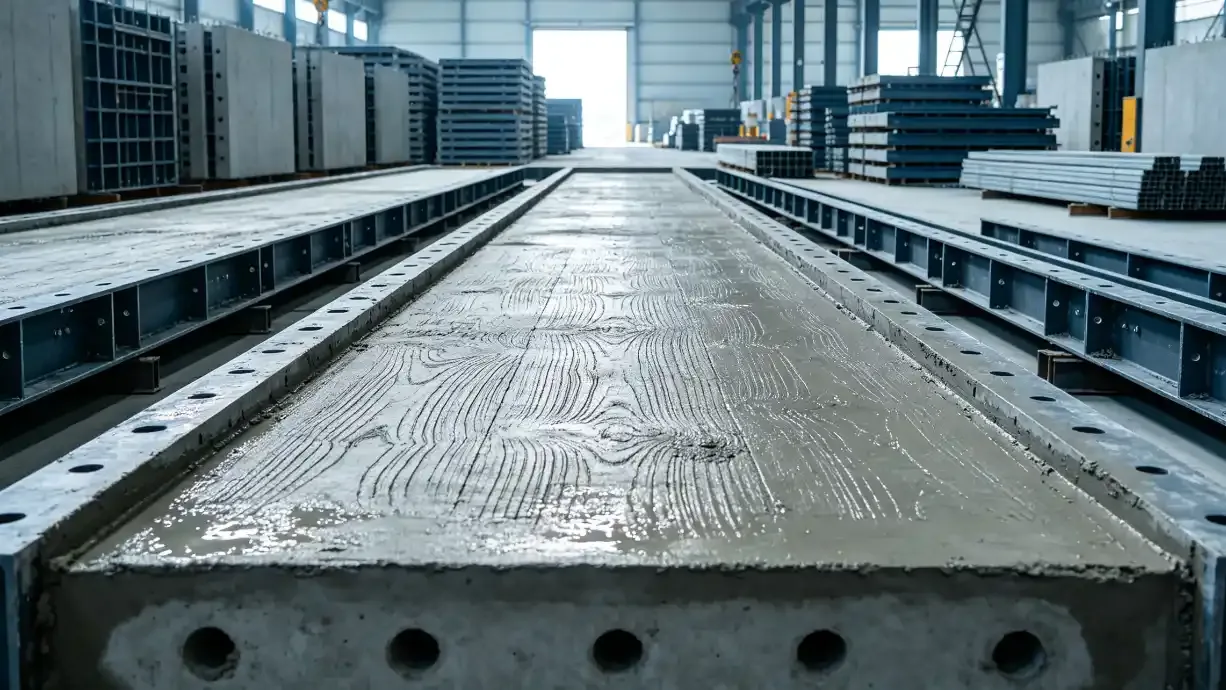
A prestressed beam leaves its mould with an upward curve already in it. That curve is not something the mould maker invents. It is calculated by the designer from the prestress force, the section and the self weight, and the mould has to reproduce the resulting profile closely enough that the beam lands on its bearings at the right elevation. Most camber disputes start with a simpler question: who was supposed to supply the number, and when.
Camber is a design output, not a mould setting
The designer sets camber because camber is structural behaviour. Prestress puts the beam into hogging, self weight pushes it back down, and the difference is the shape the beam takes. A mould supplier can build a soffit to a stated profile. It cannot decide what that profile should be, and it should not be asked to.
This is the first thing to settle in an enquiry. If the camber values are not on the component drawing or in a separate schedule, the mould order has no basis for its soffit geometry, and any profile the supplier chooses becomes an assumption the buyer has accepted.
Why the number is uncertain even when it is right
Camber is one of the least predictable quantities in prestressed concrete. A PCI Journal paper on camber variability reports that camber as large as 200 mm with 80 mm of variability is not uncommon, and that two identically prestressed girders stored in the same way and erected at the same time can still differ. The paper attributes the spread to the modulus of elasticity at release, creep, and the accuracy of the prestress loss estimate.
That spread is not a defect in the mould. It is the reason the designer works with a range rather than a single number, and it is why the mould needs to be judged against the profile it was given rather than against the camber measured on the finished beam.
How a highway agency handles the range
The Washington State Department of Transportation publishes its approach in the PGSuper camber documentation. The department predicts an upper bound and a lower bound, and its standard practice is to treat the lower bound as 50 percent of the upper bound value, because most measured cambers in its data fell between those limits. It also requires deck casting to take place within a defined window, between 40 and 120 days after the beam is cast, and reports both bound values to contractors so they can price the haunch concrete.
The useful part for a mould buyer is the band rather than the point. Camber is managed between limits, and those limits have a cost elsewhere in the project, in the haunch or shim concrete that fills the gap between the beam and the deck.
What the mould is actually asked to hold
The part of the mould that carries camber is the soffit, the surface the bottom of the beam is cast against. Everything else, side forms, end forms, stressing abutments, follows the soffit.
The enquiry therefore needs to fix two things before geometry is drawn. Whether the soffit is built to the no-load profile or to a compensated profile that anticipates elastic shortening and deflection. And at which stage the profile values are issued, because a profile issued after the mould steel is cut is a change order. The wider tolerance schedule for a mould order sets out where camber sits among the other dimensional requirements.
Three ways to build camber into a steel mould
A fixed soffit is machined or set to one profile and welded in place. It is the cheapest option and the most repeatable, and it suits a line that produces one section at one length for the life of the mould.
A packer arrangement puts shims or machined packers under soffit plates, so the profile can be stepped between a small number of values. It is useful where the design camber is still being refined, or where two similar sections share a mould body.
A segmented soffit with jacks adjusts continuously along the length. It costs more, adds mechanism under the casting face, and needs a setting procedure and a recorded survey each time it is changed. It is justified where one mould has to serve several spans or where camber is expected to be tuned after the first units are measured.
The choice belongs in the quotation. Adjustability is paid for once in the mould and again in every setup, and it only earns that cost if someone on site is going to use it.
Measurement: the reference decides the answer
A camber figure means nothing without the chord it was measured over and the way the beam was supported. Measured over the full length with the beam on its ends, a value can differ from the same beam measured on temporary supports placed elsewhere. Research on precast girders has shown that the support condition changes the measured response, so the reference has to be part of the specification rather than left to the inspector.
What a buyer should ask for is a defined measurement method: the chord, the points along the soffit or the beam, the instrument, and the stage at which the reading is taken. Release camber, camber at stripping and camber after a month in storage are three different numbers, and only one of them is a check on the mould.
Storage and the time between stripping and erection
The mould sets the shape at release. After stripping, the beam keeps changing under creep and shrinkage, and how it is stored affects how much. Support positions, time in the yard and weather all contribute, which is why a camber value quoted for erection is a prediction rather than a measurement.
For the mould order, this is an argument for recording the as-built soffit profile rather than only the camber of the first beam. The profile is the mould maker's deliverable; the camber of the finished unit is the outcome of the profile plus concrete, prestress and time.
Length variants and section changes
Camber is sensitive to span. For a given section and prestress, the upward deflection rises roughly with the square of the length, so a mould built for a 25 m beam will not produce the right profile for a 30 m beam by accident. Where a line produces several lengths from one mould family, the order has to say whether each length gets its own soffit set, or whether the soffit is adjustable and how far.
The same applies to section changes. A girder mould built for more than one section usually has interchangeable end forms and side forms. The soffit is the part that cannot be swapped as easily, and it is where the camber decision becomes a fixed cost.
What to put into the mould enquiry
| Item | What to state | Why it matters |
|---|---|---|
| Camber values | The profile, by station along the beam, and who issues it | Removes the supplier's assumption about the design intent |
| Profile basis | No-load or compensated, and the stage the values are issued | Decides the geometry before steel is cut |
| Lengths and sections | Every length and section the mould must serve | Camber changes with span, and one soffit may not cover all |
| Adjustment | Fixed, stepped or continuous, with the range | Sets the price and the setup routine |
| Soffit tolerance | Permitted deviation from the stated profile, and the measurement method | Gives the inspector a criterion |
| Records | As-built soffit survey before first cast, and the first unit's camber | Separates mould accuracy from concrete behaviour |
| Change route | How a late change to the camber values is priced and scheduled | A profile change after fabrication is a rework item |
The change route needs its own clause. Camber values are sometimes revised after the first beams are measured on a project, and a mould built with a fixed soffit cannot absorb that revision without cutting and re-setting. A buyer who expects the design to settle late should buy adjustment at the start rather than rework it later.
What Realjet can be held to
Realjet builds project specific steel moulds around the component geometry, the casting method and the plant layout, with dimensional records agreed against the component drawing. For beam work that includes the beam and girder mould family, which covers conventional, hydraulic and movable configurations. The bridge and transportation moulds category holds the long structural moulds where profile accuracy matters most, and the precast concrete moulds overview shows how the families are organised.
Camber values, the profile basis and the measurement method come from the buyer's designer and are confirmed during technical review. What the mould has to hold is agreed against those values, and the record that proves it is agreed at the same time. Prestressing equipment and the casting bed interact with the same geometry, which is why the prestressing scope on a beam line belongs in the same technical conversation as the soffit.