
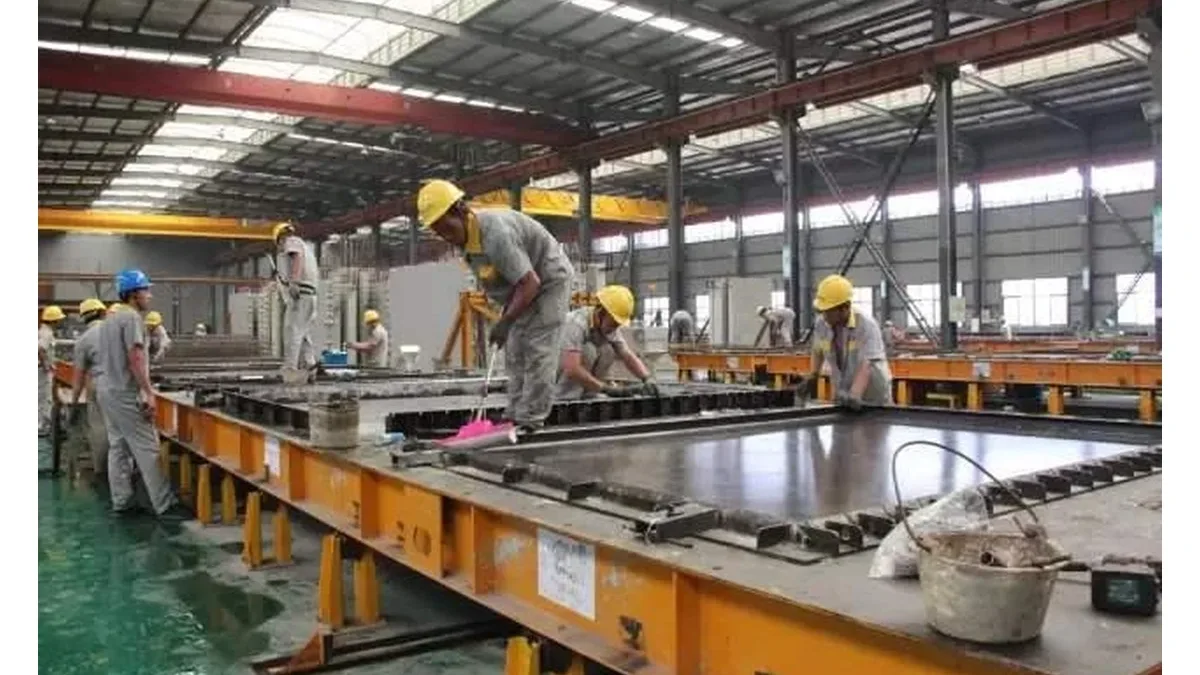
A precast plant uses water in three places that look unrelated: the batching plant, the casting beds and the yard. The water that comes back from all three carries cement fines, and that is where the planning usually breaks down. Basins are sized after the layout, the drain falls the wrong way, and the buyer discovers at commissioning that the local regulator will not accept a discharge.
This is site planning rather than equipment selection, and it has to happen while the line layout is still movable, because a settlement basin, a reclaim unit and the pipe falls between them occupy floor space and dictate where the batching plant can stand.
Where the water comes from
Four streams matter on a typical beam or wall panel line:
- Washout from the mixer, the transit mixer chute and the concrete distributor.
- Cleaning water for moulds, pallets and casting beds between casts.
- Curing water, which runs off the bed and carries fines with it.
- Yard and roof runoff, which is clean until it crosses a casting or cutting area.
The first two carry the highest solids load and the highest pH. The fourth is the one that decides whether the site needs a discharge permit at all, because once clean runoff mixes with process water, the whole volume is process water.
Why wash water is a different problem from dirty water
Concrete wash water is strongly alkaline. Guidance for construction washout puts it at around pH 12, which is caustic enough to damage aquatic life and to attack some drainage materials. It also carries suspended cementitious solids that do not settle quickly and set hard if they are left in a pipe or a sump.
The regulatory direction of travel is consistent across jurisdictions. King County in Washington requires process water from production, pouring and equipment cleaning to go to a sump, a process water recycling system or the sanitary sewer with approval, and states plainly that contaminated water must never be washed to the storm drainage system. Oregon's general permit for concrete mixer washout prohibits any discharge to surface waters, requires washout to be held in a pond or other containment, keeps the pH of the seepage pond between 6 and 9, and requires at least one foot of freeboard in the pond.
For a buyer, the practical reading is that a plant designed around "it drains to the yard" is a plant that will need a retrofit. The design questions are where the containment goes and how big it has to be.
Reuse, and the limits that come with it
Recovered process water can go back into concrete, which is why so many plants recirculate rather than discharge. The condition is water quality. EN 1008, the European specification for mixing water, treats water recovered from processes in the concrete industry as a permitted source provided the requirements in its annex for recovered water are met, and it sets chemical limits rather than a blanket ban.
The limits that most often bind on a precast line are chlorides, because of prestressing steel and embedded reinforcement:
| Concrete produced | Chloride limit in mixing water |
|---|---|
| Prestressed concrete and grout | 500 mg/l |
| Reinforced concrete | 1 000 mg/l |
| Concrete without reinforcement | 4 500 mg/l |
Sulphates are limited to 2 000 mg/l, and alkali content to about 1 500 mg/l when alkali-reactive aggregates are used. Where chemical analysis is inconclusive, the standard falls back on performance: 7 day compressive strength at least 90 percent of a control mix made with distilled water, and setting time within 25 percent of the control in either direction.
That last requirement is the one that catches plants reusing water without measuring it. Wash water carries both fines and residual admixture, and a mix that gains strength but sets two hours late will ruin a bed turnaround plan long before it fails a cube test.
Sizing the basin before the layout is frozen
Basin volume is driven by the washout generated per shift and by how long the solids need to settle, not by the footprint left over after the machines are placed. Three numbers fix the size:
- How much water each cleaning operation uses, per mould or per bed, per shift.
- How much of that water is returned to the mixer and how much is lost to evaporation, carry-out on aggregate and bleed.
- How often the settled solids are dug out, and where they go.
A plant that returns water to batching needs a basin with enough residence time for the fines to drop, plus a clear water compartment that the reclaim pump draws from. A plant that only washes moulds needs containment and removal, not a reclaim system. The two layouts have different footprints and different operating costs, and the choice belongs in the enquiry rather than in a contractor's variation.
The batching plant interface deserves its own conversation. If recovered water is fed back into the mixer, the water weighing system has to account for the solids in it, and the mix design has to be adjusted rather than left as it was. That is a control and calibration question, and the batching plant interface is where it is normally settled.
Mould and pallet cleaning is the hidden demand
On a circulation line, every pallet is cleaned before the next cast. On a long line, the same applies to each bed section. The volume per cycle looks small. Multiplied by beds per shift and shifts per year, it is the largest single water demand on the site after batching.
Two decisions reduce it. Cleaning method matters: scrapers and brushes remove most of the residue before any water is used, and a wash station with a controlled flow uses far less than a hose. The condition of the mould matters too. A casting face that has been maintained flat and free of build-up releases concrete more cleanly, which cuts both cleaning water and the risk of surface defects. The casting face specification covers the surface side of that trade-off.
Where a plant uses release agents heavily to compensate for worn faces, the wash water also picks up oil, and the separation problem changes from settling to oil removal.
Curing water and runoff
Curing by water spray or wet cover produces a continuous low-solids flow that runs off the bed. It is usually clean enough to be reused for the next cure, and it should not be allowed to join the washout stream, because diluting the washout makes the reclaim loop harder to control. Separate collection for curing water is cheap at layout stage and awkward later.
Yard runoff is the stream most often forgotten. A stockyard where beams are sprayed, or where cutting and grinding happen, drains to somewhere. If that somewhere is the same basin as the washout, the basin has to handle storm peaks as well as process load, and the freeboard requirement starts to matter on every wet day.
What the line package includes
A precast beam production line is delivered as a project package covering casting equipment, moulds and the interfaces to batching, curing and handling. Water treatment is not automatically part of that package, and buyers who assume it is end up buying it twice.
The split is worth writing down. The line supplier defines what the equipment needs, meaning water quality, pressure, flow and drain positions at each machine. The civil works contractor builds the basins, falls and containment. The water treatment or reclaim unit is bought as a separate package, or specified into the civils scope. Whoever owns the boundary has to be named in the contract, because the interface between a machine's drain outlet and a basin inlet is where most commissioning arguments start.
Realjet's line scope is the equipment and its interfaces. Where a project needs a reclaim system, the requirement is written into the enquiry as a battery limit so that the offer states what stops where. The equipment package scope article sets out how those limits are drawn in practice, and the utilities plan covers the supply side of the same system.
Questions to settle before the enquiry
A buyer who can answer these five has enough to brief a supplier and a civils contractor at the same time:
- Will the plant discharge at all, and under which permit?
- Will recovered water go back into the mix, and at what replacement ratio?
- How many moulds or bed sections are cleaned per shift, and by what method?
- Where does the settled solids go, and who removes it?
- Which package owns the basin, the pump and the pipe between them?
Where responsibility sits
The buyer owns the site, the permit and the water balance. The designer owns the drainage falls and the containment design. The line supplier owns the water demand of the equipment it supplies and the position of its drain connections. The treatment supplier owns the performance of the reclaim unit it sells.
The cheapest moment to size a basin is while the beds are still lines on a drawing, which is also the moment when the line supplier is being asked to quote. Leave it until commissioning and the containment becomes a variation with a deadline attached.