
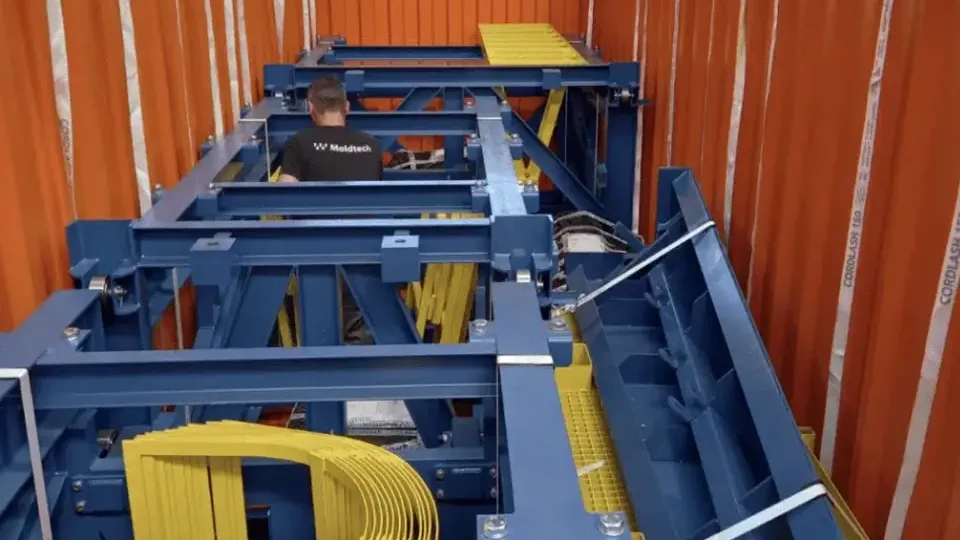
A line is designed twice
The second drawing is usually missing when the enquiry goes out. Equipment is priced as a list of machines, the freight is priced separately by a forwarder who has never seen the layout, and the gap between the two shows up on site as a frame that does not fit through a door, a bed that arrives in one piece 14 m long, or a container that cannot be unloaded because nothing on the packing list matches the assembly drawing.
The buyer who settles the shipping logic before the enquiry gets three things: a package that can actually be transported, a price that includes the split, and a site assembly scope that names who does what. All of it has to be decided early, because the split points are geometry, and geometry is fixed by the time the first drawing is approved.
What a container will take
Containers are standardised by external dimensions and rating under ISO 668. The common sizes are 20 ft and 40 ft, both 2,438 mm wide outside, with a standard height of 2,591 mm or a high cube height of 2,896 mm. Everything a machine designer cares about is smaller than those numbers: the internal section is reduced by the floor structure, the roof and the corner posts, and the door opening is smaller again than the internal section. ISO 1496 is the standard that defines the internal dimensions, not ISO 668.
That difference explains a common problem. A component drawn to fit a 2.4 m wide container will not pass the door frame, and one drawn to the external height will not clear the roof once it is on a skid. The usable envelope is what the packing drawing has to work to, and it should be stated on the drawing rather than discovered at the port.
Weight matters as much as size. A container has a maximum gross rating, and the payload left after the tare weight is often the binding constraint for dense steel parts. A 40 ft box full of mould side forms will hit its weight limit long before it runs out of volume.
What has to travel outside a container
Some parts of a line never fit a box, and there is no point designing them to. Long casting beds, gantry frames, curing chamber structures, batching plant silos and the heavier machine bases are break bulk or flat rack cargo. They travel on deck, on a flat rack, or as a project cargo shipment with its own lifting plan.
The choice has consequences beyond freight cost. Break bulk cargo is exposed to weather and to handling at both ends, so preservation, lifting points and bracing become part of the specification. It also arrives on a different schedule from the containers, which matters if the site assembly sequence assumes everything lands together.
Road limits where the plant is being built
The last leg is usually the hardest. Most countries set a threshold above which a load stops being ordinary freight. In the UK, for example, a vehicle carrying a load over 2.9 m wide, over 18.65 m in rigid length, over 44,000 kg gross, or over the axle limits is an abnormal load that has to be notified to the police, highway authorities and bridge owners, with route checks before the move. National Highways publishes those thresholds and runs the notification system.
The European Union sets maximum authorised dimensions for vehicles in national and international traffic and maximum authorised weights for international traffic in Directive 96/53/EC. National rules sit on top of that, and permits can take weeks. A line designed around container modules avoids most of this. A line designed as a few very large weldments does not, and the permit process becomes part of the project programme whether or not anyone planned for it.
Height needs its own check as well. Bridge clearances, tunnel heights, overhead lines and site gates are all local, and none of them appear in a freight quotation.
Where to split the line
The split points should follow the machine, not the shipping container. A circulation line divides naturally at station boundaries, where one machine hands a pallet to the next. A long line bed divides into sections with bolted flanges and a machined joint face, at spacing that suits both the mould modules and the truck. A curing chamber divides into wall panels and a roof frame.
Three rules make the split work. The joint has to be able to carry the load with the bolts specified, which is a design decision and belongs to the supplier's engineer. It has to locate itself, which means a dowel, a register or a machined step rather than reliance on bolt clearance. And it has to be documented, with match marks that survive galvanizing, painting and a month at sea.
Where a joint falls inside a tolerance chain, the split changes the accuracy of the finished line. Rail gauge, bed level and station heights are all set on site after assembly, so the alignment procedure has to exist before the frames leave the works.
Re-alignment is a scope item
Every line that arrives in pieces is aligned on site. Rails are set to gauge and level, beds are shimmed and grouted, transfer cars are checked against the rail, and the first pallet run proves the geometry. That work needs survey equipment, a reference datum, and someone who knows what the numbers should be.
The commercial question is who supplies that person. Options run from a supplier supervisor on site for the assembly period, to remote support with the buyer's own millwrights doing the work, to a third party installer. Each has a different price and a different effect on the warranty position when something is out of line six months later.
Write the choice into the order. An order that says "installation by others" and nothing else leaves the alignment method, the acceptance values and the responsibility for a line that will not hold gauge all undecided.
Weights, lifting points and the crane at the other end
Shipping drawings carry weights, and site lifting plans depend on them. A mould side form, a station frame and a curing chamber panel are all lifted more than once: at the works, onto the truck, off the truck, into position. Each lift needs a declared weight, a declared centre of gravity and lifting points that are designed rather than improvised.
The crane at the destination is often smaller than the one at the works. A frame that was lifted by a 50 t overhead crane in the factory may have to come off a truck with a mobile crane working at radius, over a fence, on soft ground. Declaring the lift weight and the lifting arrangement lets the buyer check that before the equipment is booked, rather than after it arrives.
Packing, marking and the list that has to match the drawing
Sea freight is unkind to machined surfaces. Bare steel rusts, hydraulic ports collect grit, and electrical cabinets fill with condensation. Preservation is a specification item: coating on machined faces, desiccant or vapour phase inhibitor in enclosures, sealed ports, and protection that can be removed without scraping a machined face.
Marking matters as much as packing. Every case should carry a number that appears on the packing list, and the packing list should be keyed to the assembly drawing so that the team on site can find the fasteners for a specific joint without opening every box. Fastener kits per joint, rather than a mixed crate of bolts, save more site time than most buyers expect. Loose items that travel inside a machine, such as anchors, shims and special tools, need their own line on the list.
Where the delivery boundary sits
The delivery term decides where the supplier's responsibility ends, and it is worth reading carefully because the differences are practical rather than legal. Under DAP the seller delivers to the named place and the buyer unloads. Under DPU the seller also unloads. The difference is a crane, a crew and an argument if a frame is dropped.
Insurance, customs clearance, port handling and the last road leg each sit on one side or the other depending on the term. Adding the site assembly scope completes the picture: transport to site, unloading, positioning, alignment and commissioning are five separate obligations, and a quotation that prices only the first is not comparable with one that prices all five.
What to put in the enquiry
| Item | What to state |
|---|---|
| Destination | plant address, nearest port, access road limits |
| Module limits | maximum width, height, length and weight the route allows |
| Container plan | which items travel boxed, which as break bulk |
| Split points | station boundaries and bed sections, with joint details |
| Site lifting | crane capacity and radius available at destination |
| Assembly scope | who aligns, who supervises, who commissions |
| Delivery term | Incoterms rule and named place |
Where to take the question
A line that is designed for its route costs less to install and argues less at handover. Realjet delivers precast production lines as project packages that cover casting equipment, moulds and the interfaces to batching, curing and handling, and the precast beam production line page describes the scope for beam factories. The precast concrete plant page covers the wider plant. Two related notes are worth reading before the enquiry goes out: Incoterms for a line order explains who unloads, and equipment package scope sets out how to split supplier, civil and utility work. If the split points are still open, fixed versus circulation lines explains how the production method decides where the joints fall.