
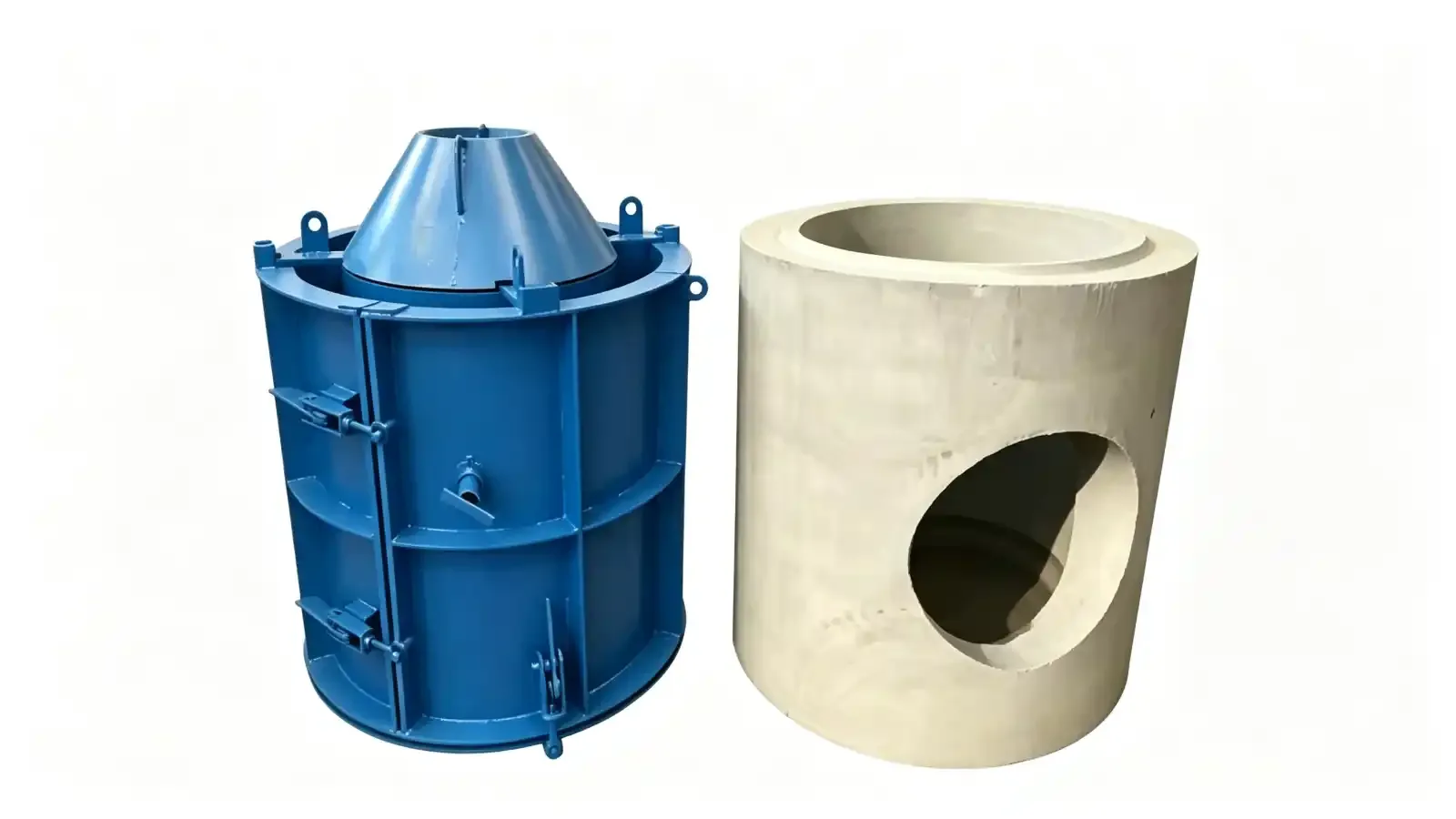
What the line actually produces
A precast manhole production line is a group of stations, moulds and handling equipment arranged to make concrete access chambers in a factory. The line takes a mix from a batching source, places it into moulds, compacts it, cures the units to a demoulding condition, strips them, and moves them to a storage position from which they can be dispatched. The buyer's product drawings decide what a finished unit is; the line decides how consistently that unit can be repeated.
The distinction matters when reading supplier offers. Realjet supplies production lines as project packages covering casting equipment, moulds and the interfaces to batching, curing and handling. It does not sell concrete manholes and does not take over the product design. A line that can make a chamber ring is not the same purchase as a line that can also make taper units, base sections and cover slabs with different geometry and different lifting needs.
The unit families set the layout
Start the enquiry with a list of the units the line must produce. Circular manholes are often assembled from a base, one or more shaft rings, a reducing or taper unit, a cover slab and access steps. Rectangular and elliptical inspection chambers use different chamber and slab geometry. Some projects use steel fibre concrete rather than a traditional reinforcement cage. Each choice changes the mould count, the core arrangement and the space needed around the casting stations.
BS EN 1917:2002 is current and covers precast concrete manholes and inspection chambers, including joints, in circular, rectangular and elliptical forms. Its scope addresses inverts not exceeding 2 m and nominal sizes up to DN 1250 for circular units or LN 1250 for rectangular and elliptical units. ASTM C478/C478M-26 covers circular vertical precast reinforced concrete manhole sections used in sewer, drainage and water works, with separate sections for grade rings, flat slab tops, risers and conical tops, base sections, and steps and ladders. The ASTM specification states that it is a manufacturing and purchase specification and does not include backfill or the relationship between field loads and product strength. That boundary belongs in the buyer's RFQ.
Wet cast or dry cast changes the equipment list
Manhole units are commonly produced by wet casting into steel moulds with vibration, or by a drier mix compacted in a machine with immediate demoulding. The right choice depends on the product family, the finish and the volume. Wet casting gives more freedom for steps, openings and shaped tapers, but it needs mould positions, curing space and a demoulding sequence. Dry casting reduces the number of occupied moulds for simple rings, but it constrains geometry and demands a different compaction and handling arrangement. The wet cast and dry cast comparison sets out the decision from a line buyer's point of view.
Ask each bidder to state which method its proposal assumes. Two offers for the same daily output can differ widely because one counts curing positions and the other counts machine cycles. A buyer who compares only the headline number will miss that difference.
Moulds, cores and stripping
The mould is where the manhole line spends most of its engineering time. A chamber ring needs an inner core and an outer shell, with a joint arrangement that survives repeated opening. A taper or reducing unit adds a shaped transition, and a base section may include a benching or inlet pocket that has to be positioned before the pour. The manhole mould RFQ guide lists the geometry inputs a mould supplier needs before it can quote.
Decide early whether units are cast as one piece or ring by ring. One-piece casting reduces the number of joints in the finished chamber but increases the mass of each mould and the crane duty at stripping. Ring-by-ring casting uses more mould sets and makes the horizontal joint a permanent design feature. The one-piece versus ring-by-ring guide explains the trade from the mould side. The mould quantity guide describes the arithmetic that links daily output, cycle time and the number of sets.
Reinforcement, covers and cast-in items
The line must hold the positions the product design calls for. Reinforcement cages, steel fibre dosing, step fixings, lifting inserts and pipe connections all have to be placed and retained while concrete is compacted. That is a fixture and sequencing problem as much as a mould problem. Ask the bidder to identify which of these items its equipment places, which are placed by labour, and which are outside its scope.
Concrete cover is a product requirement that the line has to hold. Spacers, cage jigs and the order of insertion should be part of the method statement, not left to the operator. If the project uses steps set into the shaft, the step type and its fixing detail should come from the approved product documents, since a line supplier cannot choose them on the buyer's behalf.
Curing space and cycle time
A wet cast line is often limited by the time a unit must stay in the mould or in a curing position before it can be lifted safely. The number of curing positions therefore follows from the required output and the demoulding rule, not from the number of casting stations. The line supplier should show both numbers in the proposal, together with the temperature and humidity basis used for the curing calculation.
Ask where the curing area sits relative to the stripping station and the storage yard. If units must travel a long distance before they are strong enough to move, the transfer system becomes a production risk. The line layout should show product flow, mould flow and people flow separately, as in the layout RFQ checklist. Vibration and compaction also need their own review; the compaction guide covers the equipment choices.
Handling, lifting and storage
Manhole chambers are heavy, and the lifting points in the product may be defined by the designer rather than the line supplier. A line that strips a unit with a vacuum lifter, a clamp or a spreader beam has different crane and access needs from one that lifts through cast-in anchors. State who designs the lifting arrangement and who provides the lifting gear. Do not assume that a supplier of casting equipment also takes responsibility for below-the-hook devices.
Storage space is part of the line even when it sits outside the hall. The buyer should state how many days of output must be held, whether units are stacked, and what access the yard has for dispatch. If the yard cannot clear the output, the line stops even when the casting equipment is sound.
Interfaces the line supplier does not own
A batching plant, a boiler or a water treatment system may be supplied by another party. The line RFQ should name the point of connection for each: where concrete is handed over, where steam or hot water enters the curing area, where compressed air reaches the point of use, and who owns the pipework up to that point. The batching interface guide shows how to keep that boundary explicit.
The product standards also sit with the buyer's engineer. EN 1917 and ASTM C478/C478M define requirements for manhole products; they do not specify a production line. A supplier may explain how its equipment meets a stated product requirement, but the requirement itself must come from the project specification.
What to put in the line enquiry
Send the unit schedule first: types, sizes, masses, quantities, drawings and the applicable product standard. Add the daily or weekly output the line must sustain, the mix basis, the curing basis, the available building area and the utilities at the boundary. Then list the scope you expect the supplier to price: moulds, casting stations, vibration, curing positions, transfer equipment, stripping devices, control scope and documentation.
The precast production line page describes the wider line programme, and the maintenance RFQ guide shows how to ask for maintainability at the same stage. A clear enquiry lets bidders price the same package instead of guessing which parts of a manhole factory they are being asked to supply.