
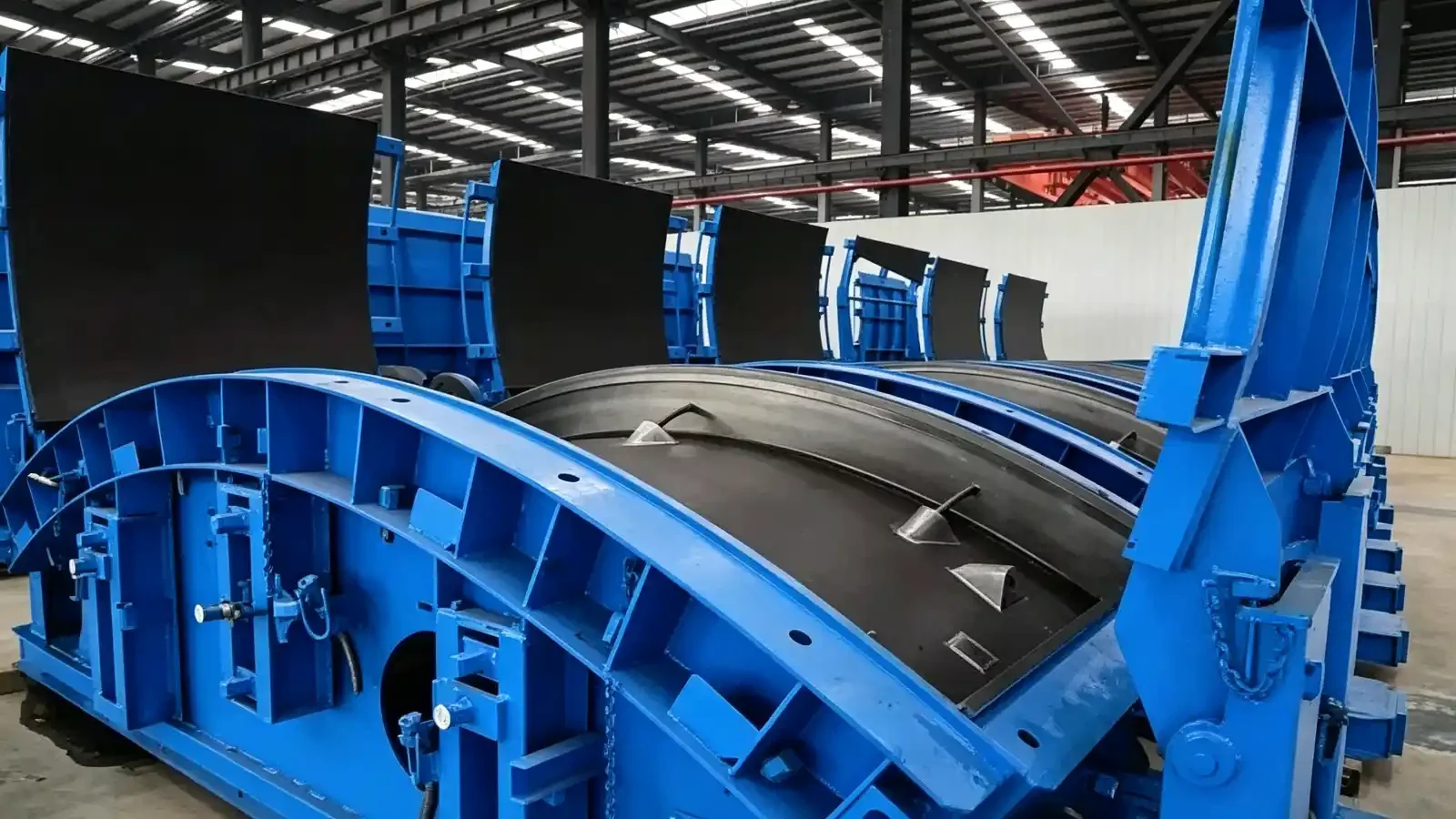
A tunnel segment mould can pass a workshop dimensional check and still produce a segment that the project will not accept. The first cast is where the steel, the concrete, the joint details and the factory routine meet. Buyers who treat it as a courtesy visit often find that nobody agreed what the cast was supposed to prove.
First cast approval is a purchasing question. It decides when a mould is accepted, which records travel with it, and who pays when the result is outside the project tolerance. Put those rules in the enquiry rather than in a meeting after manufacture.
What the first cast is for
The first cast checks that the mould, used with the agreed concrete and production method, produces a segment within the accepted geometry and finish requirements. It is not a design approval. The ring geometry, segment type, joint system and gasket arrangement belong to the project documents before the mould is ordered.
It is also not the same as trial assembly of the steel. A trial assembly checks that panels close, locks engage and parts fit together before dispatch. The tunnel segment mould RFQ guide covers the geometry and mould quantity decisions that come earlier.
A useful first cast plan states the purpose in one sentence. For example: confirm the segment geometry and groove position on the approved production station. A sentence that broadens into "prove the lining system works" has no single owner and no clear pass condition.
Decide the acceptance basis before the mould is cut
The buyer should state which tolerances apply, where they come from, and who measures them. EN 13369:2023 gives common rules for precast concrete products, including factory production control, dimensional measurement and assessment of conformity. Product standards or project documents may take precedence, so the enquiry should name the controlling document.
If the project uses another national standard, name that instead. Do not ask a supplier to work to "international tolerance" and expect a comparable answer. A tolerance without a measurement method is also incomplete: the buyer should say where on the segment the measurement is taken and with what instrument class.
The mould supplier needs a separate acceptance basis for the steel. The mould tolerances guide explains how contact surfaces and reference points are usually documented for a line order. Steel tolerance and concrete tolerance are related, but they are not the same record.
The segment that represents the family
A ring may contain ordinary segments, a key segment and special units with openings or connection provisions. The first cast of an ordinary segment does not prove the whole family. Ask the buyer to identify which types need a first cast and which can be accepted by similarity.
The rule for similarity belongs in the quality plan. If a key segment uses the same side forms but a different end arrangement, the change may be small. If it uses a different internal form and a different closure sequence, it is a different cast. The supplier should not be left to decide that alone.
Where the mould is part of a larger casting station, the first cast should be made on the equipment intended for production. Casting on a bench and then moving the mould onto its station can hide alignment and vibration differences. That matters when the mould will run as part of a tunnel segment production line.
What to measure on the first unit
Keep the measurement list short and tied to function. A long list of dimensions with no priority tends to produce a report that nobody reads. The first cast should at least cover the items below.
| Feature | Why it is measured | Evidence to keep |
|---|---|---|
| Segment envelope | Governs ring fit | Dimensional report |
| Joint face | Governs bearing and seal | Survey record |
| Gasket groove | Governs water tightness | Profile check |
| Lift insert position | Governs safe handling | Setting record |
The gasket groove is often the most sensitive item. The gasket groove guide explains why the decision starts with the joint system and ends with a controlled mould face. A groove formed by a replaceable former needs its own check after the former has been changed.
ACI PRC-347-14(21), the Guide to Formwork for Concrete, treats contract documents, tolerances, formwork inspection and adjustment as connected subjects. It is a general formwork guide rather than a tunnel segment acceptance standard, but it supports the same practical point: the specification and the check belong together.
Reinforcement, inserts and lifting anchors
A mould can hold the concrete envelope while an embedded item sits in the wrong place. Cage position, connection parts and lifting inserts need to be checked on the first unit, not inferred from the steel drawing. The designer owns the insert specification and the required capacity; the producer owns placement and the lifting plan.
CEN/TR 15728:2016 gives recommendations for cast in steel lifting inserts used during transient handling. It is not a design approval for a segment system and it does not cover permanent lifting use. It does show why insert position and embedment deserve a record of their own.
Where the mould has pockets or recesses for these items, ask for a check after stripping as well as before casting. Concrete movement during vibration can move a loose insert, and a pocket that looks correct before the pour may not be correct after it.
Release condition is not a mould decision
The strength at which a segment may be stripped is a concrete and quality question. The mould supplier can design around a stated release condition but should not invent one to make a cycle time look attractive. The producer's quality personnel or the project engineer approves the release condition.
That boundary matters commercially. A buyer who asks for a mould to produce one segment per hour has not specified a strip time. The offer should state the cycle assumptions and the inputs behind them. If the concrete strength development is slower than assumed, the mould is not automatically defective.
Curing method belongs in the same part of the enquiry. The segment may be covered, heated or left to mature; each choice changes when the mould is free for the next cast. The supplier's scope is to provide equipment compatible with the stated method, not to redesign the producer's curing plan.
What the first cast can and cannot prove
One good segment shows that a specific combination worked on a specific day. It does not establish mould life, long term repeatability or the behaviour of a different mix. Buyers should resist turning a successful first cast into a general warranty.
A poor first cast does not automatically prove that the mould is wrong. Concrete temperature, vibration, release agent, cage position and operator sequence can all affect the result. The investigation needs to separate those causes before a claim is made against the steelwork.
Agree in advance how many attempts are included in the mould price and what happens if the fault is traced to the mould. A single attempt with no cause analysis is a weak basis for either acceptance or rejection.
Records that should leave the plant with the mould
The record pack should include the drawing revision used, the concrete batch identity, the release strength evidence, the measurement report, photographs of the joint face and groove, and any corrections made before the cast was accepted. It should also identify who performed and who witnessed each check.
The production records guide covers records for a line package. For a mould order, the pack is smaller but the principle is the same: a record is useful when it can be tied to a specific unit and a specific revision. Ask for the format at enquiry stage, especially when the buyer's quality system expects a particular export.
A correction record tells the next operator what changed between the rejected attempt and the accepted one. Removing it from the pack removes useful information.
Who signs, who notices and who pays
The buyer or its engineer accepts the segment against the project documents. The producer operates the mould and supplies the concrete, the crew and the curing conditions. The mould supplier confirms the equipment against the agreed steel specification and corrects defects within its scope. Those three roles should appear on the first cast record.
Notice periods matter as much as signatures. State how quickly the producer will report a failed cast, how quickly the supplier may attend, and whether casting continues while the cause is investigated. A buyer who wants to keep production moving needs a rule for segregating suspect units.
The cause determines who pays. Mould corrections inside the agreed specification belong to the supplier. Rework caused by a different mix or a changed cure regime stays with the party that changed it. If the cause cannot be established, say how the cost will be shared before the first cast begins.
What to send in the mould enquiry
Send the ring and segment drawings, the segment schedule, joint and gasket details, connection provisions, insert data, tolerance basis, curing method, target cycle and the proposed first cast plan. State which segment types need a first cast and which will be accepted by similarity.
Then ask each supplier to return the inspection list filled in, with each row marked as supplied by the mould vendor, by the producer, or by the project engineer. This is where a mould enquiry becomes comparable. The precast concrete mould portfolio gives the wider context, the tunnel and underground mould category narrows it to this family, and the tunnel lining segment mould page shows the specific product configuration.
How Realjet frames the mould scope
Realjet develops project specific steel moulds around component geometry, casting method and plant layout, with dimensional records agreed against the component drawing. It also supplies precast production lines as project packages covering casting equipment, moulds and the interfaces to batching, curing and handling. The precast beam factory page describes that line context.
A first cast remains a joint exercise. Realjet can confirm the mould against the agreed drawings and correct equipment issues within its scope. The concrete, the release decision and acceptance against the project documents stay with the producer and the buyer. Final dimensions, functions and delivery boundaries are confirmed through technical review before manufacturing.