
A contractor with a bridge programme and a precast producer with a new order book both end up asking the same question: build the production line, or buy the elements from someone who already has one. The answer is not a preference. It comes out of three numbers, and most of the argument collapses once they are on the table.
Those numbers are the annual volume of element, the largest element that can physically reach site, and the length of the programme that will use the plant. Mould count, crane capacity and hall length all follow from them.
The decision hiding inside the enquiry
Enquiries arrive described as equipment requests. A buyer asks for a line sized to produce 30 m girders, and the conversation jumps straight to moulds and casting beds. Before that, it is worth testing whether the elements should be made at all.
Buying elements in is normal practice and often correct. Producers sell capacity by the cubic metre, the market is competitive, and a buyer who needs 400 m of beam for one bridge does not need a factory. Building a line becomes rational when volume, geometry and programme length combine to make the plant cheaper per element than the purchase price, and when the elements are too awkward to move.
What a line actually commits you to
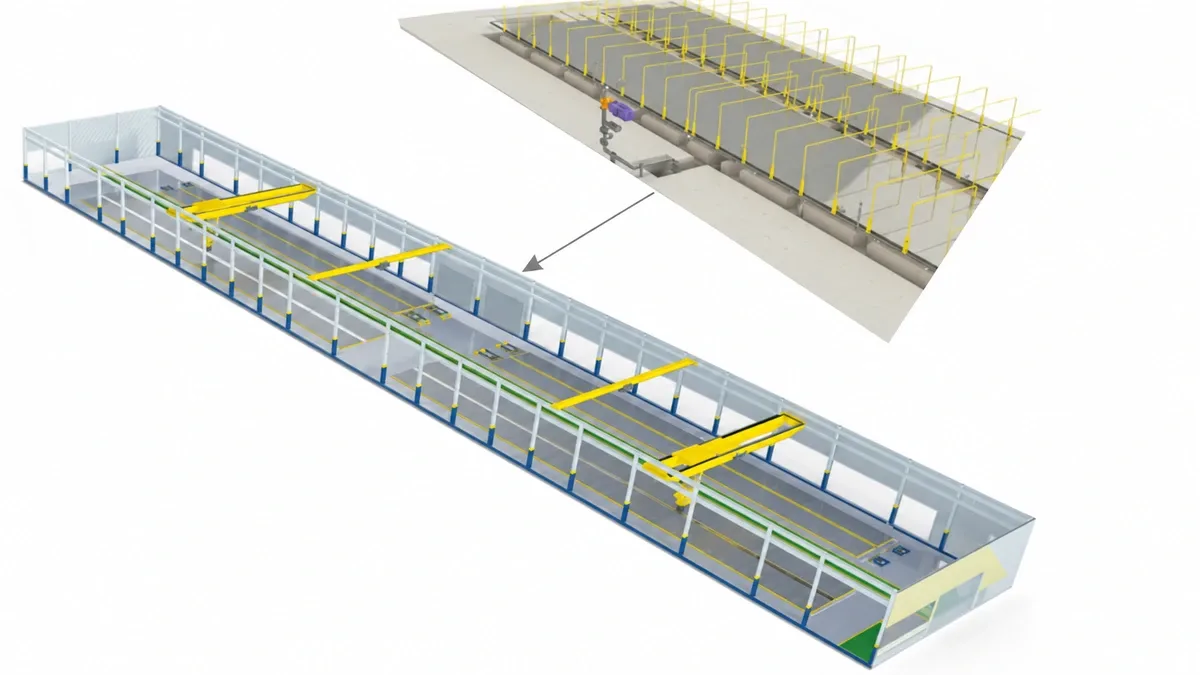
A line is not a mould and a casting bed. It is a hall with a floor designed for the loads, a gantry or handling system, a batching interface, a curing regime, a rebar or prestressing area, storage, and people who operate all of it. The equipment package scope is the part buyers underestimate, because the equipment quotation covers machines and the building covers everything else.
Three commitments follow from that.
Floor space is fixed once the hall is built. A beam line with a 30 m casting bed, a gantry runway and a storage row needs a building whose length is set by the longest element plus the handling envelope. The floor space planning guide works through that geometry.
Moulds are the variable cost inside the fixed one. A line with six moulds and a line with twelve have the same hall and different output, and the mould count is the single number that sets daily capacity.
People and utilities are ongoing. Steam, power, water and a shift pattern that matches the curing cycle do not stop when the order book pauses. A plant that runs at 40 percent utilisation still carries a full crew.
The transport ceiling on bought-in elements
The reason a producer builds a plant is often not cost. It is that the element cannot be delivered.
In China, the threshold for oversize transport is set by the Ministry of Transport regulation on abnormal load vehicles on public roads. A vehicle and load wider than 2.55 m, higher than 4 m from the ground, or longer than 18.1 m is over the limit and needs a permit. Above 3.75 m width, 4.5 m height or 28 m length, the application also needs an outline drawing and an escort plan, and approval takes fifteen working days rather than two.
Those numbers draw a hard line through the product range. A 30 m girder can travel with a permit and an escort. A 40 m segmental span cannot travel at all as one piece, which is why segmental construction exists: the element is divided at joints the designer chooses, and match casting moves the tolerance problem into the factory.
Shipping has its own envelope. A 40 foot container gives about 2.35 m of internal width and a 2.34 m door opening, so anything wider travels as break bulk on a flat rack or as deck cargo. The transport and section joint guide covers how that constraint propagates back into the mould design.
A buyer comparing a line against bought-in elements should therefore start with the envelope, not the price. If the element does not fit a road, a rail wagon or a ship, buying in is not an option and the only question left is how big the plant has to be.
Run the volume arithmetic first
The volume test is simple enough to do on one page, and it decides most of the rest.
Start with the annual requirement in metres of element, then divide by the working days available. A programme needing 6,000 m of 30 m beam over 200 working days needs 200 beams, or one beam per day.
Then look at the cycle. A beam typically occupies its mould for a working day or more once stripping, cleaning, rebar placement, stressing and casting are counted, so one cast per mould per day is a realistic planning figure for a single shift. That means roughly 200 mould-days are needed, and the mould count follows: at one cast per mould per day, six moulds cover a 200 day programme with some slack; three moulds double the duration or require a second shift.
The same arithmetic run against a bought-in supplier produces a purchase order instead of a capital project. The comparison is not the price per cubic metre alone, because the plant also carries the fixed costs listed above, and the bought-in price already contains the producer's own fixed costs plus a margin.
Where the arithmetic tips is repeat volume over years. A plant amortised over one bridge is expensive; the same plant amortised over five years of similar work is a different proposition, which is why the cost driver breakdown separates the one-off items from the recurring ones.
What the premium buys
Public cost studies are useful here because they put a number on the premium that prefabricated elements carry, and on what that premium returns.
A Federal Highway Administration case study of the 24th Street interchange in Council Bluffs, Iowa, compared precast deck panels with cast-in-place construction on the same project. The precast option added 12.4 percent to agency cost, about 1.38 million dollars on an 11.1 million dollar programme, and saved 251 calendar days, cutting construction from 426 days to 175. Adding the road user costs avoided during the shorter closure gave a benefit-cost ratio of 1.51 and a net benefit of about 700,000 dollars.
Two lessons carry over. The premium is real and should be expected, because prefabrication costs more per unit of structure than casting in place, and the return comes from time, disruption and quality rather than from the concrete. The return is also project specific: on a low traffic rural crossing with no detour cost, the same 12.4 percent premium has nothing to pay it back.
For a producer rather than a project owner, the equivalent is the plant's utilisation. A line that runs at 70 percent pays back; one that runs at 30 percent is a subsidy to the order book.
Quality control you cannot audit from a delivery note
There is a technical argument for making elements yourself, and it is stronger than the cost argument.
Curing is the clearest example. Strength gain depends on temperature and time, and a plant that logs both can show what happened to a particular element. A buyer receiving elements has a delivery note and a cube result, and cube results describe a sample, not the element in the yard. The curing system scope is where that control is bought.
Dimensional control is the second. Match casting, segment alignment and camber are all set in the factory, and a producer who owns the moulds can correct a trend before it becomes a rejected element. A buyer relying on a supplier has visibility only at inspection.
The third is traceability of the concrete itself. Mix design, batching records, admixture changes and aggregate source are all plant decisions, and they show up in surface finish and in early strength. Buyers who care about an exposed face usually find that the answer is a producer they can visit, not a specification clause.
When buying in still wins
The counter-case is common enough to plan for.
Short programmes do not justify capital. A single bridge, a station refurbishment or a one-off industrial floor is a purchase, not a plant.
Unusual geometry is often cheaper to buy. A specialist producer who already owns a mould for that section can quote from an existing asset, while a new plant would have to fund the mould from one project.
Distance cuts both ways. A plant next to the site saves transport; a plant 600 km away adds a haul cost to every element and puts the schedule at the mercy of a road permit.
And capacity exists in the market. In most regions there are producers with spare mould capacity, and renting that capacity for two years is a legitimate strategy before committing to a building.
A decision table
| Test | Points toward a line | Points toward buying in |
|---|---|---|
| Annual volume | Repeat volume over several years | One project, or a few hundred metres |
| Element envelope | Over 2.55 m wide or 18.1 m long, or awkward to handle | Standard sections that travel on a normal permit |
| Programme length | Multi-year, with a pipeline behind the first contract | Under 18 months, no follow-on work |
| Geometry | Standard sections you will repeat | One-off or rarely repeated shapes |
| Site position | Remote, with long or restricted haul routes | Close to established producers |
| Quality demand | Exposed finishes, tight camber, match cast joints | Standard finishes, conventional tolerances |
| Capital | Available, and a hall can be built | Capital better used elsewhere |
What to specify either way
If the answer is a line, the enquiry should state annual output, the element range with lengths and masses, the cycle the buyer expects, the hall dimensions available, the utilities on site and the splitting of scope between equipment supplier and builder. The supplier scope questions are worth settling before a price is compared.
If the answer is to buy in, the enquiry changes shape: the envelope and the joint details matter more than the moulds, and the buyer needs to confirm who owns dimensional responsibility at the interface.
Realjet supplies precast production line packages covering casting equipment, moulds and the interfaces to batching, curing and handling, and does not sell the concrete elements themselves. The distinction matters when a supplier offers to solve both halves, because a line supplier and an element supplier answer different questions.