
The question behind most line enquiries
A plant rarely makes one thing. A beam producer is asked for a shorter span, a different flange width or a pier cap. A building component plant takes wall panels, then slabs, then a run of balconies. The enquiry often arrives as a list of products with one annual tonnage, and the buyer asks a supplier to quote a precast production line that can handle all of them.
That is a reasonable starting point. The difficulty is what changes between products: the mould, the reinforcement, the concrete mix, the curing regime, the lifting gear and the time the line stands still while those changes happen. A line quoted only on a combined output figure can be right on paper and still fail to deliver the mix of units the plant sells.
The purchasing task is to describe that mix well enough that two suppliers quote the same job.
Write the product family list, not just the total
Start with families rather than individual drawings. A family is a group of units that share a mould platform, a casting method and a handling route. Two beam lengths on the same bed with a movable end form belong to one family. A beam and a double tee slab, with different bed widths, casting faces and stripping methods, do not.
For each family, record the drawing reference, the expected quantity per order and per year, the length or size range, the concrete volume per unit and the unit mass. Add which families are likely to run together and which will follow one another. The last point matters because a line that changes product twice a day is a different purchase from one that changes product twice a month.
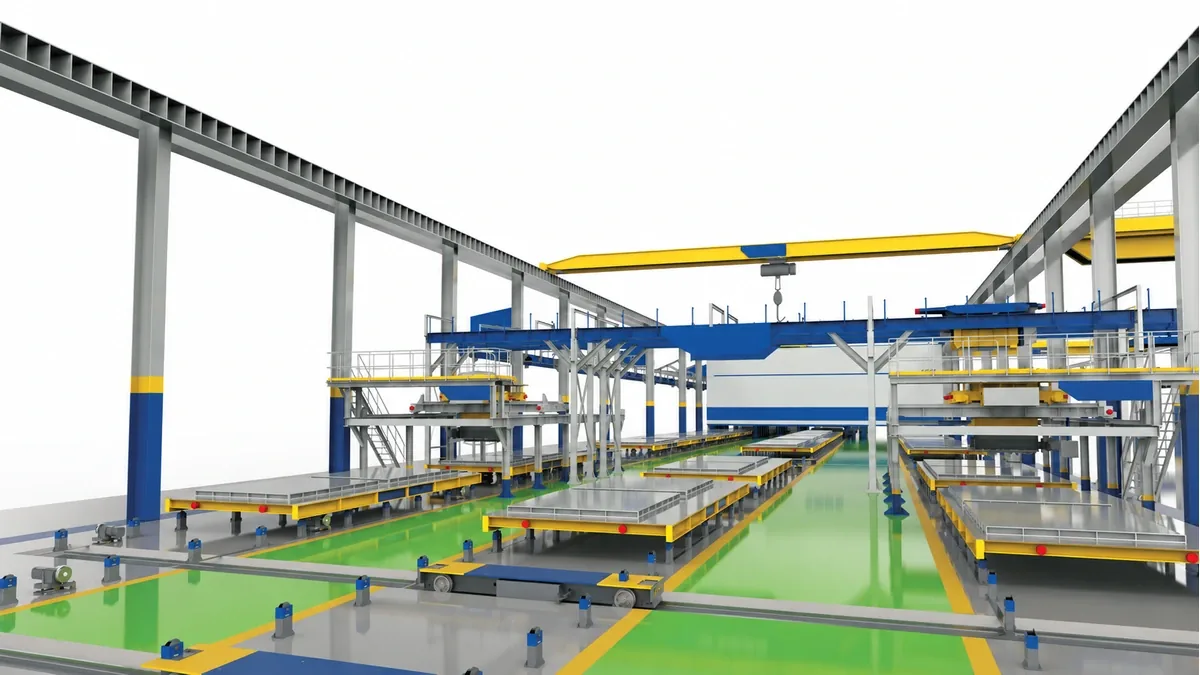
A production line type comparison is useful at this stage, because fixed and circulation systems absorb product variety in different ways.
Changeover is a capacity number
Changeover is the time from the last good unit of one product to the first good unit of the next. It includes stripping the old mould, cleaning, setting side forms or changing the casting face, placing inserts, checking dimensions and the first pour adjustments. Suppliers often quote it as a single minutes-per-change figure. Buyers should ask for it by product pair, because a change from one wall panel to a similar panel is not the same as a change to a unit with a different thickness and embedded item layout.
Case material from the segmental bridge sector makes the point plainly. A published PCI account of two small bridges describes a casting cell bought for hundreds of thousands of dollars and used for 62 segments on one project. Using one simplified cell for all segment types, instead of separate cells for typical and special units, roughly doubled the casting cycle to about two segments a week, even though it reduced the tooling bill. The producer accepted that cycle because erection was faster than casting and a stock of segments could be built ahead.
That trade belongs to the buyer. It depends on whether the plant can hold inventory, when the site wants units, and how much a shorter changeover is worth. The cycle time and output guide explains how daily output is built from bed turns and shifts.
Mould sets decide how often the line waits
A multi-product line needs enough mould positions to keep the casting stations fed without making every product wait for a shared form. The method is the same as for a single product, but it has to be done family by family. Occupied time runs from mould preparation through stripping and inspection, and it changes with geometry, prestress release and finish.
The mould quantity method is the right starting calculation. For a mixed plant, run it once per family and then look at what is shared: side forms, end forms, pallet cars and lifting beams. A shared item that appears in two calculations can be the real limit on output even when each family has enough moulds on paper.
Ask the supplier to show which moulds are dedicated, which are adjustable and which parts are swapped between families. An adjustable mould that covers three lengths is not free variety. It buys a changeover task and a dimensional check that must be done every time.
Reinforcement and embeds move with the product
Changing product often changes the cage, the inserts and the lifting points before it changes the concrete. A line that casts both lightly reinforced slabs and heavily reinforced beams needs a rebar preparation area that can serve both, and the supplier should state where that work sits in the equipment package.
The rebar cage scope guide sets out what belongs in the enquiry. For a mixed plant, add the changeover between cage types and the storage needed when cages are prepared ahead of casting. Embedded items deserve the same treatment: who supplies them, who fixes them to the mould and what datum they are set from.
Concrete mix changes have a cost
Different products may need different consistence, aggregate size or strength class. Each change asks something of batching, transport and the placing equipment. A line with one mix can be balanced around a short pour window. A line that moves between a structural mix and a facing or self-consolidating mix needs time for dosing changes, purge and cleaning.
The batching plant interface RFQ is where this should be made explicit. State which mixes the line will see, whether mixes alternate within a shift and who owns the washout between them. A supplier who assumes one mix throughout will not have priced the cleaning.
Responsibility also needs to be clear. EN 206 separates the specifier, the producer and the user of concrete, and the same party can hold more than one role. The concrete mix responsibility guide explains how to write that split into a line order. For a multi-product plant the buyer should say which party sets each mix and which party approves a change.
Curing cannot be one setting for every unit
Curing regimes follow the product and the specification, not the line layout. A thin panel and a deep girder do not reach stripping strength on the same schedule, and accelerated curing can change the mould cycle only when the project permits it and the strength evidence supports it.
A procurement study for the Federal Highway Administration describes a precast pavement project where panels had to be fabricated well before installation could begin, so the plant built a backlog against a nightly delivery programme. The lesson for a line order is about sequencing: a plant that makes several products needs a curing plan that matches the dispatch programme, not just the casting capacity. Ask the supplier how curing space is allocated between families and what happens when a slow-curing product occupies the space a fast product needs.
Handling gear must cover the heaviest unit
Overhead cranes, transfer cars and lifting beams are usually sized from the largest unit in the range. In a multi-product plant that choice can leave a mismatch with the most frequent unit, where a heavy crane is slow and expensive for small repeated lifts. The crane sizing guide covers duty and hook height; here the buyer should also describe the mix of lifts per shift.
State the mass range, the lifting points on each family and whether a spreader or vacuum device is expected. If one family needs a lifting beam that no other product uses, decide whether it is part of the line package or a separate purchase.
Space, utilities and the cost of flexibility
A line that makes several products usually needs more floor area than the same output in one product, because it holds more mould types and more work in progress. The floor space guide gives the planning method. Utilities follow the same logic: steam, compressed air and wash water should be sized for the worst realistic combination of products, not the average.
Flexibility costs money in extra mould variants, faster changeover hardware, additional curing capacity and a larger handling fleet, none of which adds a single unit of nominal output. The question to put to suppliers is which of those items the product mix actually requires, and which are being offered as general robustness. Ask for two configurations, one optimised for the current mix and one for a stated growth case, so the buyer can see what flexibility costs.
What to send with the enquiry
A short pack makes comparison possible. Include the product family list with quantities and size ranges, the expected order pattern, the permitted mix designs, stripping and curing rules, the mass range, the lifting method and the site constraints that affect delivery. Ask for the equipment list by package, the changeover times by product pair, the mould allocation and the utilities at the plant boundary.
Realjet supplies precast production lines as project packages covering casting equipment, moulds and the interfaces to batching, curing and handling. A mixed product programme is a normal starting point, provided the enquiry describes the changeovers as clearly as the output.